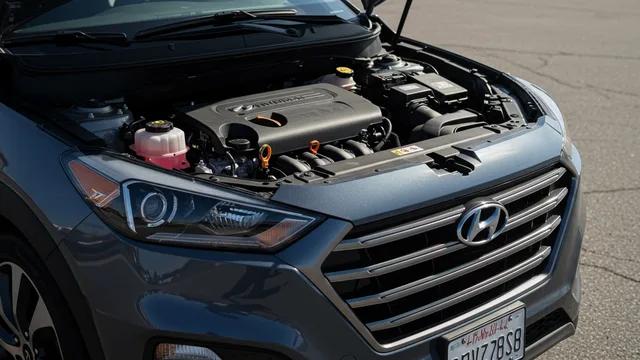
ENGINE
My name is [XXX]. My husband, [XXX], and I purchased a 2017 Hyundai Tucson (VIN: [XXX]) from a Hyundai dealership in 2023 with 53,920 miles for our daughter to commute to school. The vehicle now has approximately 77,940 miles, and she is still attending school. Since purchasing the vehicle, we have consistently returned to the same Hyundai dealership for regular maintenance, trusting its professionals to keep the vehicle safe and reliable. While driving on the freeway, our daughter suddenly lost engine power. The vehicle slowed down and would no longer accelerate. Thankfully, she managed to exit the highway before it stopped completely. Highway patrol assisted her in moving the vehicle to the roadside. The Check Engine Light and oil-pressure warning light came on, the engine made a pronounced knocking sound, and it would no longer run. We believe these symptoms closely resemble the engine defect described in Hyundai's Recall 209 (NHTSA 21V-727), involving connecting-rod-bearing failure in certain 2017 Tucson vehicles. Hyundai Motor America denied our request for assistance, stating that our VIN is not included in the recall and that no warranty coverage applies. We respectfully question whether vehicles experiencing the same or substantially similar defect may have been excluded from the recall. We request a technical investigation into why our vehicle was excluded and whether its engine failure is related to the recalled defect. This was a serious safety concern, not merely a repair expense. Our daughter could have suffered a serious accident had she been unable to exit the freeway safely. We are grateful she escaped without injury. We respectfully request that Hyundai reconsider its decision, review the vehicle's maintenance and diagnostic records, and investigate the engine failure. If the failure is related to the recalled defect, we ask Hyundai to cover the cost of engine repair or replacement. INFORMATION REDACTED PURSUANT TO THE FREEDOM OF INFORMATION ACT (FOIA), 5 U.S.C. 552(B)(6)
POWER TRAIN
The contact owns a 2017 Hyundai Tucson. The contact stated that while stopped at a stop light, the accelerator pedal was depressed; however, the vehicle failed to accelerate as intended. The contact stated that the accelerator pedal was depressed to the floorboard, and the vehicle jumped forward and then stopped. The contact stated that the vehicle was stuck in the middle of a busy highway. The vehicle was coasted to the shoulder of the roadway. The vehicle was taken to the dealer, where it was diagnosed with a dual clutch failure. The contact was informed that the dual clutch needed to be replaced. The contact stated that the failure was a known failure with the vehicle. The manufacturer was made aware of the failure, and a case was filed. The contact was informed that the repair was not covered under a special coverage program. The failure mileage was approximately 133,000.
ENGINE, ELECTRICAL SYSTEM, POWER TRAIN
On [XXX], I purchased a 2017 Hyundai Tucson from DriveTime, located at 6400 Pensacola Boulevard, Pensacola, FL 32505. Within approximately nine days of purchase, the vehicle began experiencing serious mechanical problems, raising significant concerns about its safety and roadworthiness. On [XXX], the vehicle suffered a severe loss of acceleration and was unable to exceed approximately 30 mph. This sudden reduction in engine performance created a dangerous situation while driving, particularly when attempting to maintain normal traffic speeds. Following these issues, mechanical inspections revealed water inside the spark plug wells, a severely rusted ignition coil, and a failing catalytic converter. Firestone estimated the catalytic converter repair at approximately $5,000. The presence of water and corrosion raised concerns about possible pre-existing damage and whether the vehicle had been properly inspected before being sold. The vehicle remained in repair-related custody for approximately 29 days. Despite repeated communications with DriveTime, the mechanical problems were not satisfactorily resolved. DriveTime representatives informed me that a replacement vehicle had been approved. On [XXX], I returned to the dealership expecting a replacement but was informed that no suitable vehicle was available. I was left without transportation, and the dealership failed to provide a satisfactory resolution. As of October 21, 2026, I remain without a vehicle. I am requesting that NHTSA investigate the sudden loss of engine power, possible electrical or ignition system damage caused by moisture intrusion, and any similar safety complaints involving the 2017 Hyundai Tucson. My primary concern is that these mechanical failures could cause another driver to experience a dangerous loss of power while operating the vehicle, potentially resulting in a serious collision. INFORMATION REDACTED PURSUANT TO THE FREEDOM OF INFORMATION ACT (FOIA), 5 U.S.C. 552(B)(6)
ENGINE
engine failure even though this car has always had oil changes at 110,000 miles. I would like the company to fix this since i am not the first to complain about this. I still have the car parked.
ENGINE, POWER TRAIN:AUTOMATIC TRANSMISSION
The contact owns a 2017 Hyundai Tucson. The contact stated that while driving at 65 MPH, the vehicle unexpectedly stalled and was unable to exceed 30 MPH. The contact pulled the vehicle over to the shoulder of the road, and the vehicle failed to restart. The vehicle was towed to the dealer, where it was diagnosed that the transmission failed and oil contaminated the catalytic converter, causing the catalytic converter to fail and require replacement. The transmission was repaired by the dealer, and the catalytic converter was replaced by an independent repair facility. The contact subsequently observed continued oil loss following the repairs. The vehicle was returned to the dealer, where it was diagnosed that the exhaust manifold headers failed and required replacement. The vehicle was not repaired. The contact requested and received a complete diagnostic report from the dealer. The failure mileage was approximately 90,502.