2019-2026 Audi 12V Battery Drain TSB
Audi has released TSB 2069747/5 for 2019-2026 models addressing 12V battery drain issues. Learn about diagnostic procedures, external influences that void warranty, and how technicians determine the root cause.
 Marcus Weber2023 Audi e-tron
Gilt auch für
- Audi A3
- 2022–2025
- Audi A4
- 2021–2025
- Audi A4 allroad
- 2021–2025
- Audi A5
- 2021–2025
- Audi A6
- 2021–2025
- Audi A6 allroad
- 2021–2025
- Audi A7
- 2021–2025
- Audi A7 e
- 2021–2022
- Audi A8 L e
- 2021
- Audi e-tron
- 2021–2022
- Audi e-tron GT
- 2022–2025
- Audi Q3
- 2021–2025
- Audi Q5
- 2021–2025
- Audi Q5 e
- 2024–2025
- Audi Q7
- 2021–2025
- Audi Q8
- 2021–2025
- Audi R8
- 2021–2023
- Audi RS 3
- 2022–2025
- Audi RS 5
- 2021–2025
- Audi RS 6 Avant
- 2021–2025
- Audi RS 7
- 2021–2025
- Audi RS e-tron GT
- 2022–2024
- Audi RS Q8
- 2021–2025
- Audi S e-tron GT
- 2026
- Audi S3
- 2022–2025
- Audi S4
- 2021–2025
- Audi S5
- 2021–2025
- Audi S6
- 2021–2025
- Audi S7
- 2021–2025
- Audi S8
- 2021–2025
- Audi SQ5
- 2021–2025
- Audi SQ7
- 2021–2025
- Audi SQ8
- 2021–2025
- Audi TT
- 2021–2023
- Audi TT RS
- 2021–2022
- Audi TTS
- 2021–2023
▸ 30 weitere anzeigen▾ Weniger anzeigen
Audi has issued Technical Service Bulletin (TSB) 27 23 62 2069747/5 for various 2019-2026 Audi models to address concerns regarding a drained 12V battery. This bulletin, revised on November 15, 2023, supersedes TSB 23-59 dated September 8, 2023. The TSB focuses on the documentation required before replacing a 12V battery that has been found to be drained, helping technicians identify the root cause, especially when external factors might be involved.
Symptoms of a Drained 12V Battery
The primary symptom addressed by this TSB is a vehicle's 12V battery being drained, leading to starting issues or other electrical malfunctions. Technicians are advised that if the 12V battery has to be replaced for any reason, specific diagnostic steps must be followed to determine the cause.
Important Warnings for Owners and Technicians
This TSB highlights several critical points regarding 12V battery maintenance and warranty claims:
- Warranty Exclusion: "Replacement of drained or damaged batteries due to external influence is not applicable to warranty and claims regarding such cases may be denied."
- Preventing External Drain: Owners should ensure the battery is not drained due to external influences. These include keeping the ignition on for a prolonged amount of time, parking the vehicle for over 90 days without a battery maintainer, or attaching non-OEM accessories that may draw electrical power while the vehicle is parked.
- Service Center Readiness: "Please ensure that the vehicle batteries are at an acceptable state of charge when the vehicle arrives at the service center."
- Long-Term Parking: "If the vehicle is parked for a prolonged amount of time (for example, waiting for parts), periodic (at least monthly) checks should be performed regarding the battery's state of charge."
- Immediate Recharge: "If the battery's state of charge is below 80%, the battery should be recharged immediately."
- Jump Starting for Charger: "In some cases, the battery may be too low to allow the battery charger to start up. In such cases, the charger can be started by 'jump starting' it by connecting jumper cables from a good battery to the damaged battery for a moment while the charger is connected. (The jumper cables only have to be touched to the poles as the vehicle charger needs to see an initial voltage to start up. They can be taken off as soon as the vehicle charger starts charging.)"
Diagnosis and Root Cause Analysis
To determine the root cause of an Audi 12V battery drained condition, technicians must gather additional information from the vehicle using the ODIS diagnostic system. This process is crucial before any battery replacement.
Initial Steps
- Connect a 12V battery charger to the vehicle.
- Perform the specified test plan within ODIS.
Reading History Data with ODIS
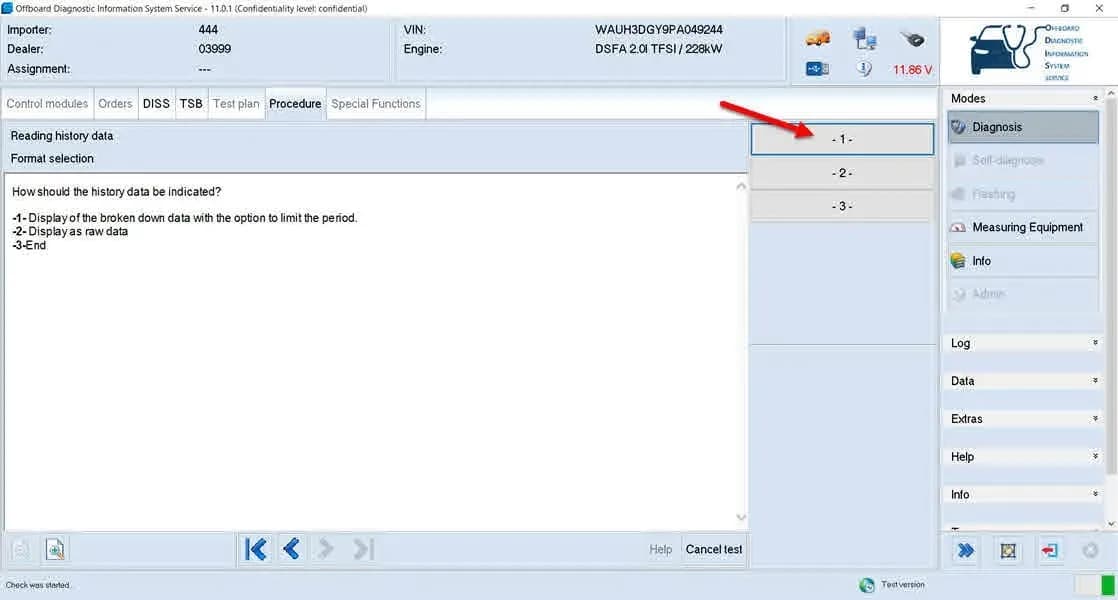
- Navigate in ODIS to "GFF >> 19 - Diagnostics interface for databus >> Guided Functions >> Reading history data."
- On the "Format selection" screen, choose option "-1- Display of the broken down data with the option to limit the period."
- On the "Structured data" screen, input "1,2,3,4,5,6,7,8" to select specific history data points, then accept. These data points include static voltage shortfall, static current exceeded, shut-off stage history, battery replacement history, energy-critical vehicle states, energy balances of last trips, energy balances of last standing times, and history battery influence.
- On the subsequent "Structured data" screen, enter the desired number of days for which history data should be printed out. Be aware that selecting too large a range may cause the test plan to fail.
Interpreting Battery History Data
ODIS will display the battery history data and store it in the GFF log. This data helps technicians identify if the drained battery was caused by misuse or external factors.
- Energy Critical Conditions (Section 5): This section reveals parameters active when the vehicle couldn't start due to a low 12V battery. Examples include the transmission being in Park, lights being on, or the ignition being left on while the battery was discharging.
- Energy Balance Standing (Section 7): This shows the duration the vehicle was parked and the corresponding battery discharge. The owner's manual states that customers are responsible for servicing (charging) the 12V battery if the vehicle is not driven for over one month. If the data shows a last standing time exceeding approximately 750 hours (about 31 days), combined with significant battery discharge and undervoltage, it suggests the battery may have been drained due to external influence.
Warranty Claim Procedure
Technicians should claim the GFF time required to perform this TSB on the warranty claim for the 12V battery replacement. This ensures proper documentation and processing of the repair.
Source: NHTSA ID 10245616
Galerie
4 Bilder
Frequently Asked Questions
- Why is my Audi 12V battery drained?
- Your Audi's 12V battery might be drained due to various factors, including leaving the ignition on for too long, parking the vehicle for extended periods (over 90 days) without a battery maintainer, or using non-OEM accessories that draw power while parked. Audi TSB 27 23 62 2069747/5 helps technicians diagnose the specific cause.
- Will Audi cover my drained 12V battery under warranty?
- According to TSB 27 23 62 2069747/5, replacement of drained or damaged batteries due to external influence is not covered under warranty, and claims for such cases may be denied. It's important to follow maintenance guidelines to avoid external factors causing the drain.
- What is TSB 27 23 62 2069747/5 about?
- TSB 27 23 62 2069747/5 is an Audi Technical Service Bulletin for 2019-2026 models that outlines the documentation requirements and diagnostic procedures using the ODIS system for a drained 12V battery before replacement. It helps identify if the battery drain is due to vehicle faults or external influences.
- How can I prevent my Audi's 12V battery from draining?
- To prevent your Audi 12V battery from draining, avoid leaving the ignition on for extended periods, use a battery maintainer if parking for over 90 days, and be cautious about installing non-OEM accessories that might draw power. Regularly check the battery's state of charge, especially if the vehicle is parked for a long time.
- What should I do if my Audi's 12V battery is too low to start?
- If your Audi's 12V battery is too low to start, you can attempt to jump start it using jumper cables from a good battery. This can also help start a battery charger if the battery is too low for the charger to initiate on its own. Once the charger starts, the jumper cables can be removed.
Related Articles
2023 Audi e-tron Problems: Recalls, Complaints & TSBs
The 2023 Audi e-tron has faced several significant safety concerns, including recalls for potential charging cable overheating and brake pedal detachment. Owners have also reported serious issues like sudden unintended acceleration and electrical system malfunctions. This profile details these…
2023 Audi e-tron Brake Pedal Recall
Audi has issued a recall (NHTSA ID: 26V240000, Audi Recall 46P7) for certain 2019-2024 E-Tron and 2020-2024 E-Tron Sportback vehicles, including the 2023 Audi e-tron. The recall addresses a potential issue where the brake pedal may detach from the brake booster, leading to a loss of brake function.
2015-2027 Audi Noise Diagnosis with Frequency Analysis App TSB
Audi has released Technical Service Bulletin 2051095/11 detailing the Audi Frequency Analysis app. This app helps technicians diagnose noise complaints more precisely across 2015-2027 Audi models. Learn how the app works, where to download it, and its features for effective vehicle noise analysis.
2023 Audi e-tron AC/DC Charging Not Possible TSB
This manufacturer communication (NHTSA ID 11031035) provides critical information for 2023 Audi e-tron owners facing issues with AC/DC charging. It specifically highlights problems linked to software version 00C6: 0093/3119, which can prevent the vehicle from charging.
2023-2025 Audi Rear Seat Reminder Message TSB 2074943/2
Audi Technical Service Bulletin 2074943/2 explains the instrument cluster message 'Please check rear seats and be aware of door safelock' in various 2023-2025 Audi models. This informational TSB details the rear occupant detection system designed to prevent children and pets from being left in…
Leave a comment
Comments are moderated and may take a moment to appear. Only your first name and the initial of your last name are shown publicly.
Comments
Be the first to comment.