2021-2025 Audi Fuel System DTCs P014800 and P008700
Audi Technical Service Bulletin (TSB) 2079461/3 details diagnostic and repair procedures for 2021-2025 Audi vehicles experiencing a 'MIL light on' or 'limp-home function' due to fuel system DTCs P014800 or P008700. This bulletin guides technicians on diagnosing and potentially replacing the…
 Sarah Mitchell2021 Audi Q8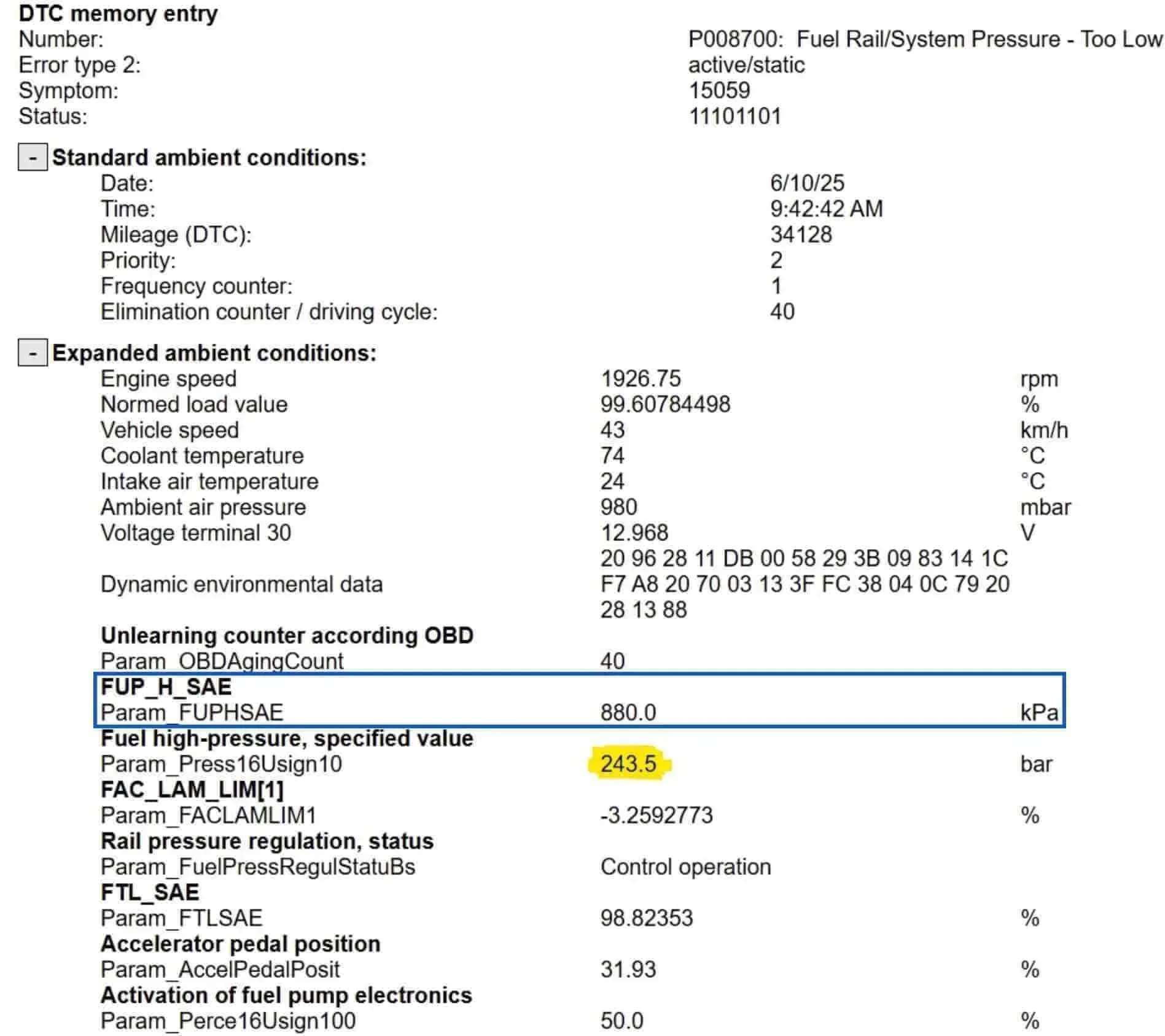
Also applies to
- Audi A4
- 2021–2025
- Audi A4 allroad
- 2021–2025
- Audi A5
- 2021–2024
- Audi A6
- 2021–2025
- Audi A6 allroad
- 2021–2025
- Audi A7
- 2021–2025
- Audi A7 e
- 2021–2022
- Audi Q5
- 2021–2025
- Audi Q5 e
- 2021, 2023, 2024, 2025
- Audi Q7
- 2021–2025
- Audi Q8
- 2022–2025
- Audi RS 5
- 2021–2024
- Audi RS 6 Avant
- 2021–2025
- Audi RS 7
- 2021–2025
- Audi RS Q8
- 2021–2025
- Audi S4
- 2021–2025
- Audi S5
- 2021–2024
- Audi S6
- 2021–2025
- Audi S7
- 2021–2025
- Audi SQ5
- 2021–2025
- Audi SQ7
- 2021–2025
- Audi SQ8
- 2021–2025
▸ Show 16 more▾ Show fewer
Owners of various 2018-2025 Audi models, including the Q5, SQ5, A4, A5, A6, A7, Q7, Q8, and their performance variants, may experience issues related to the fuel system. These problems are often indicated by a Malfunction Indicator Lamp (MIL) illumination or the vehicle entering a reduced power "limp-home" mode.
This condition is addressed by Audi Technical Service Bulletin (TSB) 2079461/3, which provides detailed diagnostic and repair instructions for technicians. The TSB specifically focuses on situations where the Engine Control Unit (ECM) logs Diagnostic Trouble Codes (DTCs) P014800 or P008700. Understanding the symptoms and the recommended repair process is crucial for resolving this Audi fuel system DTC P014800 issue effectively.
Symptoms
If your Audi is affected by this condition, you may observe the following:
- The "MIL light is on" in the instrument cluster.
- The vehicle's "limp-home function activates", restricting engine power to prevent further damage.
These symptoms suggest a problem with the fuel delivery system, prompting the ECM to store specific fault codes.
Fault Codes / DTCs
Technicians will find one or both of the following Diagnostic Trouble Codes (DTCs) stored in the Engine Control Unit -J623- (address word 0001):
| Code | Description | Module |
|---|---|---|
| P014800 | Fuel Delivery Error | Engine Control Unit |
| P008700 | Fuel Rail/System Pressure - Too Low | Engine Control Unit |
Diagnosis and Trigger Conditions
Diagnosis for the Audi fuel system DTC P014800 begins with clearing the DTCs P014800 and P008700 from the Engine Control Unit. If these DTCs reappear, further diagnostic steps are necessary. If the fault does not reset and the vehicle is in for the first time, no further diagnosis is required before proceeding with specific tests.
Technicians are instructed to perform tests related to the low-pressure pump, as detailed in the ELSA repair manual. These include "Checking fuel delivery rate" and a "Pressure test in the fuel supply line."
For concerns that are reproducible or static, a specific procedure must be followed. This involves installing a VAS 6550 pressure gauge on the low-pressure side, just before the high-pressure fuel pump. This setup allows for continuous monitoring of the in-line fuel pressure on the low-pressure side while the engine is running.
Using the ODIS-S self-diagnosis function, a graph of measured high-pressure values (Actual VS. Specified) should be set up to monitor the in-line fuel pressure on the high-pressure side. If, during engine operation, the low-side pressure does not drop below 3 bar AND the high-side pressure does not exceed 20 bar, the high-pressure fuel pump should be replaced.
For repeat repairs where the concern is not reproducible, technicians should check the expanded ambient conditions for DTCs P014800 and P008700. If the fuel rail pressure on the high-pressure side is approximately 10 bar, the high-pressure fuel pump should be replaced before considering other parts of the fuel system. An example provided in the TSB shows an actual fuel pressure of 880 kPa (8.8 bar) against a specified value of 243.5 bar, indicating the need for high-pressure fuel pump replacement.
Repair Procedure Summary
The primary repair involves the diagnosis and potential replacement of the high-pressure fuel pump. After confirming the presence of DTCs P014800 or P008700, technicians will clear the codes and re-evaluate.
If the codes return, the low-pressure fuel pump system is tested, including checks for fuel delivery rate and pressure in the supply line. For persistent issues, specialized tools are used to monitor fuel pressure in real-time. If the low-side pressure remains above 3 bar and the high-side pressure stays below 20 bar, or if the fuel rail pressure is around 10 bar in repeat cases, the high-pressure fuel pump is deemed faulty and replaced.
Required Tools and Diagnostic Software
To perform the diagnostic and repair procedures outlined in TSB 2079461/3, technicians will utilize specific equipment:
- VAS 6550 pressure gauge: Used for monitoring in-line fuel pressure on both the low and high-pressure sides of the fuel system.
- ODIS-S diagnostic software: Essential for accessing self-diagnosis functions, setting up graphs of measured values, and monitoring high-pressure fuel readings.
- ELSA repair manual: Provides detailed instructions for testing the low-pressure pump and other repair procedures.
- High-pressure fuel pump: The primary component that may require replacement.
Warranty Information
This Technical Service Bulletin provides guidance for repairs under warranty. The specific details for claiming warranty work are as follows:
- Claim Type: If the vehicle is outside of any warranty, this Technical Service Bulletin is informational only, meaning charges may apply.
- Service Number: 2463
- Damage Code: 0010
Specific labor operations and their associated codes for technicians include:
| Labor Operation | Code | Time Units (TU) / Reference |
|---|---|---|
| Remove and install high-pressure pump | 2463 19XX | See SRT with associated operations |
| Remove and install 2 high-pressure pumps | 2463 20XX | See SRT with associated operations |
| Check fuel pump | 2066 0199 | 50 TU |
| Remove and install cover | 1083 1900 | See SRT with associated operations |
| Remove and install air filter housing (gasoline engines) | 2425 19XX | See SRT with associated operations |
| GFF/ Guided Functions | 0150 0060 | Time stated on the diagnostic protocol |
All warranty claims must adhere to the Audi Warranty Policies and Procedures Manual and are subject to review or audit by Audi Warranty.
Important Owner Information
Owners should be aware that if their vehicle is no longer under warranty, this Technical Service Bulletin serves as informational guidance only. Any repairs performed may incur charges. It is always recommended to consult with an authorized Audi dealership to understand specific warranty coverage and potential costs.
Revision History
This Technical Service Bulletin has undergone several revisions to ensure accuracy and updated information:
- Revision 3 (December 11, 2025): Revised the header to add the Q5 model, updated the model table in the Condition section, and revised the Warranty section to update the Service Number.
- Revision 2 (November 19, 2025): Revised the Condition section to add models to the table and updated the Warranty section to revise the Service Number.
- Revision 1 (October 14, 2025): Initial publication of the bulletin.
NHTSA ID: 2079461/3
Frequently Asked Questions
- What does DTC P014800 or P008700 mean for my Audi?
- DTC P014800 indicates a 'Fuel Delivery Error', while P008700 signifies 'Fuel Rail/System Pressure - Too Low'. Both codes point to issues within your Audi's fuel system, often related to the high-pressure fuel pump.
- What are the common symptoms of an Audi fuel system DTC P014800?
- Owners typically report that the 'MIL light is on' (Malfunction Indicator Lamp) or that the vehicle enters a 'limp-home function activates' mode, which limits engine power. These are direct indicators of a fuel system problem.
- How is the Audi fuel system DTC P014800 diagnosed and repaired?
- Diagnosis involves clearing the DTCs, and if they return, performing fuel pump tests using specialized tools like the VAS 6550 pressure gauge and ODIS-S diagnostic software. If specific pressure readings are not met (low-side below 3 bar or high-side above 20 bar), the high-pressure fuel pump is typically replaced as outlined in TSB 2079461/3.
- Will my Audi dealership charge me for this repair?
- Warranty claims for this issue are subject to Audi's warranty policies. If your vehicle is outside of its warranty period, this Technical Service Bulletin is informational only, and charges may apply. It's best to consult with your dealership regarding specific warranty coverage.
- What tools are required for this fuel system repair?
- Technicians will use a VAS 6550 pressure gauge for monitoring fuel pressure, ODIS-S diagnostic software for self-diagnosis functions and graphing, and the ELSA repair manual for detailed procedures. A replacement high-pressure fuel pump may also be required.
Other revisions of this TSB
- 2023-2025 Audi Q8 Fuel Delivery Error TSB 2079461/2P014800, P008700
- 2020-2025 Audi Fuel System DTC P014800 P008700 TSBP014800, P008700
- 2022-2024 Audi A4/A5 DTC P008700 P014800 Stored in ECMP014800, P008700
- 2022-2024 Audi A4/A5 P008700 P014800 DTC TSBP014800, P008700
- 2021-2024 Audi e-tron Front Door Noise & Other FaultsP008700
- 2023-2024 Audi e-tron Front Door Trim Panel NoiseP008700
- 2021-2024 Audi Common Issues: Door Noise, DTCs, ChargingP008700
- 2021-2024 Audi Multiple Faults and DTCsP008700
Related Articles
2021-2025 Audi Engine Control Module Software Update 53ZC
Audi has issued an update to its Engine Control Module (ECM) software campaign 53ZC / WARR EXT – U82, dated March 20, 2026. This dealer communication indicates that additional vehicles have been added to the affected chart for this important software update. Owners of 2021-2025 Audi Q8, A7, A6…
2021-2025 Audi Black Trim Discoloration TSB
Audi has issued Technical Service Bulletin 2078651/4 to address red, purple, gray, or metallic discoloration on black exterior trim strips in 2021-2025 Audi models. This TSB explains the cause (paint UV resistance issue) and outlines the replacement procedure for affected components.
2021 Audi Virtual Cockpit Display Fault TSB 2078439/2
Audi TSB 2078439/2 addresses issues with the virtual cockpit display in 2021 A6, A7, A8, Q7, Q8 models, including a black screen or "Instrument cluster: fault" message, often accompanied by DTC B200049.
2021-2026 Audi TFSI Engine Oil Leak TSB 2053278/10
Audi has released Technical Service Bulletin 2053278/10 to address oil leaks from the cylinder head on 2.9 and 3.0 TFSI engines in various 2021-2026 models. Learn about symptoms, diagnosis, and the recommended repair process.
2021-2026 Audi Q7/Q8 Steering Noises TSB 2070913/2
Audi has released Technical Service Bulletin (TSB) 2070913/2 to address squeaking and vibrating noises originating from the steering and intermediate steering shaft in 2021-2026 Audi Q7, Q8, SQ7, SQ8, and RS Q8 models. This TSB outlines a specific repair procedure.
Leave a comment
Comments are moderated and may take a moment to appear. Only your first name and the initial of your last name are shown publicly.
Comments
Be the first to comment.