2023-2025 Audi Q8 Fuel Delivery Error TSB 2079461/2
This Technical Service Bulletin 2079461/2 addresses a common issue in 2023-2025 Audi Q8 and other models where the MIL light activates or limp-home function engages due to DTCs P014800 (Fuel Delivery Error) or P008700 (Fuel Rail/System Pressure - Too Low). The repair involves diagnosing and…
 Ahmet Topcu2023 Audi Q8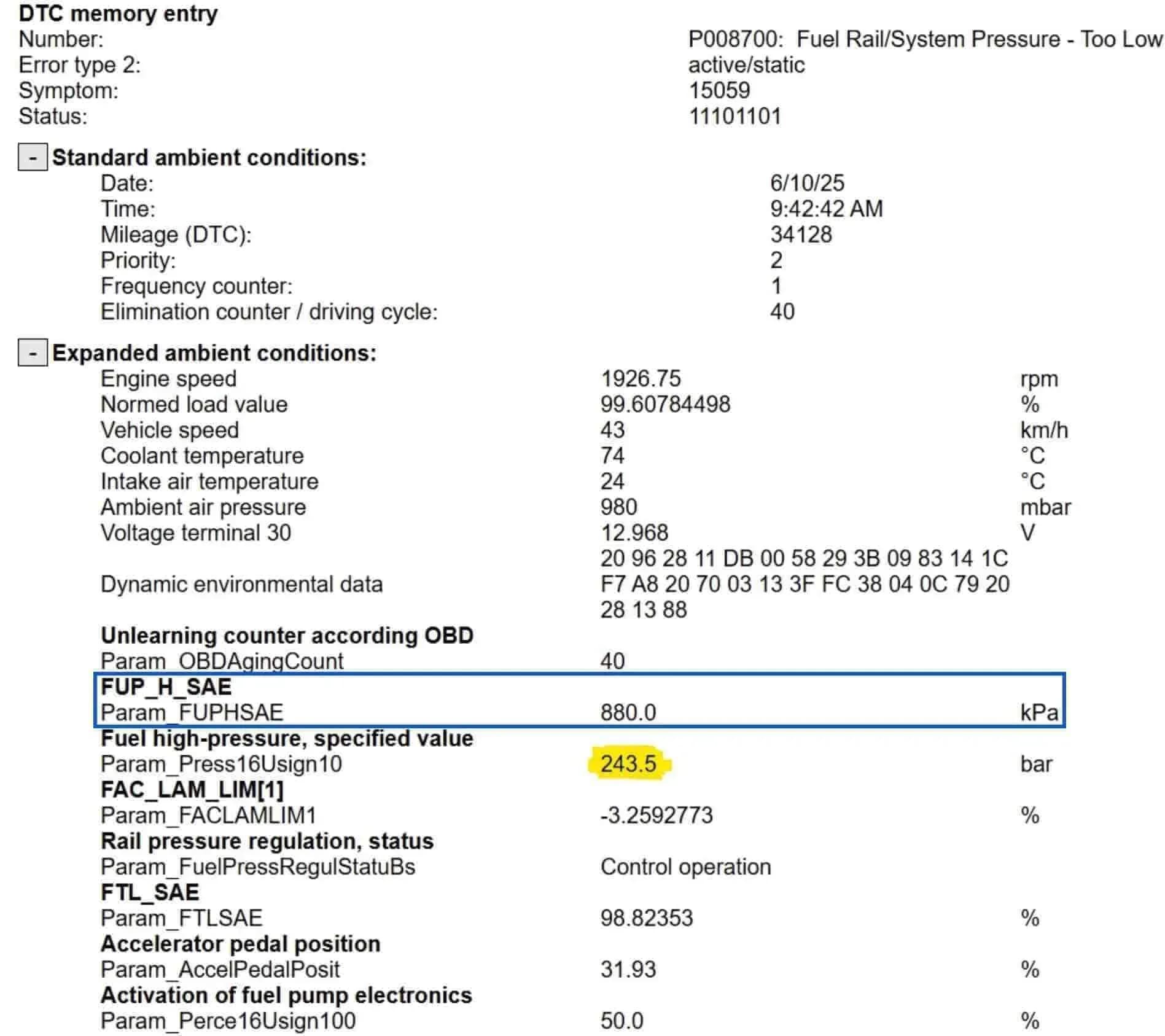
Si applica anche a
- Audi A4
- 2021–2025
- Audi A4 allroad
- 2021–2025
- Audi A5
- 2021–2024
- Audi A6
- 2021–2025
- Audi A6 allroad
- 2021–2025
- Audi A7
- 2021–2025
- Audi A7 e
- 2021–2022
- Audi Q7
- 2021–2025
- Audi Q8
- 2021, 2022, 2024, 2025
- Audi RS 5
- 2021–2024
- Audi RS 6 Avant
- 2021–2025
- Audi RS 7
- 2021–2025
- Audi RS Q8
- 2021–2025
- Audi S4
- 2021–2025
- Audi S5
- 2021–2024
- Audi S6
- 2021–2025
- Audi S7
- 2021–2025
- Audi SQ7
- 2021–2025
- Audi SQ8
- 2021–2025
▸ Mostra altri 13▾ Mostra meno
Audi has released Technical Service Bulletin (TSB) 2079461/2 to address a specific fuel system concern affecting various 2020-2025 models, including the 2023-2025 Audi Q8. This bulletin provides diagnostic and repair procedures for vehicles experiencing an illuminated Malfunction Indicator Lamp (MIL) or activating the limp-home function due to Diagnostic Trouble Codes (DTCs) P014800 or P008700 being stored in the Engine Control Unit (ECM).
This issue, often referred to as an Audi Q8 fuel delivery error P014800 or a fuel rail/system pressure problem, points to potential malfunctions within the vehicle's fuel supply system, specifically involving the high-pressure fuel pump. The TSB outlines steps for technicians to accurately diagnose and resolve these fuel system errors.
Symptoms You Might Experience
Owners of affected Audi vehicles may notice one or both of the following symptoms:
- The Malfunction Indicator Lamp (MIL), commonly known as the "Check Engine" light, illuminates on the dashboard.
- The vehicle enters "limp-home function" mode, which typically restricts engine power and speed to prevent further damage, allowing the driver to reach a service center safely.
These symptoms are direct indicators that the Engine Control Unit (ECM) has detected a fault within the fuel system.
Fault Codes (DTCs) and Their Meanings
When the MIL light is on or the limp-home function activates, the ECM, specifically the Engine Control Unit -J623- (address word 0001), will log specific Diagnostic Trouble Codes. These codes pinpoint the nature of the fuel system problem:
| Code | Description | Module | Symptom | Status |
|---|---|---|---|---|
| P014800 | Fuel Delivery Error | Engine Control Unit -J623- | N/A | N/A |
| P008700 | Fuel Rail/System Pressure - Too Low | Engine Control Unit -J623- | 15059 | 11101101 |
These codes indicate that the fuel delivery system is not operating within its specified parameters, leading to insufficient fuel pressure or an overall fuel delivery issue.
Diagnosis and Trigger Conditions
Diagnosis for the Audi Q8 fuel delivery error P014800 or P008700 begins with clearing the stored DTCs from the Engine Control Unit. If the DTCs reappear after clearing, technicians are instructed to perform specific tests related to the low-pressure fuel pump, as outlined in the ELSA repair manual. This initial step helps determine if the fault is persistent or intermittent.
Key diagnostic tests include:
- "Checking fuel delivery rate": This test assesses the volume of fuel being supplied by the low-pressure pump.
- "Pressure test in the fuel supply line": This measures the actual fuel pressure within the low-pressure side of the fuel system.
For concerns that are reproducible or static, a more detailed procedure is followed:
- A
VAS 6550pressure gauge is installed on the low-pressure side, just before the high-pressure fuel pump. This allows for real-time monitoring of the in-line fuel pressure. Simultaneously, theODIS-Sself-diagnosis function is used to graph measured high-pressure values (Actual vs. Specified). - While the engine is running, both the low-side and high-side fuel pressures are monitored. If the low-side pressure does not drop below
3 barand the high-side pressure does not exceed20 bar, the high-pressure fuel pump is identified as the likely culprit and should be replaced.
For repeat repairs where the concern is not consistently reproducible, technicians are advised to check the expanded ambient conditions associated with DTCs P014800 and P008700. If the fuel rail pressure on the high-pressure side is approximately 10 bar, the high-pressure fuel pump should be replaced before considering other components of the fuel system. An example provided in the TSB shows an actual fuel pressure of 880 kPa (8.8 bar) against a specified value of 243.5 bar, clearly indicating the need for high-pressure fuel pump replacement.
Repair Procedure Summary
The primary repair for the P014800 or P008700 fault involves the diagnosis and potential replacement of the high-pressure fuel pump. The general procedure is as follows:
- Initial Check: Clear the DTCs from the Engine Control Unit. If the fault codes return, proceed with further diagnostics.
- Low-Pressure System Tests: Conduct specific tests on the low-pressure pump, including checking the fuel delivery rate and performing a pressure test in the fuel supply line, as guided by the ELSA repair manual.
- Pressure Monitoring: For persistent issues, connect a
VAS 6550pressure gauge and useODIS-Sdiagnostic software to monitor both low-side and high-side fuel pressures while the engine is running. - High-Pressure Fuel Pump Replacement: If the low-side pressure remains above
3 barand the high-side pressure does not go above20 bar, the high-pressure fuel pump is deemed faulty and must be replaced. This is the most common resolution for the Audi Q8 fuel delivery error P014800. - Repeat Repair Scenario: In cases of intermittent or repeat issues where the fault is not easily reproducible, if the high-pressure fuel rail pressure is found to be around
10 bar, the high-pressure fuel pump should be replaced as the first step, prior to investigating other fuel system components.
Required Tools or Parts
To perform the diagnosis and repair outlined in TSB 2079461/2, technicians will require specific tools and potentially new parts:
VAS 6550pressure gauge: Essential for accurately measuring fuel pressure.ODIS-Sdiagnostic software: Used for reading DTCs, monitoring live data, and performing guided functions.- High-pressure fuel pump: The primary replacement part if diagnostics confirm its failure.
Warranty Information
This Technical Service Bulletin provides detailed warranty claim information. The Service Number associated with this repair is 2363, and the Damage Code is 0010. Labor operations are specified with unique codes for various tasks:
- Remove and install high-pressure pump:
2463 19XX - Remove and install 2 high-pressure pumps:
2463 20XX - Check fuel pump:
2066 0199(50 TU) - Remove and install cover:
1083 1900 - Remove and install air filter housing (gasoline engines):
2425 19XX - GFF/ Guided Functions:
0150 0060
All warranty claims must adhere to the Audi Warranty Policies and Procedures Manual. The claim comment should state "As per TSB 2079461/2".
Important Warnings for Owners
Owners should be aware that if their vehicle is outside of its warranty period, this Technical Service Bulletin is for informational purposes only. The repair costs may not be covered by Audi in such cases. It is always recommended to consult with an authorized Audi service center to discuss specific warranty coverage and repair options.
Source: NHTSA ID 11026228
Frequently Asked Questions
- What are the common symptoms of a fuel system issue in my Audi Q8?
- The most common symptoms include the Malfunction Indicator Lamp (MIL) illuminating on your dashboard, often referred to as the 'Check Engine' light, or your vehicle entering a 'limp-home function' mode, which limits performance to prevent damage.
- What Diagnostic Trouble Codes (DTCs) are associated with the Audi Q8 fuel delivery error P014800?
- The primary DTCs associated with this issue are P014800, indicating a 'Fuel Delivery Error', and P008700, which signifies 'Fuel Rail/System Pressure - Too Low'. Both codes are logged in the Engine Control Unit.
- What is the recommended repair for DTC P014800 or P008700?
- The recommended repair involves a diagnostic process using specialized tools like the VAS 6550 pressure gauge and ODIS-S software to monitor fuel pressures. If specific pressure conditions are met (low-side not below 3 bar and high-side not above 20 bar), the high-pressure fuel pump is typically replaced.
- Is the repair for this fuel system issue covered under warranty?
- If your Audi Q8 is still within its warranty period, the repair for TSB 2079461/2, including parts and labor, should generally be covered. However, if your vehicle is outside of warranty, the bulletin is informational only, and you may be responsible for the repair costs. Always confirm with your Audi service center.
- What is TSB 2079461/2?
- TSB 2079461/2 is a Technical Service Bulletin issued by Audi to provide authorized service centers with detailed procedures for diagnosing and repairing fuel system issues that trigger DTCs P014800 or P008700 in various 2020-2025 Audi models, including the Q8.
Altre revisioni di questo TSB
- 2021-2025 Audi Fuel System DTCs P014800 and P008700P014800, P008700
- 2020-2025 Audi Fuel System DTC P014800 P008700 TSBP014800, P008700
- 2022-2024 Audi A4/A5 DTC P008700 P014800 Stored in ECMP014800, P008700
- 2022-2024 Audi A4/A5 P008700 P014800 DTC TSBP014800, P008700
- 2021-2024 Audi e-tron Front Door Noise & Other FaultsP008700
- 2023-2024 Audi e-tron Front Door Trim Panel NoiseP008700
- 2021-2024 Audi Common Issues: Door Noise, DTCs, ChargingP008700
- 2021-2024 Audi Multiple Faults and DTCsP008700
Related Articles
2023-2026 Audi Frequency Analysis App TSB 2051095/11
Technical Service Bulletin 2051095/11 introduces the Audi Frequency Analysis app, a specialized diagnostic tool for technicians to accurately identify and address noise complaints in 2023-2026 Audi vehicles. This app helps pinpoint the source of various vehicle noises.
2021-2025 Audi Models Engine Control Module Software Update 53ZC
Audi has released Technical Service Bulletin 53ZC (WARR EXT – U82) to provide an Engine Control Module software update. This update optimizes engine oil pressure for various 2021-2025 Audi models, preventing potential issues.
2022-2025 Audi ECM Software Update 53ZC for Oil Pressure
Audi has issued Technical Service Bulletin 53ZC (WARR EXT – U82) for 2022-2025 Audi models, providing an Engine Control Module (ECM) software update. This proactive update optimizes engine oil pressure and is covered under a warranty extension.
2022-2025 Audi Models Engine Control Module Software Update
Audi has issued a dealer communication regarding a software update (UPDATE 53ZC / WARR EXT – U82) for the Engine Control Module in various 2022-2025 models. This update aims to optimize engine oil pressure and prevent potential piston wear. Owners should contact their dealer as no notification…
2022-2025 Audi Q8 Engine Control Module Update
Audi has released Technical Service Bulletin 53ZC, a proactive Engine Control Module (ECM) software update for 2022-2025 Audi Q8, Q7, A6, A7, S4, S5, SQ5, and A8 models. This update optimizes engine oil pressure to prevent potential piston wear and includes a U82 warranty extension.
Leave a comment
Comments are moderated and may take a moment to appear. Only your first name and the initial of your last name are shown publicly.
Comments
Be the first to comment.