2020-2025 Audi Fuel System DTC P014800 P008700 TSB
This Technical Service Bulletin (TSB) 2079461/1 from Audi addresses issues in 2020-2025 Audi vehicles where the Malfunction Indicator Lamp (MIL) illuminates or the vehicle enters limp-home mode, accompanied by Diagnostic Trouble Codes (DTCs) P014800 or P008700 related to the fuel system.
 Sarah Mitchell2025 Audi Q8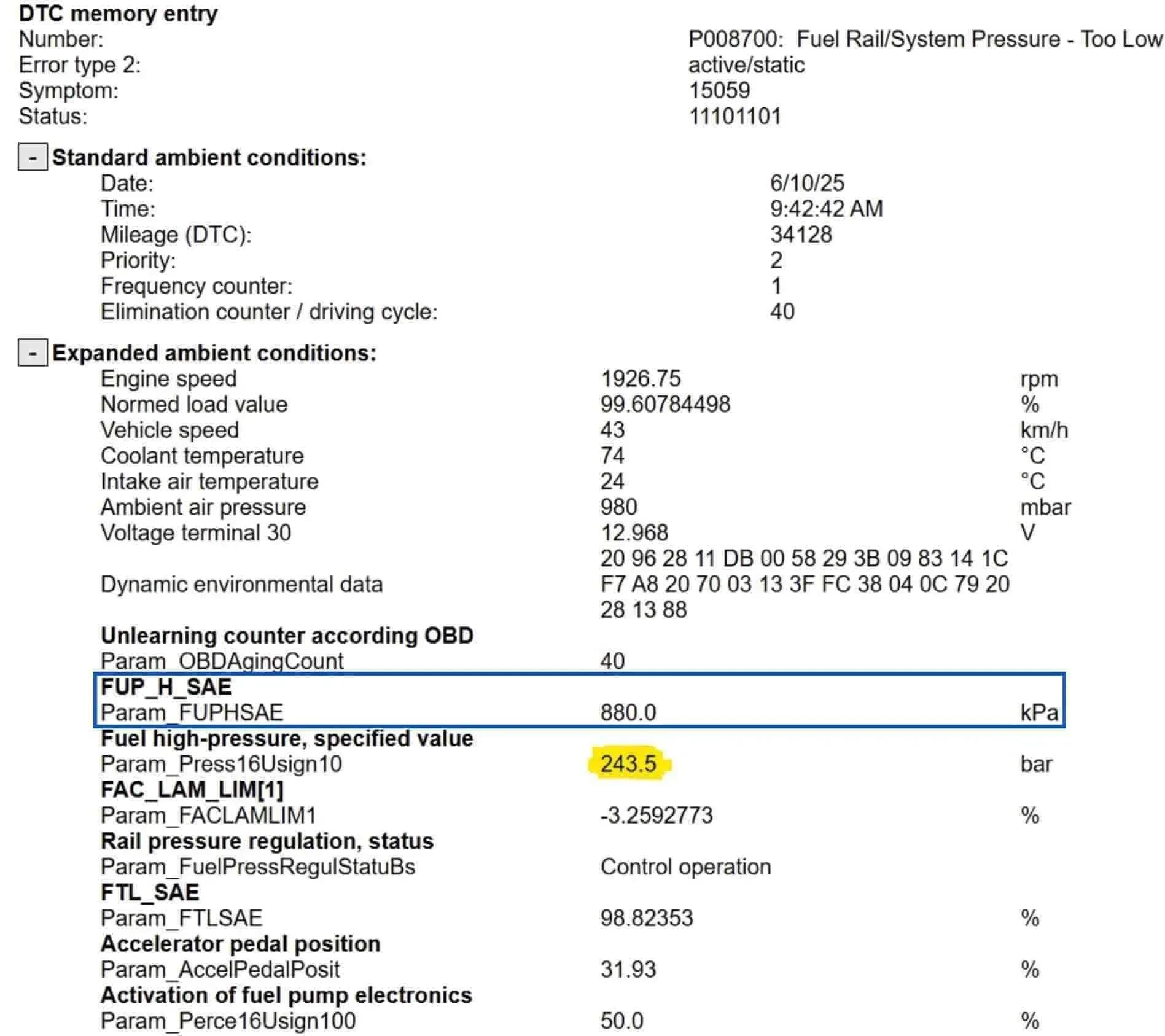
Also applies to
- Audi A4
- 2021–2025
- Audi A4 allroad
- 2021–2025
- Audi A5
- 2021–2024
- Audi A6
- 2021–2025
- Audi A6 allroad
- 2021–2025
- Audi A7
- 2021–2025
- Audi A7 e
- 2021–2022
- Audi Q7
- 2021–2025
- Audi Q8
- 2021–2024
- Audi RS 5
- 2021–2024
- Audi RS 6 Avant
- 2021–2025
- Audi RS 7
- 2021–2025
- Audi RS Q8
- 2021–2025
- Audi S4
- 2021–2025
- Audi S5
- 2021–2024
- Audi S6
- 2021–2025
- Audi S7
- 2021–2025
- Audi SQ7
- 2021–2025
- Audi SQ8
- 2021–2025
▸ Show 13 more▾ Show fewer
Owners of certain 2020-2025 Audi vehicles may encounter issues with their fuel system, leading to warning lights and reduced engine performance. This Technical Service Bulletin (TSB) 2079461/1 outlines the diagnostic and repair steps for conditions where Diagnostic Trouble Codes (DTCs) P014800 or P008700 are stored in the Engine Control Unit (ECM).
This bulletin specifically addresses concerns related to the high-pressure fuel pump, which can manifest as unusual noises or vibrations from the engine's fuel supply system. Understanding the symptoms and recommended repair procedures is crucial for addressing this Audi fuel system DTC P014800 issue effectively.
Symptoms
Owners may notice one or more of the following symptoms if their vehicle is affected by this fuel system concern:
- The Malfunction Indicator Lamp (MIL) illuminates, commonly known as the "Check Engine" light. The verbatim message displayed is often "MIL light is on".
- The vehicle's performance is restricted, and it enters a reduced power or "limp-home function activates" mode. This safety feature limits engine output to prevent further damage.
- Audible noises or vibrations originating from the high-pressure fuel pump area, described as "high-pressure fuel pump noises, vibrations -> too loud" in the complaint type.
Fault Codes / DTCs
When diagnosing the issue, technicians will typically find one or both of the following Diagnostic Trouble Codes (DTCs) stored in the Engine Control Unit (ECM) -J623- (address word 0001):
| Code | Description |
|---|---|
| P014800 | Fuel Delivery Error |
| P008700 | Fuel Rail/System Pressure - Too Low |
These codes specifically point to problems with the fuel delivery system, particularly concerning the pressure within the fuel rail. The TSB notes that P008700 can be active/static with symptom 15059 and status 11101101.
Diagnosis and Trigger Conditions
The diagnostic process for an Audi fuel system DTC P014800 or P008700 begins by clearing the stored DTCs from the Engine Control Unit. If these DTCs reappear after clearing, further investigation is required. Technicians should then perform tests related to the low-pressure fuel pump, as detailed in the ELSA repair manual. These initial tests include "Checking fuel delivery rate" and "Pressure test in the fuel supply line."
If the concern is reproducible or static, a more in-depth procedure is followed. This involves installing a specialized tool, the VAS 6550 pressure gauge, on the low-pressure side of the fuel system, specifically just before the high-pressure fuel pump. This setup allows for continuous monitoring of the in-line fuel pressure on the low-pressure side while the engine is running.
Concurrently, the ODIS-S diagnostic software is used. Technicians must select the self-diagnosis function within ODIS-S and set up a graph of "measured high-pressure measured values (Actual VS. Specified)". This graphical display allows for real-time monitoring of the in-line fuel pressure on the high-pressure side while the engine is in operation.
During engine operation, the in-line fuel pressures on both the high and low sides are closely monitored. The key diagnostic thresholds for determining if the high-pressure fuel pump needs replacement are:
- If the pressure on the low side does not drop below 3 bar.
- If the pressure on the high side does not exceed 20 bar.
If both of these conditions are met, the high-pressure fuel pump should be replaced. This indicates that the pump is not maintaining adequate pressure within the specified ranges.
For repeat repairs where the concern is not consistently reproducible, technicians will examine the expanded ambient conditions associated with the DTCs P014800 and P008700. If the fuel rail pressure on the high-pressure side is approximately 10 bar, the high-pressure fuel pump is the primary suspect and should be replaced before considering any other parts connected to the fuel system. An example provided in the TSB illustrates a scenario where the actual fuel pressure at the rail is 880 kPa (8.8 bar) compared to a specified value of 243.5 bar, indicating the high-pressure fuel pump would need replacement.
Repair Procedure Summary
The primary repair for this Audi fuel system DTC P014800 issue, as outlined in TSB 2079461/1, focuses on the diagnosis and potential replacement of the high-pressure fuel pump. After confirming the presence and recurrence of DTCs P014800 or P008700, and performing the detailed pressure tests using the VAS 6550 gauge and ODIS-S software, the decision to replace the high-pressure fuel pump is made based on the observed pressure readings and specific thresholds.
The repair process typically involves accessing and removing the faulty high-pressure fuel pump and installing a new one. Depending on the vehicle configuration, this may also include removing and installing the air filter housing, especially in gasoline engines. The TSB provides specific labor operations and associated times for these tasks to ensure efficient and accurate repair by qualified technicians.
Required Tools or Parts
Accurate diagnosis and repair of this fuel system issue require specialized equipment:
- VAS 6550 pressure gauge: Used for precise measurement of fuel pressure on the low-pressure side of the system, installed just before the high-pressure fuel pump.
- ODIS-S diagnostic software: Essential for monitoring in-line fuel pressures, comparing actual versus specified values, setting up graphical displays, and clearing DTCs.
- ELSA repair manual: Referenced for detailed procedures on testing the low-pressure pump, including "Checking fuel delivery rate" and "Pressure test in the fuel supply line."
Specific part numbers for the high-pressure fuel pump are not listed in the TSB but would be determined by the technician based on the vehicle's VIN and model.
Warranty Information
This Technical Service Bulletin provides detailed information for warranty claims related to the fuel system issue. The Claim Type specifies that "If the vehicle is outside of any warranty, this Technical Service Bulletin is informational only." This means that repairs performed under the guidance of this TSB may not be covered by Audi and could incur costs for the owner. All warranty claims must adhere to the Audi Warranty Policies and Procedures Manual.
- Service Number: 2374
- Damage Code: 0010
- Claim Comment: As per TSB 2079461/1
Labor Operations
The following labor operations are specified for addressing this issue:
| Labor Operation | Code | Time Units (TU) | Notes |
|---|---|---|---|
| Remove and install high-pressure pump | 2463 19XX | See SRT | With associated operations |
| Remove and install 2 high-pressure pumps | 2463 20XX | See SRT | With associated operations |
| Check fuel pump | 2066 0199 | 50 TU | |
| Remove and install cover | 1083 1900 | See SRT | With associated operations |
| Remove and install air filter housing (gasoline engines) | 2425 19XX | See SRT | With associated operations |
| GFF/ Guided Functions | 0150 0060 | Time stated | On the diagnostic protocol |
Owner Action
If your 2020-2025 Audi is displaying a "MIL light is on" or entering a "limp-home function activates" state, especially if accompanied by unusual engine noises, it is crucial to have your vehicle inspected by an authorized Audi service center. Inform the technician about the symptoms you are experiencing and mention the possibility of an Audi fuel system DTC P014800 or P008700.
Since this is a Technical Service Bulletin and not a recall, Audi may not directly notify owners. It is the owner's responsibility to seek diagnosis and repair. Ensure that any repairs are performed according to the procedures outlined in TSB 2079461/1 to correctly address the fuel system issue.
NHTSA ID: 11025286
Frequently Asked Questions
- What does DTC P014800 or P008700 mean in my Audi?
- DTC P014800 indicates a 'Fuel Delivery Error,' while P008700 signifies 'Fuel Rail/System Pressure - Too Low.' Both codes point to issues within your Audi's fuel system, often related to the high-pressure fuel pump.
- What are the common symptoms of this Audi fuel system problem?
- You might notice the 'MIL light is on' (Check Engine light), the vehicle entering 'limp-home function activates' mode with reduced power, or hear unusual noises and vibrations from the high-pressure fuel pump area, specifically described as 'high-pressure fuel pump noises, vibrations -> too loud'.
- How will a technician diagnose the P014800 or P008700 fault?
- Technicians will clear the DTCs, and if they return, perform low-pressure pump tests from the ELSA repair manual. For reproducible issues, they'll use a VAS 6550 pressure gauge and ODIS-S software to monitor fuel pressures. If low-side pressure doesn't drop below 3 bar and high-side doesn't exceed 20 bar, the high-pressure fuel pump is likely faulty.
- Is the repair for TSB 2079461/1 covered by warranty?
- According to the TSB, if your vehicle is outside of its warranty period, this Technical Service Bulletin is for informational purposes only, meaning the repair costs may not be covered by Audi. All warranty claims must comply with Audi Warranty Policies and Procedures Manual.
- What is the main repair for this fuel system issue?
- The primary repair involves diagnosing and potentially replacing the high-pressure fuel pump, based on specific fuel pressure readings obtained during the diagnostic process using specialized tools like the VAS 6550 pressure gauge and ODIS-S software. This is detailed in TSB 2079461/1.
Other revisions of this TSB
- 2021-2025 Audi Fuel System DTCs P014800 and P008700P014800, P008700
- 2023-2025 Audi Q8 Fuel Delivery Error TSB 2079461/2P014800, P008700
- 2022-2024 Audi A4/A5 DTC P008700 P014800 Stored in ECMP014800, P008700
- 2022-2024 Audi A4/A5 P008700 P014800 DTC TSBP014800, P008700
- 2021-2024 Audi e-tron Front Door Noise & Other FaultsP008700
- 2023-2024 Audi e-tron Front Door Trim Panel NoiseP008700
- 2021-2024 Audi Common Issues: Door Noise, DTCs, ChargingP008700
- 2021-2024 Audi Multiple Faults and DTCsP008700
Related Articles
2024-2026 Audi MMI Weather Widget 'An error has occurred' TSB
Audi Technical Service Bulletin 2081500/1 addresses the 'An error has occurred' message on the MMI weather widget in 2024-2026 Audi models. This issue typically indicates a missing data plan for the Audi Application Store.
2018-2026 Audi V6 TFSI Drive System Malfunction TSB
Audi Technical Service Bulletin 2081342/1 addresses a "Drive system fault active in instrument cluster" message and associated knock sensor DTCs (P032700, P033200, P032800, P033300) in 2018-2026 V6 TFSI models. This issue is often caused by temporary moisture absorption in the knock sensor housing.
2024-2026 Audi Q8 48V Starter Generator DTCs P0A1A00 P19F800
Audi has released Technical Service Bulletin (TSB) 2076994/7 to address issues with the 48V starter generator (BSG) in 2024-2026 Audi Q8, A6, A7, Q7, and A6 allroad models equipped with MHEV. Owners may experience an illuminated engine warning lamp and various diagnostic trouble codes (DTCs)…
2025 Audi Q8 Bluetooth/Smartphone Interface Connection TSB
Audi Technical Service Bulletin 2079837/2 addresses customer complaints regarding slow or interrupted Bluetooth and Audi smartphone interface connections in 2025 Audi models, including the Q8. The issue stems from a software fault in the emergency call module control unit (DA 0075). The…
2023-2025 Audi On-Car Analysis List for Technicians
Audi's TSB 2066297 outlines an on-car analysis list for technicians, addressing common concerns such as the 48V battery cooling fan DTC P0A8200, B&O extendable tweeter operational issues, and PPE/PPC vehicle time synchronization problems for 2023-2025 Audi models.
Leave a comment
Comments are moderated and may take a moment to appear. Only your first name and the initial of your last name are shown publicly.
Comments
Be the first to comment.