2022-2024 Audi Parking Aid Malfunction TSB 2069694/1
Audi Technical Service Bulletin (TSB) 2069694/1 addresses the 'Front/rear parking aid: Sensor view restricted because of environmental factors' warning message and associated DTCs B107BF0 and B10FCF0 in 2022-2024 Audi A3, S3, RS 3, Q4 e-tron, and Q4 Sportback e-tron models. This TSB clarifies that…
 David Chen2022 Audi S3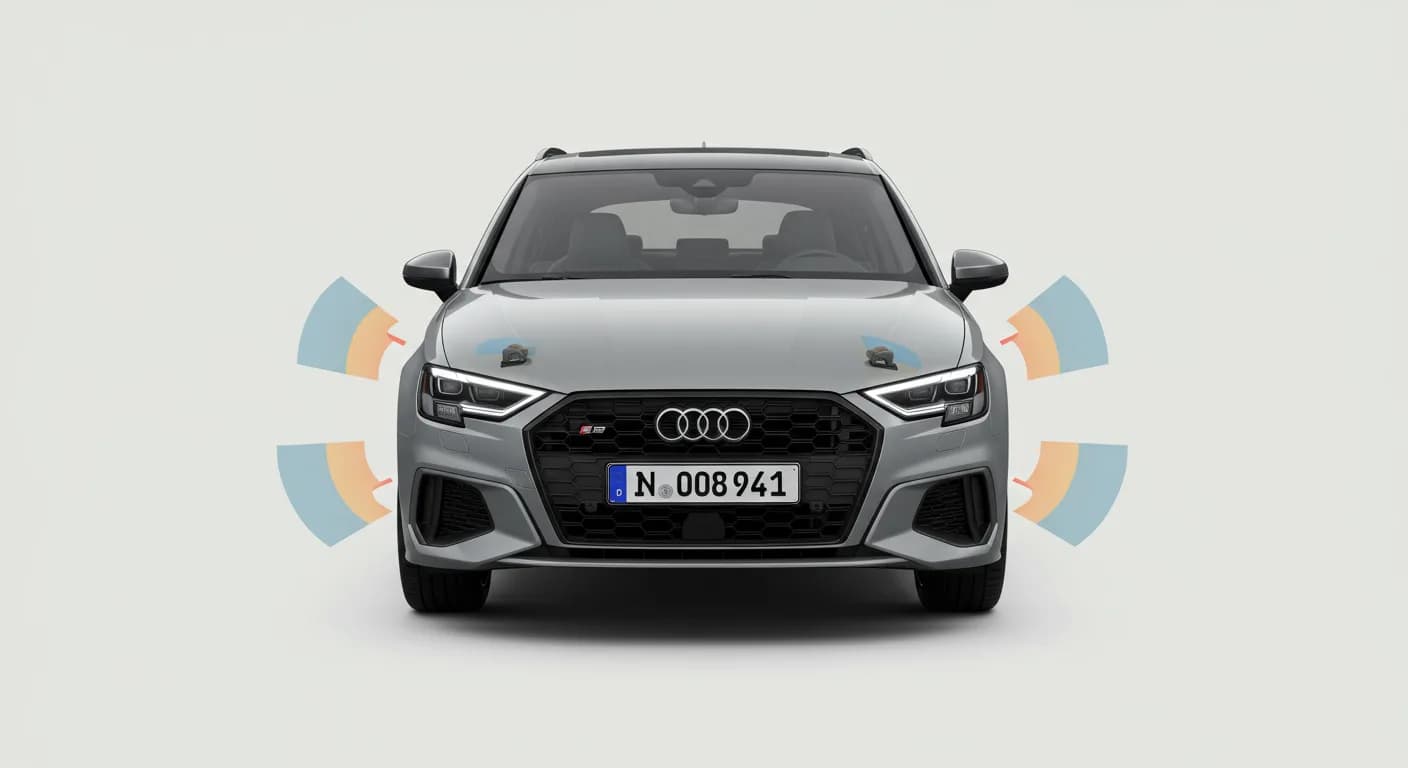
Si applica anche a
- Audi A3
- 2022–2024
- Audi RS 3
- 2022–2024
- Audi S3
- 2023–2024
Audi has issued Technical Service Bulletin (TSB) 2069694/1 (also referred to as 91 23 80 2069694/1) to address instances where the parking aid system displays a "Front/rear parking aid: Sensor view restricted because of environmental factors" warning message. This TSB applies to 2022-2024 Audi A3, S3, RS 3, Q4 e-tron, and Q4 Sportback e-tron models. This Audi parking aid malfunction is often accompanied by specific diagnostic trouble codes (DTCs) related to environmental influences on the parking aid sensors.
This bulletin clarifies that the warning message and the associated DTCs, B107BF0 and B10FCF0, are typically triggered by external factors affecting the vehicle's ultrasound parking aid sensors. Understanding this TSB can help owners and technicians properly diagnose and address the root cause of the Audi parking aid malfunction without unnecessary part replacements.
Symptoms
Owners of affected Audi vehicles may observe the following in their instrument cluster:
- The warning message: "Front/rear parking aid: Sensor view restricted because of environmental factors"
This message indicates that the parking aid system's sensors are temporarily unable to function correctly due to external conditions.
Fault Codes / DTCs
When the Audi parking aid malfunction occurs, one or both of the following diagnostic trouble codes (DTCs) may be stored in the parking aid control module (-J446-, address word DA0076):
| Code | Description |
|---|---|
| B107BF0 | Rear parking aid sender, malfunction because of environment influences |
| B10FCF0 | Front parking aid sender, malfunction because of environment influences |
These DTCs are often accompanied by specific symptom codes, including 1080304 or 13959168 for B107BF0, and 1113328 or 13959169 for B10FCF0. These codes point directly to environmental factors as the cause of the sensor's temporary unavailability.
Important Warnings
Audi explicitly states critical information regarding the diagnosis and repair of this Audi parking aid malfunction:
- "Note: In this case, replacement of the driver assistance systems -J446- (DA0076) without clear findings is not effective. Part replacement of the -J446- (DA0076) does not solve this issue. Claims for replaced parts will be subject to review." This means technicians should not replace the parking aid control module if the issue is sporadic and caused by environmental factors, as it will not resolve the problem and may lead to warranty claim rejections.
Diagnosis and Trigger Conditions
The new generation of ultrasound parking aid sensors in these Audi models are highly sensitive to external influences. These can include:
- Dirt, mud, or debris on the sensors.
- Ice or snow accumulation.
- External ultrasound signals or noises.
When the system detects such problems, it temporarily disables itself to prevent false warnings. The warning message is then displayed to the driver.
Diagnosis depends on whether the issue is sporadic or constant:
- Scenario 1 (Sporadic Occurrence): If the warning message appears intermittently, it is likely caused by environmental influences. In such cases, no further measures or part replacements are necessary, as the system is functioning as designed under adverse conditions.
- Scenario 2 (Reproducible or Static Occurrence): If the concern is consistently reproducible or the warning remains active, it may indicate a faulty ultrasound sensor, mounting, or related circuit. A significantly increased frequency counter within the fault code's standard ambient conditions can also suggest a genuine malfunction. In this scenario, standard diagnostic procedures should be followed to pinpoint the specific faulty component.
Repair Procedure Summary
For technicians, TSB 2069694/1 outlines a series of checks to perform on the respective ultrasound sensors, depending on the stored DTCs:
- Visual Inspection: Check the sensors for any dirt, ice, foreign objects, stickers, or an improperly fitted license plate that might obstruct their view.
- Physical Damage Check: Inspect the bumper, air intake grille, and underbody for any damage that suggests an impact during parking, which could affect sensor alignment or function. Also, look for mechanical damage like stone chips or scratches on the sensors themselves.
- Fitment Check: Verify the proper fit of the sensors, bumpers, and surrounding trim components. Loose or misaligned parts can interfere with sensor operation.
- Measured Value Analysis: Use diagnostic tools to check the "Parking aid sender settling time in the parking aid control module, J446 (address word DA0076)." Observe for a cyclic or dynamic change in measured values when an obstacle is approached, which helps confirm sensor functionality.
If these checks reveal a consistent fault (Scenario 2), further standard diagnosis is required. However, if the issue is sporadic and linked to environmental factors (Scenario 1), no repair is needed, and replacement of the J446 control unit is specifically advised against.
Owner Action
If you experience an Audi parking aid malfunction with the "Front/rear parking aid: Sensor view restricted because of environmental factors" message, especially if it occurs intermittently or during adverse weather conditions, it is likely due to environmental factors.
- Initial Check: First, visually inspect your vehicle's parking sensors, bumper, and grille for any obvious obstructions like dirt, ice, or debris. Cleaning these areas may resolve the issue.
- Dealer Visit: If the warning persists after cleaning, or if it appears consistently regardless of environmental conditions, it is advisable to contact your authorized Audi service center. Inform them about the specific warning message and any DTCs you may have observed. Reference Audi TSB 2069694/1 to ensure they are aware of the manufacturer's guidance on this issue.
This TSB is informational and does not apply to any Audi warranty.
NHTSA ID: 10233706
Frequently Asked Questions
- What does the message "Front/rear parking aid: Sensor view restricted because of environmental factors" mean in my Audi?
- This message indicates that your Audi's parking aid system is temporarily unable to function correctly because its ultrasound sensors are obstructed or affected by external conditions such as dirt, ice, or other environmental interference. This is detailed in Audi TSB 2069694/1.
- What are DTC B107BF0 and B10FCF0, and how do they relate to my Audi's parking aid?
- DTC B107BF0 (Rear parking aid sender, malfunction because of environment influences) and B10FCF0 (Front parking aid sender, malfunction because of environment influences) are diagnostic trouble codes stored when the parking aid system detects issues due to environmental factors. They confirm that the "Audi parking aid malfunction" is related to external conditions affecting the sensors.
- Should I replace the parking aid control module (J446) if I see these codes?
- No, Audi TSB 2069694/1 specifically advises against replacing the driver assistance systems -J446- (parking aid control module) if the issue is sporadic and caused by environmental influences. Replacing it will not resolve the problem and could lead to warranty claim rejections.
- What should I do if my Audi shows a parking aid malfunction with these warnings?
- First, visually inspect and clean your parking sensors, bumper, and grille for any dirt, ice, or debris. If the warning persists or occurs consistently after cleaning, contact your Audi service center. Mention the specific warning message and reference Audi TSB 2069694/1 for proper diagnosis.
Altre revisioni di questo TSB
- 2019-2026 Audi Parking Aid Malfunction TSB 2058769/8B107BF0, B10FCF0
- 2023-2025 Audi Parking Aid System Malfunction TSBB107BF0, B10FCF0
- 2023-2025 Audi Parking Aid Fault DTC B107BF0 B10FCF0B107BF0, B10FCF0
- 2022-2025 Audi A3, S3, RS 3 Parking Aid Sensor MalfunctionB107BF0, B10FCF0
- 2019-2024 Audi Parking Aid Fault DTC B107BF0B107BF0, B10FCF0
- 2021-2023 Audi e-tron Parking Aid Malfunction DTC B107BF0B107BF0, B10FCF0
- 2021-2023 Audi Parking Aid Malfunction TSBB107BF0, B10FCF0
- 2021 Audi Parking Aid System Malfunction TSBB107BF0, B10FCF0
Related Articles
2022-2023 Audi MIB3 MMI Software Update for Emergency Call Fault
Audi has issued Technical Service Bulletin (TSB) 2079134/4 for 2022-2023 A3, S3, RS 3, e-tron GT, and RS e-tron GT vehicles equipped with MIB3 infotainment systems. This TSB addresses various MMI function problems and the 'Emergency call fault' message by providing a critical software update.
2021-2024 Audi A3/S3/TT Whining Noises TSB 2074764/2
Audi Technical Service Bulletin 2074764/2 describes whining noises from the rear end of 2021-2024 Audi A3, S3, and TT models during acceleration or deceleration. This TSB clarifies that these noises are comfort-related and replacing parts will not resolve the issue.
2022-2025 Audi MIB3 Volume Control Not Working TSB U11B900
Audi has released Technical Service Bulletin 2072873/6 to address issues with the MIB3 infotainment system's volume control and skip buttons not working in 2022-2025 A3, S3, RS 3, e-tron GT, and RS e-tron GT models. The problem is linked to DTC U11B900, indicating a software issue requiring an…
2022-2023 Audi MIB3 Conbox Software Update
Audi has released a software update for the conbox component within the MIB3 infotainment system. This update, detailed in manufacturer communication NHTSA ID 11027377, applies to various 2022-2023 Audi A3, S3, RS 3, e-tron GT, and RS e-tron GT models.
2022-2024 Audi A3/S3/RS3 Exterior Lighting Warning TSB 2074786/3
Audi Technical Service Bulletin 2074786/3 details a 'Warning lamp for exterior lighting' issue in 2022-2024 A3, S3, RS3, and Q4 e-tron vehicles. This TSB addresses DTCs U112100, U110B00, and B126A29, often resolved by light switch replacement.
Leave a comment
Comments are moderated and may take a moment to appear. Only your first name and the initial of your last name are shown publicly.
Comments
Be the first to comment.