2021-2022 Audi e-tron A/C Not Cooling DTCs P053000 P251500
Audi has released Technical Service Bulletin (TSB) 2068460/7 to address concerns with the air conditioning system in 2021-2022 Audi e-tron models, where owners may experience 'Air conditioner does not work' or 'no cooling output'. This TSB specifically targets diagnostic trouble codes P053000 and…
 Ahmet Topcu2022 Audi e-tron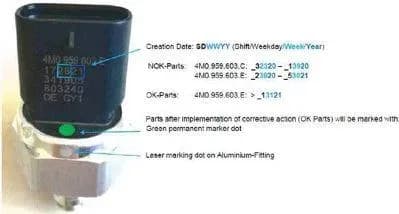
S'applique également à
- Audi A7 e
- 2021–2022
- Audi A8 L e
- 2021
- Audi e-tron
- 2021
- Audi e-tron GT
- 2022
- Audi e-tron Sportback
- 2021–2022
- Audi Q5 e
- 2021
- Audi RS e-tron GT
- 2022
▸ Afficher 1 de plus▾ Afficher moins
Audi has released Technical Service Bulletin (TSB) 2068460/7, issued on September 12, 2025, to address a common concern among owners of certain 2021-2022 Audi e-tron vehicles: the air conditioning system not providing adequate or any cooling output. This TSB specifically targets instances where diagnostic trouble codes (DTCs) P053000 and P251500 are stored in the vehicle's thermal management system.
The TSB, identified by transaction number 2068460/7, provides detailed information for diagnosing and resolving the underlying hardware issue with the A/C refrigerant pressure sensors. If you are experiencing an Audi e-tron A/C not cooling problem, this bulletin outlines the necessary steps for repair.
Symptoms of A/C Malfunction
Owners may notice various issues related to the climate control system. These symptoms often point to the underlying problem addressed by TSB 2068460/7:
- The air conditioner is not working at all, or the cooling output is strongly reduced.
- Climate control cooling functions related to the condenser are damaged.
- Parking heating or cooling cannot be switched on or activated.
- The A/C system switches on or off by itself (ECO, AC modes).
- The MMI A/C status display shows incorrect readings.
- Automatic climate control mode (AUTO) switches off by itself or cannot be activated.
- The climate control unit has no cooling output function.
- The display control head for the A/C system or climate control operating unit temperature button is damaged.
- Infotainment controls related to climate functions are not working.
- Engine coolant temperature regulation is irregular.
- Increased electrical leakage current or current draw related to climate control system adjustment memory.
- Manual climate control mode has no function.
- Ventilation with fresh air blower levels 1 or 2 have no function, or indicate too little automotive fluids.
- Parking heating/cooling auxiliary heater cannot be switched on or activated.
- Automatic climate control mode (AUTO) misfires.
Fault Codes / DTCs
When a workshop diagnoses the Audi e-tron A/C not cooling issue, they may find specific diagnostic trouble codes (DTCs) stored in the thermal management system (diagnostic address 00C5, Audi Q4 diagnostic address 0008). These codes indicate a problem with the A/C refrigerant pressure sensors.
| Diagnostic Trouble Code | Description | Storage State |
|---|---|---|
| P251500 | A/C Refrigerant Pressure Sensor "B" Circuit | Static, Intermittent |
| P053000 | A/C Refrigerant Pressure Sensor "A" Circuit | Static, Intermittent |
Diagnosis and Technical Background
The workshop will reproduce the fault and confirm the presence of either DTC P053000 or P251500. The technical background for these issues is identified as a hardware problem with the pressure sensor itself.
Important Sensor Information and Warnings
When replacing pressure sensors, it is crucial to verify if a sensor has been previously replaced. This can be determined by markings on the sensor, such as a green dot on the plastic part (not always present), laser marking on the aluminum part, a production date greater than week 31 of 2021 (>3121), or if the component already has an index E marking.
Critical Warning for Sensor Replacement: If an index E sensor can no longer be ordered from the replacement parts warehouse and index J sensors are available, note that index E and index J sensors are not compatible. If an index J version of a sensor is installed, all other pressure sensors in the affected vehicle must also be replaced with index J sensors. If index E sensors are still available in the replacement parts warehouse, they should be ordered.
Repair Procedure Summary
The primary repair for the Audi e-tron A/C not cooling issue, as outlined in TSB 2068460/7, involves replacing the faulty pressure sensors. The service procedure requires replacing all pressure sensors in the air conditioning circuit. This typically includes draining and refilling the refrigerant.
Warranty Information
For vehicles outside of warranty, this Technical Service Bulletin is for informational purposes only. For vehicles under warranty, claims should be submitted according to the Audi Warranty Policies and Procedures Manual. The Service Number associated with this repair is 8757, and the Damage Code is 0040. Specific labor operations are provided for different Audi models:
- A6/A7: Pressure switches (both) remove and reinstall (8709 2050), Refrigerant drain and fill (8703 1700).
- Q7/Q8: Pressure switches (both) remove and reinstall (8757 2093), Refrigerant drain and fill (8703 1700).
- A8: Pressure switch (G395) remove and reinstall (8757 1950), Pressure switch (G826) remove and reinstall (8764 1950), Refrigerant drain and fill (8703 1700).
- e-tron GT: Pressure switches (all 3) remove and reinstall (8709 2050), Refrigerant drain and fill (8703 1700).
- Q5: Pressure switches (both) remove and reinstall (8709 2050), Refrigerant drain and fill (8703 1700).
- e-tron: Pressure switch (G395) remove and reinstall (8757 1950), Pressure switch (G826) remove and reinstall (8764 1950), or Pressure switches (both) remove and reinstall (8709 2051).
- Q4: Pressure switch remove and reinstall (8709 19xx).
Additional operations include checking pressure switch (8709 0199), GFF (0150 0060), and charging battery (2706 8950).
Revision History
This TSB has undergone several revisions to ensure accuracy and completeness:
- Revision 7 (Date not specified): Updated text for the title, header (added PR criteria), condition, technical background, production solution, service, and warranty (corrected labor operations).
- Revision 6 (May 10, 2024): Revised the Service section to include a statement regarding sensor interchangeability and corrected labor operations in the Warranty section.
- Revision 5 (October 2, 2023): Revised the Technical Background and Service sections to correct component designations, and updated the Warranty section with corrected SRTs.
Source: NHTSA ID: 11023751
Frequently Asked Questions
- What does TSB 2068460/7 address for Audi e-tron vehicles?
- TSB 2068460/7 addresses issues where the air conditioning system in 2021-2022 Audi e-tron models is not providing cooling output, often accompanied by diagnostic trouble codes P053000 or P251500. It points to a hardware problem with the A/C refrigerant pressure sensors.
- What are the common symptoms of the Audi e-tron A/C not cooling problem?
- Owners may experience the air conditioner not working at all, reduced cooling, the A/C system switching on/off by itself, incorrect MMI A/C display readings, or automatic climate control mode issues. These symptoms are linked to the 'Audi e-tron A/C not cooling' fault.
- What DTCs are associated with the A/C pressure sensor issue in Audi e-tron?
- The primary diagnostic trouble codes (DTCs) associated with this issue are P053000, indicating an 'A/C Refrigerant Pressure Sensor "A" Circuit' fault, and P251500, indicating an 'A/C Refrigerant Pressure Sensor "B" Circuit' or 'A/C Pressure/Temperature Sensor 2, electrical malfunction'.
- What is the repair procedure for the Audi e-tron A/C not cooling issue?
- The repair procedure involves replacing all pressure sensors in the air conditioning circuit. It's crucial to ensure sensor compatibility; if using an index J sensor, all other sensors in the vehicle must also be replaced with index J sensors.
- Is this repair covered under warranty?
- If your vehicle is outside of warranty, this Technical Service Bulletin serves as informational guidance. For vehicles still under warranty, the repair may be covered, and claims should be processed according to the Audi Warranty Policies and Procedures Manual, using Service Number 8757 and Damage Code 0040.
Autres révisions de ce TSB
- 2020-2022 Audi A/C Not Cooling: DTC P053000, P251500 TSBP053000, P251500
- 2020-2022 Audi AC Not Cooling: DTCs P053000, P251500P053000, P251500
- 2021-2022 Audi A/C Not Cooling: DTC P053000, P251500 TSBP053000, P251500
- 2021-2022 Audi AC Not Cooling P053000 P251500P053000, P251500
- 2021-2022 Audi AC Not Cooling TSB P053000 P251500P053000, P251500
- 2020-2022 Audi AC Not Cooling: DTC P053000, P251500P053000, P251500
- 2021-2022 Audi AC Not Cooling with DTC P053000 P251500P053000, P251500
Related Articles
2022 Audi e-tron Problems: Electrical System & Braking Concerns
The 2022 Audi e-tron has faced significant owner complaints regarding its electrical system, including sudden power loss and charging hazards, as well as various braking malfunctions. This profile details these issues and relevant service bulletins.
2022-2026 Audi Guided Fault Finding Reporting Obligation
Audi has issued Technical Service Bulletin TPI 2033392, also known as Transaction No. 2081531/1, regarding a reporting obligation for technicians when Guided Fault Finding produces an unexpected result. This TSB outlines the process for contacting Audi Product Support for diagnostic assistance.
2022-2026 Audi Infotainment System Complaints
Audi has released Technical Service Bulletin (TSB) 2081405/1 to address various customer complaints regarding infotainment systems in 2022-2026 Audi vehicles. This TSB helps technicians diagnose issues often caused by external media or mobile devices, rather than vehicle technology.
2018-2026 Audi Models Cracking Noise TSB 2061464/11
Audi Technical Service Bulletin 2061464/11 describes a cracking noise from the front or rear axle when changing direction in various 2018-2026 Audi models. The issue is due to stub axle movement and is resolved by bonding the stub axle to the wheel bearing with locking fluid.
2022-2026 Audi Parking Aid False Warnings TSB 2024323/13
Audi has released Technical Service Bulletin 2024323/13 to address customer complaints of false parking aid warnings. This bulletin details various environmental and vehicle-specific conditions that can cause the parking aid system to issue alerts even when no obstacles are present. It provides…
Leave a comment
Comments are moderated and may take a moment to appear. Only your first name and the initial of your last name are shown publicly.
Comments
Be the first to comment.