2020-2022 Audi AC Not Cooling: DTC P053000, P251500
Audi has issued Technical Service Bulletin 2068460/2 for 2020-2022 models, including the e-tron, addressing air conditioning systems that do not cool. This TSB covers DTCs P053000 and P251500, indicating issues with refrigerant pressure sensors.
 Marcus Weber2021 Audi e-tron
Also applies to
- Audi A6
- 2021–2022
- Audi A6 allroad
- 2021–2022
- Audi A7
- 2021–2022
- Audi A7 e
- 2021–2022
- Audi A8 L e
- 2021
- Audi e-tron
- 2022
- Audi e-tron GT
- 2022
- Audi Q5
- 2021
- Audi Q7
- 2021–2022
- Audi Q8
- 2021–2022
- Audi RS 6 Avant
- 2021–2022
- Audi RS 7
- 2021–2022
- Audi RS e-tron GT
- 2022
- Audi RS Q8
- 2021–2022
- Audi S6
- 2021–2022
- Audi S7
- 2021–2022
- Audi S8
- 2021–2022
- Audi SQ5
- 2021–2022
- Audi SQ7
- 2021–2022
- Audi SQ8
- 2021–2022
▸ Show 14 more▾ Show fewer
Symptoms
Owners of 2020-2022 Audi vehicles may experience their air conditioning system failing to cool the cabin. This condition may be intermittent in nature, meaning the AC might work sometimes and not others.
Fault Codes / DTCs
When the air conditioning system does not cool, technicians may find one or both of the following Diagnostic Trouble Codes (DTCs) stored in the Thermal management control unit, J1024 (address word 00C5):
| Code | Description |
|---|---|
| P053000 | Air conditioning system pressure sensor electrical fault |
| P251500 | Refrigerant pressure sensor 2 electrical fault |
Technical Background
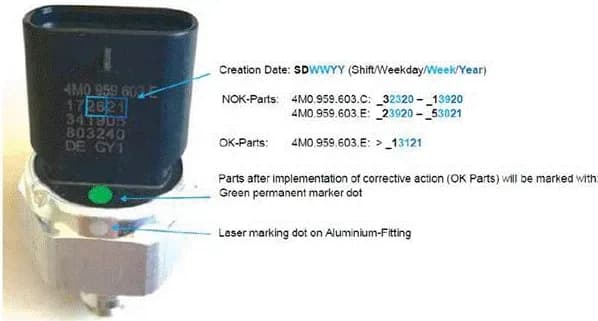
Audi has identified that a failure in the sensor electronics can lead to an incorrect evaluation of pressure within the air conditioning system. The specific sensors at fault are those with base part number 4M0959603 (also referred to as G395 / G827) that were manufactured before Calendar Week 31, 2021. This issue causes the air conditioning system to not cool the cabin effectively. An improved version of the sensor has since been implemented in production to prevent this issue.
This Technical Service Bulletin, identified as 87 23 38 2068460/2, supersedes Technical Service Bulletin Group 87 number 22-35 dated November 9, 2022. The current revision, Revision 2, was issued on January 31, 2023, primarily to revise the warranty details regarding the maximum time allowed for GFF (Guided Fault Finding) procedures.
Diagnosis and Repair Summary
If your 2020-2022 Audi is experiencing an Audi e-tron P053000 air conditioning issue, a technician will first confirm the symptom of the AC not cooling. The next critical step involves inspecting all pressure sensors in the refrigerant circuit that have the base part number 4M0959603 and a build date prior to Calendar Week 31, 2021. Each affected model may have between one and three of these sensors installed.
Technicians will carefully inspect the markings on the sensor to determine if it has already been replaced with an improved version. An improved sensor, produced after Calendar Week 31, 2021, will typically have an index 'E', a green dot on the connector housing, and a laser marking on the aluminum housing. Sensors without these specific markings or with an older build date will require replacement.
The repair procedure involves removing and reinstalling the faulty pressure switches. This often necessitates additional labor operations depending on the specific Audi model. For instance, it may include draining and refilling the refrigerant (labor operation 8703 1750), and for some models, removing other components such as storage compartments (7007 1900 for e-tron GT), wheels (4405 1951), or cross braces (5069 1960). For e-tron models, disabling and activating the high voltage system (9310 8302) may also be required for safety during the repair. The specific labor operations for pressure switch removal and reinstallation vary by model, such as 8757 1900 for A6/A7 and A8 (non-PHEV), 8757 2093 for Q7/Q8, 8757 1950 for A8 PHEV, 8709 2099 for e-tron and some Q5 variants, and 8709 1901 for other Q5 variants.
Required Parts
To address the Audi e-tron P053000 air conditioning problem, the following part is required:
| Part Number | Part Description | Quantity |
|---|---|---|
| 4M0959603E | Pressure and temperature sensor | 1-3 |
Always consult with your Audi Parts Department and/or ETKA for the latest information and part bulletins.
Warranty Information
This repair is covered under warranty for up to 48 months or 50,000 miles, whichever comes first. For Audi Certified Pre-Owned (CPO) vehicles, the claim type is G10. If your vehicle is outside of these warranty parameters, this Technical Service Bulletin serves as informational guidance only.
The Service Number for this bulletin is 8757, and the Damage Code is 0040. Diagnostic time for Guided Fault Finding (GFF) is allocated as 0150 0000 (maximum 50 Time Units). Road tests before and after the service procedure are not allocated additional time (0 Time Units). All warranty claims must adhere to the Audi Warranty Policies and Procedures Manual and are subject to review or audit by Audi Warranty, as per TSB 2068460/2.
Source: NHTSA ID 10230992
Frequently Asked Questions
- What does DTC P053000 mean for my Audi?
- DTC P053000 indicates an 'Air conditioning system pressure sensor electrical fault' in your Audi. This fault, along with P251500, suggests that the air conditioning system's pressure sensors may be malfunctioning, leading to a lack of cooling.
- How do I know if my Audi's AC pressure sensor needs replacement?
- If your 2020-2022 Audi's air conditioning is not cooling the cabin, especially intermittently, and a diagnostic scan reveals DTC P053000 or P251500, a faulty pressure sensor is likely the cause. Technicians will check the sensor's part number (4M0959603) and its manufacturing date (before Calendar Week 31, 2021) to confirm if it needs replacement.
- Is the repair for the Audi e-tron P053000 air conditioning issue covered by warranty?
- Yes, the repair for the Audi e-tron P053000 air conditioning issue is covered under Audi's warranty for up to 48 months or 50,000 miles. Certified Pre-Owned vehicles also have specific coverage. If your vehicle is outside these parameters, the TSB serves as informational guidance for the repair.
Other revisions of this TSB
- 2021-2022 Audi e-tron A/C Not Cooling DTCs P053000 P251500P053000, P251500
- 2020-2022 Audi AC Not Cooling: DTCs P053000, P251500P053000, P251500
- 2020-2022 Audi A/C Not Cooling: DTC P053000, P251500 TSBP053000, P251500
- 2021-2022 Audi A/C Not Cooling: DTC P053000, P251500 TSBP053000, P251500
- 2021-2022 Audi AC Not Cooling P053000 P251500P053000, P251500
- 2021-2022 Audi AC Not Cooling TSB P053000 P251500P053000, P251500
- 2021-2022 Audi AC Not Cooling with DTC P053000 P251500P053000, P251500
Related Articles
2021 Audi e-tron Electrical Malfunction and Power Loss
A 2021 Audi e-tron owner reported a severe 'Electrical Malfunction' resulting in complete loss of power on the highway. The issue has persisted despite dealer attempts to fix it over five months, posing significant safety risks.
2021-2026 Audi UTR Troubleshooting & FAQs TSB 2081409/1
This Audi Technical Service Bulletin (TSB 2081409/1) provides comprehensive answers to frequently asked questions and troubleshooting steps for the Audi Universal Traffic Recorder (UTR) accessory, covering topics like SD card compatibility, video playback, Wi-Fi issues, and more.
2021-2025 Audi Emergency Call System Fault TSB
Audi has released Technical Service Bulletin 2059528/18 to address an "Emergency call function: malfunction! Function unavailable. Please contact service" warning, often accompanied by a red SOS LED and DTC B200000. This issue affects various 2021-2025 Audi models and is due to a software problem…
2021-2026 Audi Adaptive Light System Fault C12B3FA TSB
Audi has released Technical Service Bulletin 2054202/7 to address an intermittent 'Audi adaptive light: system fault' message and DTC C12B3FA in various 2021-2026 models. This TSB outlines diagnosis and resolution for driver assistance system malfunctions.
2021-2026 Audi Parking Aid False Warnings TSB 2024323/12
This Technical Service Bulletin (TSB 2024323/12) details diagnostic and repair procedures for 2021-2026 Audi vehicles experiencing false parking aid warnings. Learn about environmental factors, sensor checks, and proper installation to resolve issues like 'Parking aid does not work / warning is…
Leave a comment
Comments are moderated and may take a moment to appear. Only your first name and the initial of your last name are shown publicly.
Comments
Be the first to comment.