2021-2022 Audi AC Not Cooling with DTC P053000 P251500
Audi has issued TSB 2068460/1 for 2021-2022 models experiencing AC system failure and DTCs P053000 or P251500. The issue stems from a faulty pressure sensor (part 4M0959603) and requires replacement with an improved version. Learn how to identify the problem and what steps to take.
 David Chen2021 Audi e-tron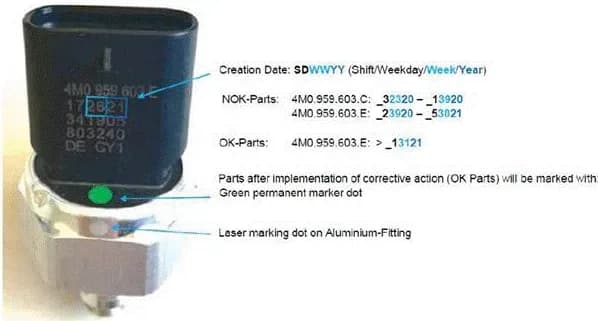
Também se aplica a
- Audi A6
- 2021–2022
- Audi A6 allroad
- 2021–2022
- Audi A7
- 2021–2022
- Audi A7 e
- 2021–2022
- Audi A8 L e
- 2021
- Audi e-tron
- 2022
- Audi e-tron GT
- 2022
- Audi Q5
- 2021
- Audi Q7
- 2021–2022
- Audi Q8
- 2021–2022
- Audi RS 6 Avant
- 2021–2022
- Audi RS 7
- 2021–2022
- Audi RS e-tron GT
- 2022
- Audi RS Q8
- 2021–2022
- Audi S6
- 2021–2022
- Audi S7
- 2021–2022
- Audi SQ5
- 2021–2022
- Audi SQ7
- 2021–2022
- Audi SQ8
- 2021–2022
▸ Mostrar mais 13▾ Mostrar menos
Symptoms
Owners of certain 2021-2022 Audi models may experience their vehicle's air conditioning system failing to cool the cabin. This issue can be intermittent, meaning the AC might work sometimes and not at others. When this condition occurs, technicians may find specific diagnostic trouble codes (DTCs) stored in the vehicle's thermal management control unit.
Fault Codes / DTCs
When the Audi AC not cooling P053000 symptom is present, one or both of the following Diagnostic Trouble Codes (DTCs) may be stored in the J1024 Thermal management control unit (address word 00C5):
| Code | Description | Module | | :--- | :---------- | | P053000 | Air conditioning system pressure sensor electrical fault | J1024 Thermal management | | P251500 | Refrigerant pressure sensor 2 electrical fault | J1024 Thermal management |
Diagnosis / Trigger Conditions
The root cause of the Audi AC not cooling P053000 and P251500 fault codes is a failure within the sensor electronics of the air conditioning pressure sensors. This electronic malfunction leads to an incorrect or lost pressure evaluation within the refrigerant circuit. The specific sensors at issue are those with base part number 4M0959603 and a build date prior to Calendar Week 31, 2021. These sensors are identified as G395 and G827 within the system.
Audi has since implemented an improved version of this sensor in production to prevent this issue in newer vehicles.
Repair Procedure Summary
If your 2021-2022 Audi exhibits the symptoms of the AC not cooling and has the associated DTCs, a technician will perform the following steps:
- Inspect Existing Sensors: The technician will first inspect all pressure sensors in the refrigerant circuit that have the base part number 4M0959603 and were manufactured before Calendar Week 31, 2021. Depending on the specific model, there can be between one and three of these sensors (G395 / G827) located in various positions on either the low or high pressure sides of the refrigerant circuit.
- Identify Improved Sensors: The technician will check the markings on each sensor. Improved sensors, produced after Calendar Week 31, 2021, can be identified by a green dot on the connector housing and a laser marking on the aluminum housing. Sensors with an 'E' index and these markings are the improved type and do not need replacement.
- Replace Faulty Sensors: Any sensor with part number 4M0959603 that has a build date before Calendar Week 31, 2021, and lacks the identifying marks of the improved version, will be replaced. The replacement involves draining and refilling the refrigerant system and may require removing other components for access, depending on the vehicle model.
Required Parts
The primary part required for this repair is the improved pressure and temperature sensor:
- Part Number: 4M0959603E
- Quantity: 1-3 (depending on the vehicle model and which sensors require replacement)
Always confirm the latest part information with your Audi Parts Department or ETKA.
Important Warnings
This Technical Service Bulletin (TSB 2068460/1) outlines a repair procedure. Warranty coverage for this repair is generally available for vehicles up to 48 months or 50,000 miles, whichever comes first. For Certified Pre-Owned (CPO) vehicles, coverage is under the G10 claim type, subject to owner verification. If your vehicle is outside of these warranty parameters, this TSB serves as informational guidance, and repair costs may apply.
Owner Action
If you own a 2021-2022 Audi and are experiencing the air conditioning system not cooling, especially if you suspect the Audi AC not cooling P053000 or P251500 fault codes, it is recommended to schedule an appointment with an authorized Audi service center. They can diagnose the issue, confirm the presence of the relevant DTCs, and perform the necessary inspection and replacement of the AC pressure sensors.
Source: NHTSA ID 10226899
Frequently Asked Questions
- What causes the 2021-2022 Audi AC not cooling issue?
- The issue is caused by a failure in the electronics of the air conditioning pressure sensors, specifically part number 4M0959603, manufactured before Calendar Week 31, 2021. This leads to incorrect pressure readings and the AC system failing to cool.
- What are the diagnostic trouble codes associated with this AC problem?
- The primary diagnostic trouble codes (DTCs) linked to this problem are P053000, indicating an 'Air conditioning system pressure sensor electrical fault', and P251500, for a 'Refrigerant pressure sensor 2 electrical fault'. These are typically stored in the J1024 Thermal management control unit.
- How can I tell if my Audi's AC pressure sensor needs replacement?
- A technician will inspect the sensors. Improved sensors, produced after Calendar Week 31, 2021, have a green dot on the connector housing and a laser marking on the aluminum housing. If your sensor lacks these marks and has the older part number and build date, it likely needs replacement.
- Will this repair be covered under warranty?
- Yes, the repair is typically covered under Audi's new vehicle limited warranty for up to 48 months or 50,000 miles. For Certified Pre-Owned (CPO) vehicles, it may also be covered under the G10 claim type. If your vehicle is outside these warranty periods, the TSB serves as informational guidance, and charges may apply.
- What is the TSB number for the Audi AC not cooling problem?
- The Technical Service Bulletin (TSB) addressing the 2021-2022 Audi AC not cooling P053000 and P251500 issue is 87 22 35 2068460/1, also referenced as 2068460.
Outras revisões deste TSB
- 2021-2022 Audi e-tron A/C Not Cooling DTCs P053000 P251500P053000, P251500
- 2020-2022 Audi AC Not Cooling: DTCs P053000, P251500P053000, P251500
- 2020-2022 Audi A/C Not Cooling: DTC P053000, P251500 TSBP053000, P251500
- 2021-2022 Audi A/C Not Cooling: DTC P053000, P251500 TSBP053000, P251500
- 2021-2022 Audi AC Not Cooling P053000 P251500P053000, P251500
- 2021-2022 Audi AC Not Cooling TSB P053000 P251500P053000, P251500
- 2020-2022 Audi AC Not Cooling: DTC P053000, P251500P053000, P251500
Related Articles
2021 Audi e-tron Electrical Malfunction and Power Loss
A 2021 Audi e-tron owner reported a severe 'Electrical Malfunction' resulting in complete loss of power on the highway. The issue has persisted despite dealer attempts to fix it over five months, posing significant safety risks.
2021-2026 Audi UTR Troubleshooting & FAQs TSB 2081409/1
This Audi Technical Service Bulletin (TSB 2081409/1) provides comprehensive answers to frequently asked questions and troubleshooting steps for the Audi Universal Traffic Recorder (UTR) accessory, covering topics like SD card compatibility, video playback, Wi-Fi issues, and more.
2021-2025 Audi Emergency Call System Fault TSB
Audi has released Technical Service Bulletin 2059528/18 to address an "Emergency call function: malfunction! Function unavailable. Please contact service" warning, often accompanied by a red SOS LED and DTC B200000. This issue affects various 2021-2025 Audi models and is due to a software problem…
2021-2026 Audi Adaptive Light System Fault C12B3FA TSB
Audi has released Technical Service Bulletin 2054202/7 to address an intermittent 'Audi adaptive light: system fault' message and DTC C12B3FA in various 2021-2026 models. This TSB outlines diagnosis and resolution for driver assistance system malfunctions.
2021-2026 Audi Parking Aid False Warnings TSB 2024323/12
This Technical Service Bulletin (TSB 2024323/12) details diagnostic and repair procedures for 2021-2026 Audi vehicles experiencing false parking aid warnings. Learn about environmental factors, sensor checks, and proper installation to resolve issues like 'Parking aid does not work / warning is…
Leave a comment
Comments are moderated and may take a moment to appear. Only your first name and the initial of your last name are shown publicly.
Comments
Be the first to comment.