2025-2026 Audi A5, S5, A6 Door Handle Release TSB
If your 2025-2026 Audi A5, S5, or A6 has an exterior door handle manual release mechanism that ejects unexpectedly, Technical Service Bulletin 2079351/2 outlines potential causes, diagnostic codes like B1908F0 and U112100, and warranty information.
 David Chen2026 Audi A6
También aplica a
- Audi A5
- 2025–2026
- Audi S5
- 2025–2026
Owners of certain 2025-2026 Audi A5, S5, and A6 vehicles may encounter an unexpected issue where the manual release mechanism for the exterior door handles ejects without any apparent reason. This behavior is detailed in Audi Technical Service Bulletin (TSB) 2079351/2, which provides guidance for diagnosing and addressing this concern. This TSB is crucial for understanding why your Audi A6 door handle release might be triggering unexpectedly.
This bulletin, identified as "57 Workshop info: manual release mechanism for exterior door handles is triggered," was initially published as Revision 1 on September 29, 2025. It was subsequently revised to Revision 2 on February 9, 2026, to update the header by adding models and revising the condition table. The TSB applies to 2025-2026 Audi A5 and S5 (FU platform), 2025 Audi A6 Sportback e-tron and S6 Sportback e-tron, and 2026 Audi A6 models.
Symptoms
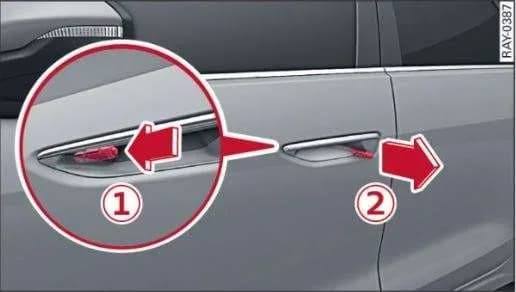
The primary symptom reported by vehicle owners is that "The manual release mechanism for the exterior door handles is ejected for no reason." This means the small pin or lever designed for emergency manual door opening pops out, as illustrated in Figure 1 of the bulletin, even when there's no actual emergency or intentional activation. This can be a surprising and inconvenient occurrence for drivers.
Fault Codes / DTCs
When the manual release mechanism ejects, specific diagnostic trouble codes (DTCs) may be logged in the vehicle's control units, providing clues to the underlying cause. Technicians will look for these codes during diagnosis.
| Code | Description | Module |
|---|---|---|
| B1908F0 | Crash response active | Door control units (0042, 0052, 00BB, 00BC) |
| U112100 | Data bus missing message - symptom: 86111 | Convenience system central module (0046) |
These codes indicate that the vehicle's systems may be detecting conditions that mimic a crash or a communication error, which can inadvertently trigger the door handle release mechanism. For example, the B1908F0 code suggests that the door control unit believes a crash response is active, leading to the release. The U112100 code points to a data bus communication issue within the convenience system.
Technical Background and Diagnosis
Audi has identified several technical reasons, beyond those described in the Owner's Manual (such as an actual accident or manual pin release), that can cause the manual release mechanism to eject. Understanding these conditions is key to properly diagnosing the Audi A6 door handle release issue.
Vehicle battery discharged/weak: A low or failing battery can cause various electrical anomalies throughout the vehicle. Insufficient voltage can lead to erratic behavior in control units, potentially triggering the door handle release as a safety precaution if the system interprets low power as a fault condition. This can result in unexpected system responses across different modules.
Driver's door unlocked via emergency power supply at front bumper: If the driver's door was manually unlocked using the emergency power supply located at the front bumper, this action might be misinterpreted by the vehicle's systems. The system could register an unusual state, leading to the ejection of the manual release mechanism as a protective or default action.
Missing signals from airbag (fallback function relating to crash detection): The airbag system is intricately linked to crash detection and vehicle safety protocols. If signals from the airbag control unit are missing or corrupted, the vehicle's safety systems might activate fallback functions, including the door handle release, under the assumption of a potential crash scenario. This is a critical safety measure that can be inadvertently triggered by signal issues.
Sudden interruption of a diagnostic session while terminal 15 is switched on: During diagnostic procedures, if the ignition (Terminal 15) is on and the diagnostic session is abruptly interrupted, it can confuse the control units. This unexpected interruption can lead to system errors that manifest as the door handle release mechanism ejecting, as the system may enter an undefined state.
Unplugging of control units involved in signal transmission while terminal 15 is activated: Disconnecting critical control units while the ignition is on can disrupt the vehicle's communication network. The TSB specifically mentions several control units whose unplugging can cause issues: the airbag control unit, J1312 control unit for drive system and running gear functions (HCP1), J1273 central control unit for data bus communication (HCP5), J519 onboard supply control unit (HCP4), the door control unit, and the exterior door handle itself. Unplugging any of these while active can cause a cascade of errors, including the unexpected door handle release.
Implausible signal chain of verified messages when programming the VKMS (vehicle key management system): Issues during the programming of the Vehicle Key Management System (VKMS) can lead to incorrect or "implausible" signal chains. If the VKMS receives or transmits verified messages that are inconsistent, it can trigger erroneous safety or operational responses, potentially including the door handle release mechanism.
Service Procedure Summary
For technicians addressing the "57 Workshop info: manual release mechanism for exterior door handles is triggered" issue, the first step is to thoroughly check if any of the causes listed under the Technical Background section could have applied. It's important to note that workshop activities themselves can sometimes lead to the manual release mechanisms being ejected.
Technicians should review event memory entries logged in various diagnostic addresses. These entries, along with their corresponding date and time, can provide crucial indications about the cause of the complaint. Examples of such entries include "Wiring-related entries" and "Airbag signal message failures." If these or other event memory entries suggest the issue occurred due to other causes, technicians are advised to consult workshop materials for further diagnosis and resolution.
If, however, there are no further indications of an underlying cause, or if the manual release mechanisms were triggered during the workshop visit itself, the procedure is straightforward: re-insert the pins for the manual release mechanism. Technicians should refer to the Owner's Manual for instructions on how to properly re-insert these pins. Importantly, the TSB states that it is not necessary to perform further checks on the manual release mechanisms if this is the case. This guidance helps prevent unnecessary diagnostic time and part replacements.
Warranty Information
Owners should be aware of the warranty implications for this specific issue. According to TSB 2079351/2, the reasons listed under the "Technical Background" section—such as a weak battery, emergency unlocking, missing airbag signals, diagnostic session interruptions, unplugging control units, or VKMS programming issues—are explicitly stated as not a fault covered under warranty.
For other potential causes, such as wiring-related issues or failures due to control units involved in transmitting signals, these must be billed separately via the corresponding service number. The bulletin clearly states: "It is not possible to bill for fault finding and/or component replacement under warranty via this TSB." This means that if the door handle release occurs due to one of the conditions outlined in the TSB's technical background, the associated diagnostic and repair costs will likely not be covered under the standard vehicle warranty. Owners should discuss this with their Audi service center to understand potential charges.
Source: NHTSA ID: 2079351/2
Frequently Asked Questions
- What does it mean if my Audi's exterior door handle manual release ejects unexpectedly?
- This means the emergency pin or lever on your exterior door handle has popped out without you intentionally activating it or due to an accident. Audi TSB 2079351/2 addresses this specific issue for 2025-2026 A5, S5, and A6 models.
- What are the common causes for the Audi A6 door handle release issue?
- The TSB lists several potential causes, including a weak vehicle battery, emergency unlocking via the front bumper, missing airbag signals, interruptions during diagnostic sessions, unplugging control units while the ignition is on, or issues during Vehicle Key Management System (VKMS) programming.
- Are repairs for the unexpected door handle release covered under warranty?
- According to TSB 2079351/2, the reasons listed under 'Technical Background' (such as battery issues or diagnostic interruptions) are generally not covered under warranty. Other causes, like wiring faults or control unit failures, may be billed separately. It is explicitly stated that 'It is not possible to bill for fault finding and/or component replacement under warranty via this TSB' for the specific conditions outlined.
- What should I do if my 2025-2026 Audi A5, S5, or A6 door handle releases unexpectedly?
- If you experience this issue, it's recommended to have your vehicle inspected by an authorized Audi service center. They can check for diagnostic trouble codes like B1908F0 or U112100 and evaluate the technical background conditions. If no other cause is found or if it occurred during workshop activity, the pins for the manual release mechanism can be re-inserted as per the Owner's Manual.
Otras revisiones de este TSB
- 2025 Audi Q5 Software Update for Electrical System WarningsU112100
- 2025 Audi A5 / A6 e-tron Exterior Door Handle Ejection TSBB1908F0, U112100
- 2025 Audi Q5 / SQ5 Software Update for Various Error MessagesU112100
- 2022-2024 Audi A3, S3, RS 3 Exterior Lighting Warning TSBU112100
- 2022-2024 Audi e-tron GT U112100 Suspension DTC TSBU112100
- 2022-2024 Audi e-tron GT DTCs U110E00, U110100, U112100U112100
- 2021-2024 Audi e-tron Ghost DTCs in HV Charger ECUU112100
- 2021-2025 Audi Air Suspension Malfunction Warning TSBU112100
Related Articles
2025-2026 Audi Drive System Fault DTC P119A00 P119B00
Audi has issued Technical Service Bulletin 2081542/1 for 2025-2026 A6, S5, and SQ5 models experiencing a 'Drive system fault' and storing DTCs P119A00 or P119B00. This is a known software issue, and a solution is anticipated by Q2 2026. Owners are advised against component replacement.
2025-2026 Audi Rear Lid Malfunction TSB 2081508/1
Audi has released Technical Service Bulletin (TSB) 2081508/1, a Pending Service Solution (PSS 55), concerning a rear lid malfunction in certain 2025-2026 Audi A5, S5, Q5, SQ5, and A6 models. Owners may experience the rear lid not opening or closing fully, or closing too quickly. This TSB outlines…
2025-2026 Audi Software Update 03.11.00/C Overview
Audi TSB 2081477/1 details the planned introduction dates for the combined software update 03.11.00/C PPE/PPC KD2 for various 2025-2026 Audi models. This informational bulletin outlines new software versions and affected platforms.
2025-2026 Audi Radiator Fan Fault P1A7B00 TSB
Audi has released Technical Service Bulletin 2081427/1 to address a check engine light (MIL) and unusual radiator fan behavior, often accompanied by DTC P1A7B00, in certain 2025-2026 A5, S5, Q5, SQ5, and 2026 A6 models. The fix involves configuring the HCP4 control unit.
2025-2026 Audi Time Changes Automatically While Driving
Audi has issued Technical Service Bulletin 2081404/1 addressing a software issue in 2025-2026 A5, Q5, and A6 models where the vehicle's clock automatically changes by an hour while driving. This TSB explains that a permanent fix is expected by late 2026, and no component replacement is needed.
Leave a comment
Comments are moderated and may take a moment to appear. Only your first name and the initial of your last name are shown publicly.
Comments
Be the first to comment.