2020-2022 Hyundai Push-Button Shifter Diagnosis TSB
This Technical Service Bulletin (TSB) 21-AT-009H addresses diagnosis procedures for automatic transaxle push-button shifter operation in various 2020-2022 Hyundai models. It covers symptoms, diagnostic steps using the GDS, and potential repairs.
 David Chen2022 Hyundai Tucson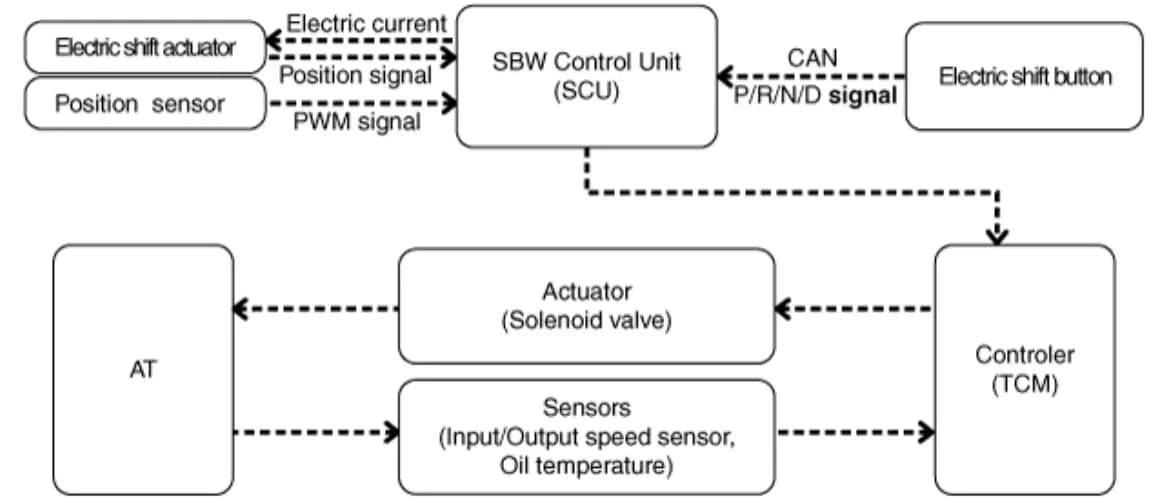
Also applies to
- Hyundai Palisade
- 2021
- Hyundai Santa Fe
- 2021–2022
- Hyundai Sonata
- 2021–2022
Hyundai has released Technical Service Bulletin (TSB) 21-AT-009H to provide a comprehensive diagnostic procedure for issues related to the automatic transaxle push-button shifter. This TSB is crucial for technicians to accurately identify and address operational problems with the shifter system in various Hyundai models, including the 2020-2022 Hyundai Tucson, Santa Fe, Sonata, and Palisade. Owners searching for a Hyundai Tucson shifter diagnosis will find this information helpful.
Symptoms
Owners may notice their push-button shifter not operating as expected, such as an inability to select gears (P, R, N, D) or incorrect gear display on the instrument cluster. This TSB specifically addresses the diagnosis of the shifter's operation, which can manifest as incorrect gear selection, inability to shift, or other related malfunctions. The diagnostic process aims to pinpoint whether the issue lies with the SBW (Shift-By-Wire) lever, control unit, actuator, or related wiring.
Fault Codes / DTCs
For specific models, certain Diagnostic Trouble Codes (DTCs) may indicate a problem with the push-button shifter system. For the Palisade (LX2) model, the following DTCs are particularly relevant to the SBW system:
| DTC | Description | TSB Reference |
|---|---|---|
| P106D00 | Actuator initialization error | 21-AT-008H – SCU Update |
| P106D71 | Actuator motor stuck error | 21-AT-008H – SCU Update |
| U110382 | SBW lever alive counter error | 21-AT-008H – SCU Update |
If these DTCs are found in a Palisade (LX2), TSB 21-AT-008H is referenced for a potential SCU (SBW Control Unit) update.
Parts Information
When components of the push-button shifter system require replacement, refer to the parts catalog using the following PNCs (Parts Number Codes) to ensure correct part numbers are ordered:
- SBW Lever: PNC 46700, Part Number 467W0-*****
- SBW Control Unit (SCU): PNC 42950 or 42951, Part Number 42950-***** or 42951-*****
- SBW Actuator: PNC 42910, Part Number 42910-*****
- Position sensor: PNC 42700, Part Number 42700-*****
NOTE: TSB 21-AT-007H provides specific procedures for replacing the position sensor or SBW actuator.
Warranty Information
This service bulletin applies under normal warranty conditions. The following operation codes are provided for warranty claims:
- Position sensor: Op Code 42700R00
- SBW lever: Op Code 46700R00
- SBW Actuator: Op Code 42910R00
- SBW Control Unit: Op Code 42950R00
- Engine control unit: Op Code 39110R00
- Transmission control unit: Op Code 95440R00
- Hybrid Additional: Op Code 42700RH1
- GDS (Global Diagnostic System): Op Code 42700RQ0
The Causal Code for these operations is ZZ3, and the Nature Code is 13A.
Diagnosis and Repair Procedure Summary
Diagnosis for the automatic transaxle push-button shifter involves using the Global Diagnostic System (GDS). The process outlined in TSB 21-AT-009H guides technicians through a series of diagnostic steps:
- Initial Scan: Connect a GDS and perform a "Fault Code searching" scan for "All" systems. Record any Diagnostic Trouble Codes (DTCs) and their descriptions, then delete the DTCs.
- DTC-Specific Actions:
- If DTCs are found in any model, refer to the related shop manual's "E-Shifter" or "SBW Control Unit" section for repair guidance.
- Specifically for the Palisade (LX2), if DTCs P106D00, P106D71, or U110382 are present, refer to TSB 21-AT-008H for an SBW Control Unit (SCU) update.
- SBW Lever Data Analysis: Start the engine. From the GDS home screen, select "Data Analysis" and then the "A/T menu". Push the shift buttons to change gears (P, R, N, D). Observe if the cluster and GDS data show the correct gear. If correct, the TCU received proper signals, and the SBW lever and harness are functioning. Proceed to Step 4. If the correct lever position is not shown, the SBW lever or related harness may have a fault. If no damage or loose pins are found in the harness, the SBW lever should be replaced.
- SCU Data Analysis: Start the engine. From the GDS home screen, select "Data Analysis" and then the "SCU menu". Push the shift buttons to change gears. Check if the GDS data shows both "Correct Target Lever Position" and "Actual Lever Position". If both are correct, the SCU commanded the SBW actuator correctly, and the actuator, position sensors, and harness are functioning. Proceed to Step 5. If the "Target Lever Position" is incorrect, the SCU or harness may have a fault. If the "Actual Lever Position" is incorrect, the SBW actuator or harness may have a fault. Note that the "Motor Feedback Current" should briefly show voltage when a shift button is pressed, and the sum of "Position sensor 1 and 2" readings should be approximately 100%.
- SCU Actuation Test: Turn the engine off and press the start button twice without pressing the brake pedal to turn the ignition ON. Press the brake pedal. From the GDS home screen, select "Actuation Test" and then the "SCU menu". Test the "Target position" for P, R, N, and D. If the GDS and cluster show the "Correct Target Position", the SCU, SBW actuator, and harness are operating correctly. Proceed to Step 6. If the "Target Position" is incorrect, the SCU, SBW actuator, or related harness may have a fault.
- Wiring Harness Inspection: If Steps 3-5 do not reveal a fault, visually inspect the wiring harness between the PCM or TCU and the transmission for any damage, open/short circuits, or damaged/loose pins. If damage is found, repair or replace the harness and test drive the vehicle. If no damage is found, proceed to Step 7.
- Intermittent Issue: If no faults were found in Steps 3-5 and the issue cannot be duplicated, it may be an intermittent problem. Contact Hyundai Techline for further advice. This comprehensive Hyundai Tucson shifter diagnosis ensures all potential causes are investigated.
SBW System Overview
The Shift-By-Wire (SBW) system relies on four main components to enable gear shifting: the electric shift actuator, position sensor, SBW Control Unit, and the electric shift button. Additionally, the Powertrain Control Module (PCM) or Transmission Control Unit (TCU) is required to select the correct transmission solenoids. The SBW Control Unit receives input from the electric shift button and the position sensor, processes this information, and sends signals to the actuator and the Controller (TCM) via the CAN/P/R/N/D signal to facilitate gear changes.
Source: NHTSA ID 10200877
Gallery
5 images
Frequently Asked Questions
- What is TSB 21-AT-009H about?
- TSB 21-AT-009H provides a detailed diagnostic procedure for technicians to troubleshoot problems with the automatic transaxle push-button shifter in various Hyundai models, including the 2020-2022 Hyundai Tucson, Santa Fe, Sonata, and Palisade.
- What are common fault codes associated with the push-button shifter?
- For the Hyundai Palisade (LX2), specific fault codes like P106D00 (Actuator initialization error), P106D71 (Actuator motor stuck error), and U110382 (SBW lever alive counter error) are listed in TSB 21-AT-009H, indicating potential issues with the SBW system.
- Will I receive a recall notice for this issue?
- TSB 21-AT-009H is a Technical Service Bulletin, not a recall. This means Hyundai is providing diagnostic and repair guidance to dealerships for known issues, but owners are typically not notified directly unless they report a specific symptom or a related recall is issued.
- What should I do if my Hyundai Tucson shifter diagnosis indicates a problem?
- If your Hyundai Tucson shifter diagnosis reveals a problem, your dealership will follow the procedures outlined in TSB 21-AT-009H. This may involve using the GDS for data analysis and actuation tests, and potentially replacing components like the SBW lever, control unit, actuator, or position sensor, as well as checking wiring harnesses.
- Are there other TSBs related to the push-button shifter?
- Yes, TSB 21-AT-009H references TSB 21-AT-007H for specific replacement procedures concerning the position sensor or SBW actuator, indicating a broader set of service information available for these components.
Other revisions of this TSB
Related Articles
2021-2024 Hyundai Santa Fe / Tucson DTC U028700 EOP
Hyundai has issued Technical Service Bulletin (TSB) 26-AT-002H for certain 2021-2024 Santa Fe and Tucson vehicles. This TSB addresses diagnostic trouble code U028700, indicating a "Lost Communication With Trans Fluid Pump Module," which can cause the Idle Stop & Go (ISG) system to become…
2022 Hyundai Tucson Inoperable Horn Warranty Extension
Hyundai has issued a warranty extension for certain 2022 Tucson (NX4A) vehicles experiencing an inoperable horn. This issue, detailed in TSB 26-BE-004H, is caused by foreign substances oxidizing internal horn parts. Coverage is extended to 10 years/120,000 miles.
2022 Hyundai Tucson Inoperative Horn TSB 26-BE-004H
Hyundai has issued Technical Service Bulletin 26-BE-004H for certain 2022 Tucson (NX4A) vehicles experiencing an inoperative horn. This TSB extends warranty coverage to 10 years/120,000 miles for horn replacement due to internal oxidation from foreign substances.
2021-2022 Hyundai Anti-Theft Ignition Cylinder Protector TSB
Hyundai has issued Technical Service Bulletin 25-01-089H (Customer Satisfaction Campaign P33) to address vehicle theft concerns by installing an anti-theft ignition cylinder protector and anti-theft decals on various 2021-2022 models.
2021-2022 Hyundai Anti-Theft Ignition Cylinder Protector Campaign P33
Hyundai has launched Customer Satisfaction Campaign P33 for 2021-2022 models, offering a free anti-theft ignition cylinder protector and decals. This hardware upgrade, detailed in TSB 25-01-089H, is available upon customer request to counter social media theft methods.
Leave a comment
Comments are moderated and may take a moment to appear. Only your first name and the initial of your last name are shown publicly.
Comments
Be the first to comment.