2021-2025 Audi Instrument Cluster Fault (DTC B200049)
Audi has issued Technical Service Bulletin (TSB) 2068380/7 to address instrument cluster faults and black screens in various 2021-2025 models. This issue, often indicated by DTC B200049, is caused by a hardware discrepancy and may require instrument cluster replacement.
 David Chen2021 Audi Q8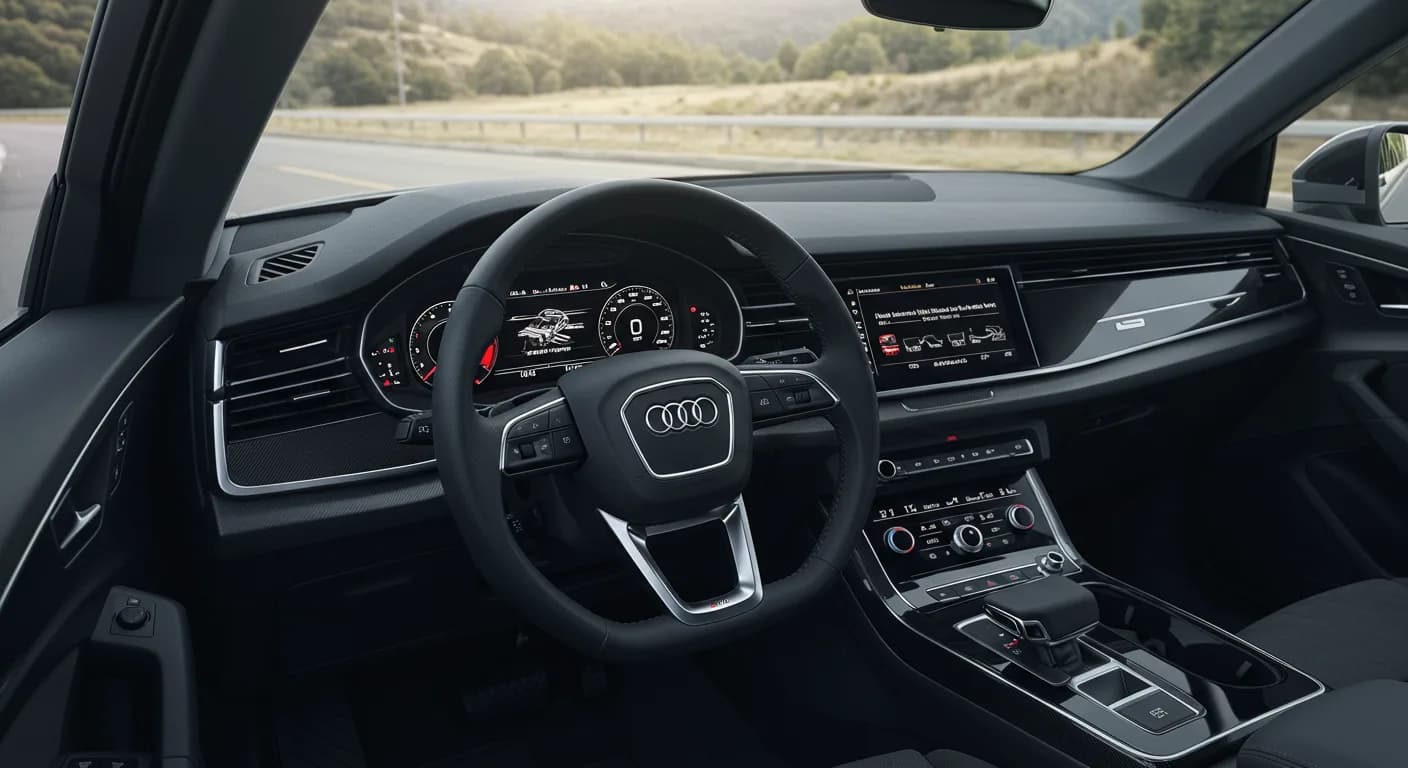
Also applies to
- Audi A6
- 2021–2025
- Audi A6 allroad
- 2021–2025
- Audi A7
- 2021–2025
- Audi A7 e
- 2021–2022
- Audi A8 L e
- 2021
- Audi Q3
- 2024–2025
- Audi Q7
- 2021–2025
- Audi Q8
- 2022–2025
- Audi RS 6 Avant
- 2021–2025
- Audi RS 7
- 2021–2025
- Audi RS Q8
- 2021–2025
- Audi S6
- 2021–2025
- Audi S7
- 2021–2025
- Audi S8
- 2021–2025
- Audi SQ7
- 2021–2025
- Audi SQ8
- 2021–2025
▸ Show 10 more▾ Show fewer
Audi has released Technical Service Bulletin (TSB) 2068380/7 to address concerns regarding the instrument cluster in several 2021-2025 models. Owners may experience a faulty instrument cluster or a black screen upon starting the vehicle. This TSB outlines the diagnostic steps and the necessary repair for this specific condition.
Symptoms
Owners of affected Audi vehicles, such as the Audi Q8, may notice the following issues:
- A warning message displayed in the instrument cluster stating: "Instrument cluster: fault. Limited warning messages. Please contact workshop."
- The Audi Virtual cockpit appearing completely black when the vehicle is started.
These symptoms indicate a potential problem with the instrument cluster's functionality.
Fault Codes / DTCs
When diagnosing this issue, technicians may find the following Diagnostic Trouble Code (DTC) stored in the Instrument Cluster control module (J285, diagnostic address 0017):
| Diagnostic Trouble Code | Description | Symptom Code |
|---|---|---|
| B200049 | Control module faulty Internal electrical malfunction | 10485833 |
This DTC B200049 specifically points to an internal electrical malfunction within the instrument cluster control module.
Technical Background
According to Audi, the root cause of this problem is a hardware issue within the Audi virtual cockpit. This discrepancy stems from the production process of the instrument cluster components. An optimized instrument cluster hardware design was implemented for units produced on or after August 1, 2024.
Diagnosis and Repair Procedure
For an Audi Q8 instrument cluster fault, the repair procedure involves checking the production date of the existing instrument cluster. If the instrument cluster was produced before August 1, 2024, it will need to be replaced.
- Check Production Date: A technician will use a self-diagnosis tool to access diagnostic address 17 (Instrument Cluster control module). They will then navigate to the control module OBD dropdown, select "Identification," and click "show expanded identification." Expanding the "Fazit identification" will reveal the "Day of manufacture" for the instrument cluster.
- Instrument Cluster Replacement: If the production date of the instrument cluster is before August 1, 2024, the instrument cluster must be replaced. This replacement should be performed according to the instructions detailed in the ELSA repair manual.
Required Parts and Tools
To perform the repair, the following parts are typically required:
- Instrument Cluster: Quantity 01
- Fasteners, Bolts, Nuts, and Screws: As needed, per the repair manual.
Technicians should consult ETKA (Electronic Parts Catalog) and/or their Parts Department for the most current information and part bulletins.
Warranty Information
This Technical Service Bulletin 2068380/7 specifies that if the vehicle is outside of any applicable warranty, the bulletin serves as informational guidance only. For warranty claims, the following codes are used:
- Service Number: 9025
- Damage Code: 0040
- Labor Operations:
- Remove and replace dash panel insert: 9025 XXXX
- Self-diagnosis (document production date): 0129 0050
- GFF (Guided Fault Finding): 0150 0060
- Claim Comment: As per TSB 2068380/7
All warranty claims must comply with the Audi Warranty Policies and Procedures Manual.
Important Warnings
This TSB has a release date of July 31, 2025, indicating it is a forward-looking or pre-release document. Owners should be aware that the optimized instrument cluster hardware was implemented starting August 1, 2024. If your vehicle experiences an Audi Q8 instrument cluster fault and was manufactured with an older instrument cluster, replacement is the recommended solution.
NHTSA ID: 11021445
Frequently Asked Questions
- What does DTC B200049 mean for my Audi?
- DTC B200049 indicates an internal electrical malfunction within the instrument cluster control module. This code is often associated with symptoms like a black virtual cockpit screen or the message "Instrument cluster: fault. Limited warning messages. Please contact workshop."
- What should I do if my Audi's instrument cluster is black or shows a fault message?
- If your 2021-2025 Audi's instrument cluster is black or displays a fault message, it is recommended to contact an authorized Audi workshop. They can diagnose the issue, check for DTC B200049, and determine if your instrument cluster needs replacement based on its production date, as outlined in TSB 2068380/7.
- Is the instrument cluster replacement covered under warranty?
- The instrument cluster replacement may be covered under your Audi's warranty, depending on the terms and conditions. If your vehicle is outside of warranty, Technical Service Bulletin 2068380/7 is for informational purposes only. It's best to consult with your Audi dealer regarding warranty coverage.
- How can I tell if my Audi's instrument cluster is affected by this issue?
- The issue primarily affects instrument clusters manufactured before August 1, 2024. A technician can check the exact production date of your instrument cluster using diagnostic tools. If your vehicle is a 2021-2025 Audi and exhibits symptoms like a black screen or fault messages, it may be affected.
Other revisions of this TSB
- 2021 Audi Virtual Cockpit Display Fault TSB 2078439/2B200049
- 2021 Audi Virtual Cockpit Display Black or Fault Message TSBB200049
- 2021-2025 Audi Instrument Cluster Fault DTC B200049B200049
- 2021-2024 Audi Virtual Cockpit Blank Display TSB 2068380/4B200049
- 2022-2024 Audi Virtual Cockpit Blank Display TSBB200049
- 2021-2024 Audi Virtual Cockpit Blank Display TSB 2068380/3B200049
- 2021-2022 Audi Red Steering Warning DTC B200049B200049
- 2021 Audi Q7/Q8 Red Steering Warning DTC B200049B200049
Related Articles
2021-2025 Audi Engine Control Module Software Update 53ZC
Audi has issued an update to its Engine Control Module (ECM) software campaign 53ZC / WARR EXT – U82, dated March 20, 2026. This dealer communication indicates that additional vehicles have been added to the affected chart for this important software update. Owners of 2021-2025 Audi Q8, A7, A6…
2021-2025 Audi Fuel System DTCs P014800 and P008700
Audi Technical Service Bulletin (TSB) 2079461/3 details diagnostic and repair procedures for 2021-2025 Audi vehicles experiencing a 'MIL light on' or 'limp-home function' due to fuel system DTCs P014800 or P008700. This bulletin guides technicians on diagnosing and potentially replacing the…
2021-2025 Audi Black Trim Discoloration TSB
Audi has issued Technical Service Bulletin 2078651/4 to address red, purple, gray, or metallic discoloration on black exterior trim strips in 2021-2025 Audi models. This TSB explains the cause (paint UV resistance issue) and outlines the replacement procedure for affected components.
2021 Audi Virtual Cockpit Display Fault TSB 2078439/2
Audi TSB 2078439/2 addresses issues with the virtual cockpit display in 2021 A6, A7, A8, Q7, Q8 models, including a black screen or "Instrument cluster: fault" message, often accompanied by DTC B200049.
2021-2026 Audi TFSI Engine Oil Leak TSB 2053278/10
Audi has released Technical Service Bulletin 2053278/10 to address oil leaks from the cylinder head on 2.9 and 3.0 TFSI engines in various 2021-2026 models. Learn about symptoms, diagnosis, and the recommended repair process.
Leave a comment
Comments are moderated and may take a moment to appear. Only your first name and the initial of your last name are shown publicly.
Comments
Be the first to comment.