2022-2023 Audi Q3/Q5/Q7 P240700 MIL On TSB
Audi Technical Service Bulletin 2071770/9 addresses the 'MIL on' condition and DTC P240700 'EVAP emission control system leakage diagnosis pump current fluctuating' in 2022-2023 Audi Q3, Q5, and Q7 models, resolved by a software update.
 Sarah Mitchell2023 Audi Q7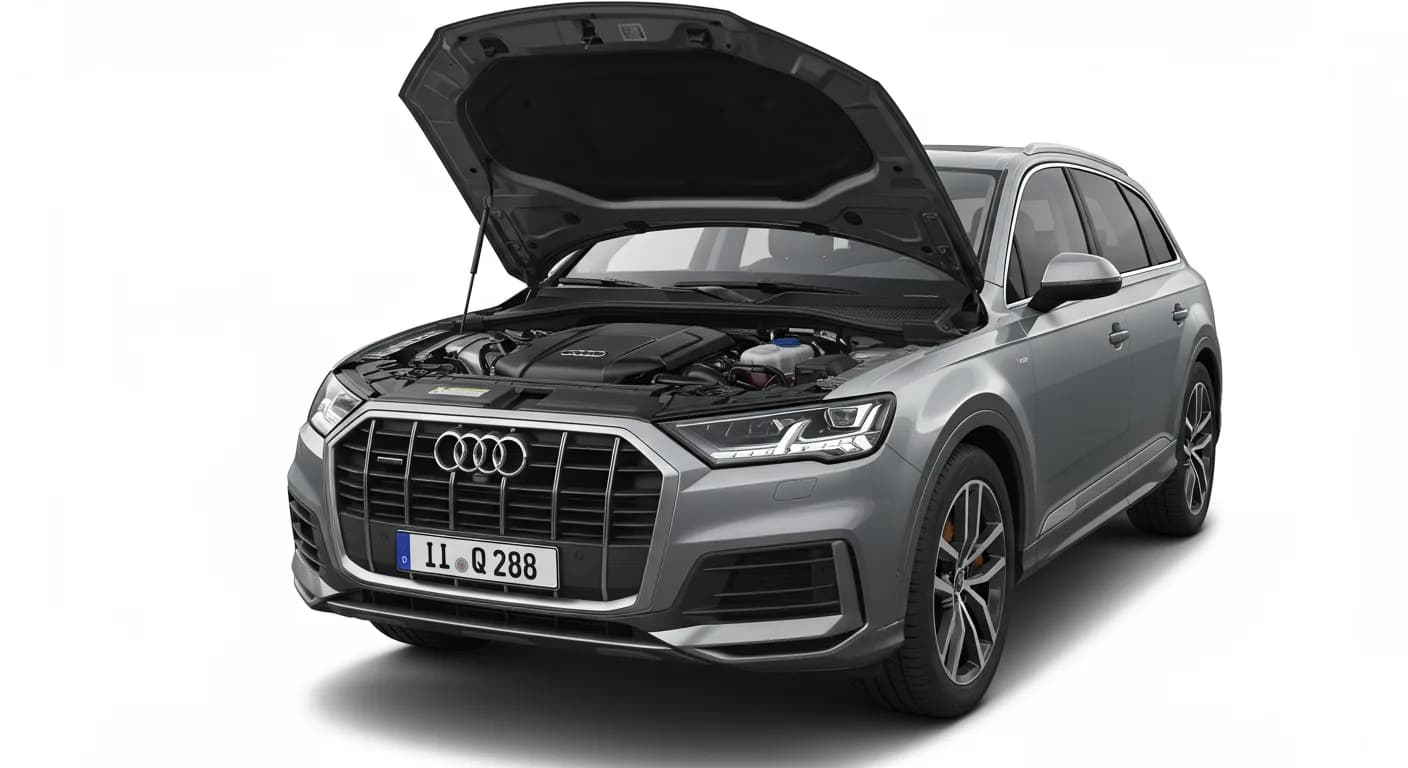
Also applies to
- Audi Q3
- 2022–2023
- Audi Q5
- 2022–2023
- Audi Q7
- 2022
Symptoms
Owners of 2022-2023 Audi Q3, Q5, and Q7 vehicles may experience the Malfunction Indicator Lamp (MIL) illuminated on their dashboard. This is the primary symptom associated with the condition described in Technical Service Bulletin 2071770/9.
Fault Codes / DTCs
When the MIL is illuminated, a diagnostic scan of the Engine Control Module (-J623-, address word 0001) will reveal the following Diagnostic Trouble Code:
- P2407 (P240700): "EVAP emission control system leakage diagnosis pump current fluctuating"
No other relevant event memory entries are typically logged in the engine control unit for this specific issue.
Important Warnings for High-Voltage Vehicles
For Audi Q5 PHEV models, which include high-voltage components, a critical step must be followed during the software update. To prevent potential damage to the high-voltage components, the high-voltage cable must be removed before the SVM (Software Version Management) code is entered. Charging the high-voltage battery during a software update can cause damage.
Diagnosis
The root cause of the illuminated MIL and the "Audi Q7 P240700 MIL on" condition is identified as overly sensitive On-Board Diagnostics (OBD) for the EVAP system. This sensitivity leads to the erroneous detection of a "leakage diagnosis pump current fluctuating" fault, even when no actual mechanical issue is present in the EVAP system.
Repair Procedure Summary
The permanent solution for this condition involves updating the software in the Engine Control Module (-J623-, address word 0001). This new software addresses the overly sensitive OBD diagnostics, preventing the false triggering of the P240700 DTC. The repair procedure requires following the instructions in TSB 2011732, which covers Software Version Management (SVM) operating procedures. The SVM action code 01A320 is used to perform the update.
Specific software part numbers and versions are updated depending on the model and model year:
- Q7 2.0I MY2023: Old software part number 4M0.906.259.AB (versions 0002, 0003, 0004) is updated to new software part number 4M0.906.259.AB (version 0005).
- Q7 2.0I MY2022: Old software part number 4M0.906.259.AE (version 0001) is updated to new software part number 4M0.906.259.AE (version 0002).
- Q3 MY2022: Old software part number 83A.906.259.D (version 0001) is updated to new software part number 83A.906.259.D (version 0002).
- Q3 MY2023: Old software part number 83A.906.259.F (version 0001) is updated to new software part number 83A.906.259.F (version 0002).
- Q5 MY2022: Old software part number 80A.906.259.AB (version 0002) is updated to new software part number 80A.906.259.AB (version 0003).
- Q5 PHEV MY2022: Old software part number 80A.906.259.AA (version 0001) is updated to new software part number 80A.906.259.AA (version 0002).
- Q5 MY2023: Old software part number 80A.906.259.AE (versions 0002, 0003) is updated to new software part number 80A.906.259.AE (version 0004).
- Q5 PHEV MY2023: Old software part number 80A.906.259.AD (version 0001) is updated to new software part number 80A.906.259.AD (version 0002).
Required Tools
To perform the software update, technicians will need a VAS tester with the current version of ODIS (Windows 10), specifically models VAS 6160 or VAS 6150.
Warranty Information
This Technical Service Bulletin (TSB 2071770/9) provides guidance for addressing the "Audi Q7 P240700 MIL on" issue. If your vehicle is outside of its warranty period, this TSB is for informational purposes only, meaning the repair may not be covered free of charge. All warranty claims must adhere to the Audi Warranty Policies and Procedures Manual. The service number associated with this bulletin is 2048, and the damage code is 0040.
Superseded Bulletins
This current Technical Service Bulletin, 01 24 47 2071770/9, supersedes previous bulletins addressing the same issue. It replaces Technical Service Bulletin Group 01 number 24-33, dated August 27, 2024. It also replaces Pending Service Solution (PSS) TSB 2066675, which covered the "MIL on DTC P240700 Evap leak detection pump circuit" for 2022 and 2023 Audi Q5, Q5 PHEV, Q7 2.0I, and Q3 vehicles.
NHTSA ID: 11012475
Frequently Asked Questions
- What does the DTC P240700 'EVAP emission control system leakage diagnosis pump current fluctuating' mean?
- This diagnostic trouble code indicates that the vehicle's Engine Control Module has detected an anomaly in the current readings from the EVAP (Evaporative Emission Control System) leakage diagnosis pump. In the case of Audi models covered by TSB 2071770/9, this is often a false alarm caused by overly sensitive diagnostic software rather than a physical leak.
- Which Audi models and years are affected by the P240700 MIL on issue?
- This issue primarily affects 2022-2023 Audi Q3, Q5, and Q7 models, including Q5 PHEV variants. The specific software update required varies by model and model year.
- How is the 'MIL on' with DTC P240700 resolved for these Audi vehicles?
- The resolution involves a software update to the Engine Control Module (-J623-) using the SVM action code 01A320. This update recalibrates the OBD diagnostics to prevent the false triggering of the P240700 fault code.
- Is there anything special to know for Audi Q5 PHEV owners regarding this repair?
- Yes, for Q5 PHEV models, it is crucial that the high-voltage cable is removed before the SVM code is entered during the software update. This prevents potential damage to the high-voltage components from unintended battery charging during the process.
Other revisions of this TSB
- 2022-2025 Audi Models MIL On DTC P240700 TSBP240700
- 2022-2023 Audi MIL On DTC P240700 Fuel Tank SystemP240700
- 2022-2023 Audi MIL on DTC P240700 Evap LeakP240700
- 2022-2023 Audi Q7/Q5/Q3 MIL On for DTC P240700P240700
- 2022-2023 Audi Q3, Q5, Q7 MIL On for DTC P240700P240700
- 2022-2023 Audi MIL on DTC P240700 Evap LeakP240700
- 2022-2023 Audi Q5 PHEV, Q3, Q7 MIL On with DTC P240700P240700
- 2022-2023 Audi Q3, Q5 e, Q7 MIL On with DTC P240700P240700
Related Articles
2021-2026 Audi Q7/SQ7 Power Closing Door Latch Inoperative TSB
Audi has released Technical Service Bulletin (TSB) 2058159/7 to address an intermittent issue with the power closing door latch system in 2021-2026 Audi Q7 and SQ7 models. This condition can also trigger an electronic parking brake warning in the instrument cluster.
2023 Audi Q7 / SQ7 P275300 Transmission Fluid Cooler Hotfix
Audi has issued Service Information AOS-26-09 for 2023 Q7 and SQ7 vehicles. This hotfix addresses the P275300 Transmission Fluid Cooler Circuit/Open fault, which previously lacked a diagnostic test plan in ODIS, ensuring proper diagnosis and repair.
2023 Audi Q7 Panoramic Sunroof Creaking Noise TSB
If your 2023 Audi Q7 with a panoramic sunroof is making creaking or cracking noises, Technical Service Bulletin (TSB) 2080568/1 outlines a procedure to resolve it. The issue stems from unfavorable tolerances between the inner acoustic seal and the guide rail.
2023 Audi Q7 Engine Start Delay TSB 2079917/1
Audi has released Technical Service Bulletin (TSB) 2079917/1 for the 2023 Audi Q7 45 TFSI, addressing instances where the engine can only be started with a delay. This issue is often accompanied by fault codes P157000 or P164000, indicating an engine control module problem.
2022-2025 Audi Q7/SQ7 Sunroof Roller Blind Malfunction TSB
Audi Technical Service Bulletin 2077195/1 addresses a common issue in 2022-2025 Audi Q7 and SQ7 vehicles where the sunroof roller blind gets stuck. The TSB identifies broken sliders (part number 4M0877307B) as the cause, often due to excessive force, and clarifies that this repair is not covered…
Leave a comment
Comments are moderated and may take a moment to appear. Only your first name and the initial of your last name are shown publicly.
Comments
Be the first to comment.