2021-2023 Audi Q8 Corroded Splice Points TSB
Audi has issued Technical Service Bulletin (TSB) 2067785/2 for 2021-2023 Q8, SQ8, and RS Q8 models concerning various electrical issues and diagnostic trouble codes (DTCs) caused by corroded splice points in the driver's sill area. This TSB outlines the diagnostic and repair procedures.
 Marcus Weber2021 Audi Q8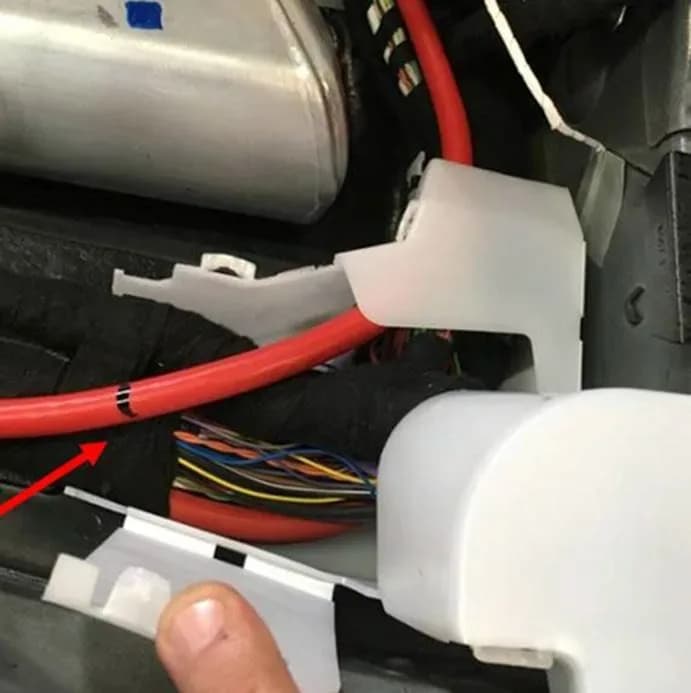
Também se aplica a
- Audi Q8
- 2022–2023
- Audi RS Q8
- 2021–2023
- Audi SQ8
- 2021–2023
Revision History
Technical Service Bulletin 97 22 86 2067785/2, issued on August 29, 2022, supersedes the previous Technical Service Bulletin Group 97 number 22-85 dated August 26, 2022. The revision history includes:
- Revision 1 (August 26, 2022): Initial publication.
- Revision 2 (Undated): Revised Warranty (updated claim types).
Symptoms
Owners of 2021-2023 Audi Q8, SQ8, and RS Q8 vehicles may experience a range of electrical and functional problems due to corroded splice points in the driver's sill area. These issues can manifest as various functional issues, instrument cluster messages, and display failures. Lighting and other operational issues, including problems with the ambient lighting or the MMI (Multi Media Interface), are also common.
In severe cases, the vehicle may not be possible to start. Technicians often find that the fuse block at the driver's side footrest (SB) has low or no voltage to one or more circuits. Other observed symptoms include an inoperative driver's seat, an illuminated check engine lamp, and limited function of the ambient lighting. The root cause of these diverse symptoms is often the same: corroded splice points, which is the focus of this Audi Q8 corroded splice points TSB.
Technical Background
Audi has identified that in climates where road salts are used to melt snow, heavy salt concentrations can enter the vehicle between the driver-side sill and carpet. When this mixture comes into contact with the body harness, it can cause the splice points in the driver's sill location to oxidize. This oxidation leads to poor electrical connections, resulting in the various functional issues and diagnostic trouble codes experienced by owners.
Fault Codes / DTCs
When diagnosing the issues related to corroded splice points, various Diagnostic Trouble Codes (DTCs) may be present in multiple control units. The following table provides a guide for common symptoms and their associated DTCs, which are addressed by TSB 2067785/2:
| Splice | Symptom | DTC |
|---|---|---|
| B304 | Driver seat inoperative | No DTC |
| B304 | Driver seat inoperative | U020800 1 Lost Communication with Seat Control Module A |
| B468 | Secondary air | P041800 Sec. Air Injection System Relay A Circuit |
| B468 | Secondary air | P225700 Secondary Air Injection System Control “A” Circuit low |
| Motor mount | Motor mount | P157200 Left Electro-Hydraulic Engine Mount Solen.val. Short circuit to ground |
| Motor mount | Motor mount | P157300 Left Electro-Hydraulic Engine Mount Solen.val. Open circuit |
| Motor mount | Motor mount | P157600 Right Electro-Hydraulic Engine Mount Solen.val. Short circuit to ground |
| Motor mount | Motor mount | P157700 Right Electro-Hydraulic Engine Mount Solen.val. Open circuit |
| Radiator shutter | Radiator shutter | U028400 Lost Communication With Active Grille Air Shutter Module "A" |
| B698 | AC system failure | U150600 Local data bus no communication |
| B698 | AC system failure | U150C00 Local data bus 11 no communication |
| B711 | Ambient lighting inoperative | U150600 Local data bus 5 no communication |
Important Warnings
When performing the repair for the Audi Q8 corroded splice points, technicians must adhere to specific guidelines to ensure proper repair and prevent further damage:
- Tool Usage: When opening the harness tape, a locally sourced seam ripper is recommended. Technicians are explicitly advised to
Galeria
9 imagens
Frequently Asked Questions
- What is Audi TSB 2067785/2 about?
- Audi Technical Service Bulletin 2067785/2 addresses various electrical functional issues, instrument cluster messages, and inoperative components in 2021-2023 Audi Q8, SQ8, and RS Q8 vehicles. These problems are often linked to corroded splice points in the driver's sill area, which can trigger multiple diagnostic trouble codes (DTCs).
- What DTCs are associated with corroded splice points in Audi Q8 models?
- Corroded splice points can lead to a variety of DTCs, including U150600 (Local data bus no communication), U028400 (Lost Communication With Active Grille Air Shutter Module 'A'), U020800 (Lost Communication with Seat Control Module A), P041800 (Sec. Air Injection System Relay A Circuit), P225700 (Secondary Air Injection System Control 'A' Circuit low), P157200, P157300, P157600, P157700 (Electro-Hydraulic Engine Mount Solenoid Valve issues), and U150C00 (Local data bus 11 no communication).
- What is the repair for the Audi Q8 corroded splice points issue?
- The repair involves inspecting and servicing the splice points in the driver's sill area. This typically includes repairing oxidized splice points using a wire harness repair set (VAS 1978 B) and potentially replacing a terminal 30 power cable. There are two versions of the repair: one involves cutting and splicing the new cable, while the other involves de-pinning the fuse blocks and installing the cable without cutting.
- Will Audi notify owners about this TSB?
- This is a Technical Service Bulletin (TSB), not a recall. Manufacturers typically do not send direct notifications to owners for TSBs. If your 2021-2023 Audi Q8, SQ8, or RS Q8 is experiencing symptoms like inoperative driver seat or various warning messages, you should discuss TSB 2067785/2 with your Audi dealership.
- Are there any specific warnings during the repair of the Audi Q8 corroded splice points?
- Yes, technicians are advised to avoid using a razor blade when opening the harness to prevent unintended wire cuts. It's also crucial to ensure proper routing of the new repair cable, specifically to not route it between the harness and the exterior body or inside the main harness itself. Splice points must be staggered, and textile tape should be wrapped with a 50% overlap for crash requirements.
Outras revisões deste TSB
- 2023 Audi A6 Check Engine Light & Harness Chafing TSBP157200, P157600
- 2017-2024 Audi Q7/SQ7 Corroded Splice Points Warning TSBU150600, U028400, U020800
- 2019-2023 Audi Q8/SQ8/RS Q8 Corroded Splice Points TSB 2067785/1U150600, U028400, U020800
Related Articles
2021-2025 Audi Engine Control Module Software Update 53ZC
Audi has issued an update to its Engine Control Module (ECM) software campaign 53ZC / WARR EXT – U82, dated March 20, 2026. This dealer communication indicates that additional vehicles have been added to the affected chart for this important software update. Owners of 2021-2025 Audi Q8, A7, A6…
2021-2025 Audi Fuel System DTCs P014800 and P008700
Audi Technical Service Bulletin (TSB) 2079461/3 details diagnostic and repair procedures for 2021-2025 Audi vehicles experiencing a 'MIL light on' or 'limp-home function' due to fuel system DTCs P014800 or P008700. This bulletin guides technicians on diagnosing and potentially replacing the…
2021-2025 Audi Black Trim Discoloration TSB
Audi has issued Technical Service Bulletin 2078651/4 to address red, purple, gray, or metallic discoloration on black exterior trim strips in 2021-2025 Audi models. This TSB explains the cause (paint UV resistance issue) and outlines the replacement procedure for affected components.
2021 Audi Virtual Cockpit Display Fault TSB 2078439/2
Audi TSB 2078439/2 addresses issues with the virtual cockpit display in 2021 A6, A7, A8, Q7, Q8 models, including a black screen or "Instrument cluster: fault" message, often accompanied by DTC B200049.
2021-2026 Audi TFSI Engine Oil Leak TSB 2053278/10
Audi has released Technical Service Bulletin 2053278/10 to address oil leaks from the cylinder head on 2.9 and 3.0 TFSI engines in various 2021-2026 models. Learn about symptoms, diagnosis, and the recommended repair process.
Leave a comment
Comments are moderated and may take a moment to appear. Only your first name and the initial of your last name are shown publicly.
Comments
Be the first to comment.