2021-2023 Audi e-tron AC Compressor Noise TSB
Audi Technical Service Bulletin 2063467/7 addresses cabin noise in 2021-2023 Audi e-tron and e-tron Sportback models when the air conditioning is active. The noise is often caused by vibrating refrigerant lines or an improperly seated compressor isolator, requiring physical separation or adjustment.
 Sarah Mitchell2022 Audi e-tron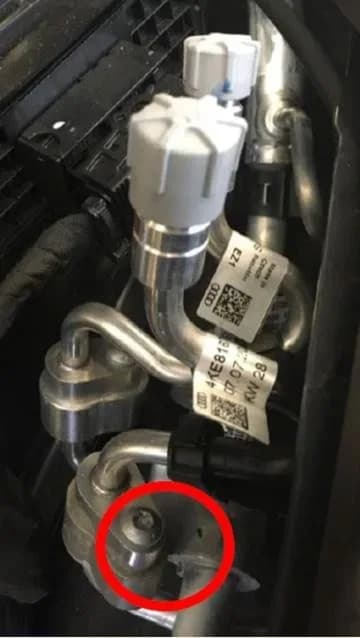
Gilt auch für
- Audi e-tron
- 2021, 2023
- Audi e-tron Sportback
- 2021–2022
Symptoms
Owners of 2021-2023 Audi e-tron and e-tron Sportback vehicles may notice a specific noise inside the cabin when the air conditioning system is active. This "noise heard in the cabin when the air conditioning system is active" is particularly noticeable when the AC compressor is running. The noise typically disappears when the air conditioning system is turned off, helping to isolate the source of the problem. Workshop findings confirm that this symptom is easily reproducible and does not originate from inside the cabin itself.
Technical Background
Audi has identified that the Audi e-tron AC noise often stems from vibrations caused by physical contact between various components in the front motor compartment. Specifically, the noise can be due to:
- Direct contact between adjacent refrigerant lines.
- Contact between a refrigerant line and the Bowden cable clip for the front hood release.
When the air conditioning compressor operates, these points of contact can transfer vibrations into the cabin, creating the audible noise. In some cases, the compressor isolator spring may also be incorrectly seated in its rubber mounting, leading to an improperly seated compressor isolator assembly that contributes to the vibration and noise.
Repair Procedure Summary
Technical Service Bulletin 2063467/7 outlines a multi-step repair process to address the Audi e-tron AC noise:
- Identify Contact Points: Technicians will inspect the refrigerant lines for any areas where they are making direct contact with each other or other components. Visual aids (like Figure 1 and Figure 3 in the TSB) help identify these points.
- Separate and Secure Refrigerant Lines: Any refrigerant lines found to be in contact must be separated. If necessary, they are retained in a separated position using a hose holder, clip, or tie-wrap (as shown in Figure 5 and Figure 6).
- Check Bowden Cable Clip Contact: An additional inspection point is the refrigerant line containing the service port and its proximity to the Bowden cable clip for the front hood release. If contact is found, these components must be separated and secured (Figure 7).
- Inspect Coaxial Refrigerant Line: Technicians also check for contact between the coaxial refrigerant line and the refrigerant line containing the service port, separating and securing them if necessary (Figure 8).
- Correct Compressor Isolator Seating: The compressor isolator spring assembly is inspected for proper fit and seating within its rubber mounting. If found poorly seated (Figure 9), the spring and/or rubber mount may need to be twisted to correctly index them, ensuring the isolator assembly lies flat against the bracket (Figure 10).
- Adjust Service Port Mounting: A possible point of contact is the service port mounting block with an adjacent line (Figure 11). This is corrected by pushing the service port to create a permanent clearance (Figure 12).
Important Warnings
For proper documentation and warranty claims, technicians are required to take photos of the customer's concern and upload them into DOC-IT with the repair order. These photos must include a date stamp and VIN reference, and be taken in focus with sufficient light.
Warranty Information
This repair, as detailed in TSB 2063467/7, is generally covered under Audi's warranty program. The claim type is 110, applicable for up to 48 months or 50,000 miles. For Certified Pre-Owned (CPO) vehicles, claim type G10 applies, requiring owner verification. If the vehicle is outside of warranty, this Technical Service Bulletin serves as informational guidance only.
- Service Number: 8744
- Damage Code: 0020
- Labor Operations: Specific labor operations include removing and reinstalling the front storage compartment (7007 1900), separating and securing refrigerant/coolant lines (8744 1399, 70 TU), and correcting compressor isolator positions.
- Diagnostic Time: Diagnostic procedures (GFF) and road tests before and after service are typically performed with no additional allowance (0 TU).
All warranty claims must adhere to the Audi Warranty Policies and Procedures Manual and are subject to review or audit by Audi Warranty.
Additional Information
All part and service references mentioned in TSB 2063467 are subject to change. Technicians should always consult their Parts Department and/or ETKA for the most current information and parts bulletins. The Repair Manual should also be checked for any fasteners, bolts, nuts, and screws that require replacement during the repair.
NHTSA ID: 11002146
Galerie
2 Bilder
Frequently Asked Questions
- What causes the AC compressor noise in my 2021-2023 Audi e-tron?
- The AC compressor noise in your 2021-2023 Audi e-tron is typically caused by vibrating refrigerant lines making contact with other components or an improperly seated compressor isolator spring assembly, as detailed in TSB 2063467/7.
- Is there a specific Technical Service Bulletin (TSB) for the Audi e-tron AC noise?
- Yes, Audi Technical Service Bulletin 2063467/7 addresses the issue of cabin noise when the air conditioning system is active in 2021-2023 Audi e-tron and e-tron Sportback models.
- What is the repair for the Audi e-tron AC compressor noise?
- The repair involves identifying and separating any contacting refrigerant lines using clips or tie-wraps, ensuring the compressor isolator spring assembly is correctly seated, and adjusting any service port mounting interference. This procedure is outlined in TSB 2063467/7.
- Will the repair for the Audi e-tron AC noise be covered under warranty?
- Yes, the repair described in TSB 2063467/7 is generally covered under Audi's warranty for up to 48 months or 50,000 miles. For Certified Pre-Owned vehicles, specific coverage applies, and vehicles outside of warranty will find the TSB informational.
Related Articles
2022 Audi e-tron Problems: Electrical System & Braking Concerns
The 2022 Audi e-tron has faced significant owner complaints regarding its electrical system, including sudden power loss and charging hazards, as well as various braking malfunctions. This profile details these issues and relevant service bulletins.
2022-2026 Audi Guided Fault Finding Reporting Obligation
Audi has issued Technical Service Bulletin TPI 2033392, also known as Transaction No. 2081531/1, regarding a reporting obligation for technicians when Guided Fault Finding produces an unexpected result. This TSB outlines the process for contacting Audi Product Support for diagnostic assistance.
2022-2026 Audi Infotainment System Complaints
Audi has released Technical Service Bulletin (TSB) 2081405/1 to address various customer complaints regarding infotainment systems in 2022-2026 Audi vehicles. This TSB helps technicians diagnose issues often caused by external media or mobile devices, rather than vehicle technology.
2018-2026 Audi Models Cracking Noise TSB 2061464/11
Audi Technical Service Bulletin 2061464/11 describes a cracking noise from the front or rear axle when changing direction in various 2018-2026 Audi models. The issue is due to stub axle movement and is resolved by bonding the stub axle to the wheel bearing with locking fluid.
2022-2026 Audi Parking Aid False Warnings TSB 2024323/13
Audi has released Technical Service Bulletin 2024323/13 to address customer complaints of false parking aid warnings. This bulletin details various environmental and vehicle-specific conditions that can cause the parking aid system to issue alerts even when no obstacles are present. It provides…
Leave a comment
Comments are moderated and may take a moment to appear. Only your first name and the initial of your last name are shown publicly.
Comments
Be the first to comment.