2021-2022 Audi Front End Creaking Noise TSB
Audi has issued TSB 2058489/6 to address creaking noises from the front end of 2021-2022 Q7, Q8, A8, and e-tron models. The bulletin identifies the hydro-bushing as the source and outlines the repair process for this common suspension noise.
 Ahmet Topcu2022 Audi e-tron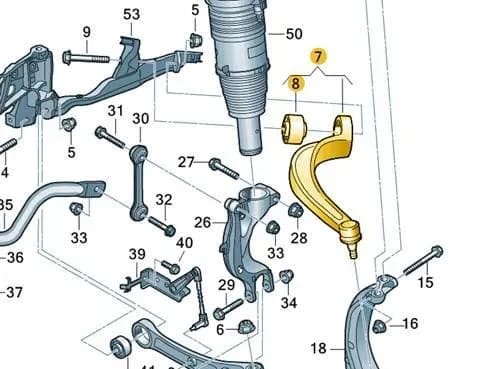
Also applies to
- Audi A8 L e
- 2021
- Audi e-tron
- 2021
- Audi Q7
- 2021–2022
- Audi Q8
- 2021–2022
- Audi RS Q8
- 2021–2022
- Audi S8
- 2021
- Audi SQ7
- 2021–2022
- Audi SQ8
- 2021–2022
▸ Show 2 more▾ Show fewer
Audi has released Technical Service Bulletin (TSB) 2058489/6 to address customer complaints regarding creaking noises originating from the front end of certain 2021-2022 Audi models. This bulletin, which supersedes TSB Group 40 number 22-41 dated June 8, 2022, provides comprehensive instructions for diagnosing and repairing this specific issue.
Symptoms
Owners may experience an "Audi front end creaking noise" that manifests as squeaking, creaking, or similar sounds. These noises are typically heard from the front end of the vehicle when driving on uneven roads. The sounds can also be felt in the footwell or behind the dash panel, indicating a potential issue with the vehicle's suspension components.
Technical Background and Diagnosis
Audi's investigation has determined that the creaking noises are generated on the lower-left guide in the area of the hydro-bushing (referenced as Positions 7 and 8 in Figure 1 of the TSB). Technicians can often reproduce these noises during a workshop inspection.
It is important to note that parts such as the coupling rod (Position 30 in Figure 2 of the TSB) are frequently replaced by mistake, but this will not resolve the problem. The noises from the guide link can be transmitted into the vehicle interior due to the connection of the subframe on the body, making them noticeable in the footwell.
Important Warnings for Owners
- Do not replace parts like the coupling rod (Figure 2, Position 30) for this issue, as they are often replaced by mistake and will not resolve the creaking noise. The problem lies with the hydro-bushing or guide link.
- If your vehicle is outside of the specified warranty period (48 months/50,000 miles), this Technical Service Bulletin is for informational purposes only, meaning the repair costs may not be covered by Audi warranty.
Repair Procedure Summary
The repair procedure outlined in TSB 2058489/6 involves addressing the hydro-bushing or the entire guide link, depending on the vehicle's repair history.
- Initial Repair (Hydro-Bushing Replacement): If the hydro-bushing has not been previously replaced, technicians are instructed to replace the hydro-bushing on the guide link in pairs (Figure 1, Position 8). This procedure must follow the instructions in the ELSA Repair Manual under
Chassis >> Suspension >> Wheels, Steering >> 40 Front Axles >> Lower Control Arm and Ball Joint >> Guide link bonder rubber bushing, Removing and Installing. - Repeat Repair (Guide Link Replacement): If repeat repairs are necessary and the hydro-bushing has already been replaced (pressed out/in), the complete guide link must be replaced (Figure 1, Position 7). This procedure also refers to the ELSA Repair Manual under
Chassis >> Suspension >> Wheels, Steering >> 40 Front Axles >> Lower Control Arm and Ball Joint >> Guide link, Removing and Installing.
Technicians are advised to precisely locate the source of the noise using acoustic testers and to check the repair history for any previous repairs related to this issue.
Required Parts and Tools
For the repair, the following parts are specified:
- Hydro-Bushing: Part Number
4M0407183B, Quantity02. - Guide Link: Required only if the hydro-bushing has been replaced previously and the noise persists. Specific part numbers should be referenced in ETKA.
- Fasteners, Bolts, Nuts, and Screws: As needed per the ELSA Repair Manual.
Warranty Information
Warranty claims for this repair should be submitted in accordance with the Audi Warranty Policies and Procedures Manual. The applicable claim types and coverage are:
- Claim Type 110: Covers repairs up to 48 months or 50,000 miles.
- Claim Type G10: Applicable for CPO (Certified Pre-Owned) covered vehicles with a verified owner.
The Damage Code for this issue is 0020. Service Number 4012 is used for the repair. Diagnostic time for a general fault finding (GFF) has no allowance. Road tests before and after the service procedure are allocated 10 Technical Units (TU) each, with diagnostic codes 0121 0002 and 0121 0004 respectively.
Repair times vary by model: 4016 2050 for A8, Q7, Q8 models, and 4016 2000 for e-tron models when replacing the hydro-bushing. For replacing the guide link, the repair time is 4012 5650.
Owner Action
If you own a 2021-2022 Audi Q7, Q8, A8, or e-tron and are experiencing an "Audi front end creaking noise," it is recommended to contact an authorized Audi service center. Describe the symptoms clearly and mention any previous attempts at repair. The dealership will be able to diagnose the issue using the guidelines provided in TSB 2058489/6 and perform the necessary repairs.
Source: NHTSA ID 10216010.
Gallery
1 image
Frequently Asked Questions
- What causes the Audi front end creaking noise in 2021-2022 models?
- The creaking noise in 2021-2022 Audi Q7, Q8, A8, and e-tron models is typically caused by the hydro-bushing on the lower-left guide, as detailed in Audi Technical Service Bulletin 2058489/6.
- How is the Audi front end creaking noise repaired?
- The repair involves replacing the hydro-bushing on the guide link. If the hydro-bushing has been replaced previously and the noise persists, the entire guide link will be replaced instead, following instructions in the ELSA Repair Manual.
- Is the repair for the Audi front end creaking noise covered by warranty?
- Yes, the repair is generally covered under Audi's new vehicle limited warranty for up to 48 months or 50,000 miles, whichever comes first. It is also covered for CPO (Certified Pre-Owned) vehicles. If your vehicle is outside these warranty periods, the TSB is for informational purposes only, and costs may apply.
- What is the part number for the hydro-bushing mentioned in TSB 2058489/6?
- The part number for the hydro-bushing specified in TSB 2058489/6 is 4M0407183B, and two units are typically required for the repair.
Related Articles
2022 Audi e-tron Problems: Electrical System & Braking Concerns
The 2022 Audi e-tron has faced significant owner complaints regarding its electrical system, including sudden power loss and charging hazards, as well as various braking malfunctions. This profile details these issues and relevant service bulletins.
2022-2026 Audi Guided Fault Finding Reporting Obligation
Audi has issued Technical Service Bulletin TPI 2033392, also known as Transaction No. 2081531/1, regarding a reporting obligation for technicians when Guided Fault Finding produces an unexpected result. This TSB outlines the process for contacting Audi Product Support for diagnostic assistance.
2022-2026 Audi Infotainment System Complaints
Audi has released Technical Service Bulletin (TSB) 2081405/1 to address various customer complaints regarding infotainment systems in 2022-2026 Audi vehicles. This TSB helps technicians diagnose issues often caused by external media or mobile devices, rather than vehicle technology.
2018-2026 Audi Models Cracking Noise TSB 2061464/11
Audi Technical Service Bulletin 2061464/11 describes a cracking noise from the front or rear axle when changing direction in various 2018-2026 Audi models. The issue is due to stub axle movement and is resolved by bonding the stub axle to the wheel bearing with locking fluid.
2022-2026 Audi Parking Aid False Warnings TSB 2024323/13
Audi has released Technical Service Bulletin 2024323/13 to address customer complaints of false parking aid warnings. This bulletin details various environmental and vehicle-specific conditions that can cause the parking aid system to issue alerts even when no obstacles are present. It provides…
Leave a comment
Comments are moderated and may take a moment to appear. Only your first name and the initial of your last name are shown publicly.
Comments
Be the first to comment.