2021-2022 Audi A5/S5/RS5 Water Sloshing Sound TSB
Audi has issued Technical Service Bulletin (TSB) 51 22 23 2061754/3 to address a 'water sloshing' sound reported by owners of 2021-2022 A5, S5, and RS5 models. The TSB outlines a procedure to modify the sill cavity sound absorber to allow proper water drainage.
 Ahmet Topcu2022 Audi A5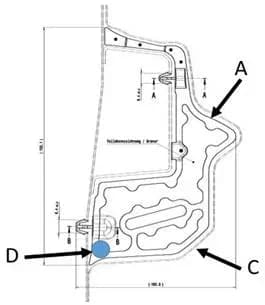
Também se aplica a
- Audi A5
- 2021
- Audi RS 5
- 2021–2022
- Audi S5
- 2021–2022
Owners of certain 2021-2022 Audi A5, S5, and RS5 models may notice an unusual "water sloshing sound is heard while driving," particularly during driving, cornering, or braking. This noise is often described as originating from the floor area of the vehicle. Audi has released Technical Service Bulletin (TSB) 51 22 23 2061754/3 to address this concern.
This TSB, issued on January 7, 2022, supersedes an earlier bulletin, Group 51 number 21-21, dated April 20, 2021. The revision history indicates updates were made to include additional models and model years.
Symptoms
The primary symptom of this issue is a distinct "water sloshing sound is heard while driving." Customers report hearing a sound like "water ‘sloshing’" when the vehicle is in motion, especially during turns or when braking. This noise is typically perceived as coming from the floor area. Upon inspection, technicians have found water accumulated in the cavities within the vehicle's side sills.
Technical Background
The root cause of the Audi A5 water sloshing sound is water accumulation in the side members and sills. Over time, water can enter these areas but is unable to drain properly. This is because the sill cavity sound absorber blocks the normal flow of water, preventing it from reaching the drainage points. The trapped water then creates the noticeable sloshing noise as the vehicle moves.
Audi has implemented production improvements to body structure components to prevent future water accumulation and ensure proper drainage in newer vehicles.
Important Warnings
This Technical Service Bulletin provides repair instructions for vehicles still under warranty. If your vehicle is outside the applicable warranty period (up to 48 months or 50,000 miles), this information is for reference only, and any repairs may not be covered.
Repair Procedure Summary
The repair procedure outlined in TSB 51 22 23 2061754/3 involves modifying the sound absorber within the side sills to facilitate proper water drainage. Here's a summary of the steps:
- Access Drainage Points: The underbody trim is detached to expose the side member plugs. Any accumulated water in the sill areas will drain out through these openings.
- Identify Water Entry: Technicians will identify the general opening where water typically enters this space.
- Locate Sound Absorber: The specific fastener position (number 4) and the location of the sound absorber (marked 'A' in the TSB's figures) are identified for modification.
- Create Drainage Hole: An 8mm to 10mm hole is made through the sound absorber at a specific point (marked 'D' in the TSB's diagrams). This hole allows accumulated water to reach the normal drainage and exit the sill cavity.
- Fabricate Tool: A specialized tool is fabricated from an 8mm to 10mm steel rod. One end is bent into an 'L' shape, 50mm long, and heated to approximately 500°C (932°F).
- Melt Hole: The heated, fabricated tool is guided through the identified opening to melt the new drainage hole in the sound absorber.
- Apply Corrosion Protection: After the modification, cavity preservative or anti-corrosion wax is applied to the modified area using specific sprayers (VAG 1379 or VAG 1538). Technicians must ensure that the existing drain plugs on the front and rear of the side members are fully functional and undamaged.
- Reassembly: Finally, the underbody and sill trim are reassembled.
Required Tools and Parts
To perform this repair, specific materials are required:
- Fasteners, Bolts, Nuts, and Screws: As needed, per the Repair Manual (refer to ETKA/ELSA).
- Cavity Preservative: Part numbers D 330KD2A1 or D 321M16M2.
- Sprayers: VAG 1379 or VAG 1538 (or equivalent generic sprayers).
Warranty Information
This repair is covered under Audi's warranty for up to 48 months or 50,000 miles, whichever comes first. The service number for this procedure is 5145, with a damage code of 0050. The labor operations include 5145 1099 for loosening/refastening trim and modifying sound absorbers, and 5101 7501 for body seal coat cavity work. Diagnostic time is designated as GFF, with no allowance for road tests before or after the procedure. All warranty claims must adhere to the Audi Warranty Policies and Procedures Manual and are subject to review.
Next Steps for Owners
If you own a 2021-2022 Audi A5, S5, or RS5 and are experiencing the "water sloshing sound is heard while driving," it is recommended to contact your authorized Audi dealership. Inform them about the Audi A5 water sloshing sound and reference TSB 51 22 23 2061754/3. The dealership will be able to diagnose the issue and perform the necessary repair to ensure proper drainage and eliminate the noise.
Source: NHTSA ID: 10206963
Galeria
5 imagens
Frequently Asked Questions
- What is the 'water sloshing' sound I hear in my Audi A5/S5/RS5?
- The 'water sloshing' sound in your 2021-2022 Audi A5, S5, or RS5 is likely caused by water accumulating in the side sill cavities. This issue is addressed by Audi Technical Service Bulletin (TSB) 51 22 23 2061754/3, which explains that the sill cavity sound absorber can block normal water drainage.
- Which Audi models are affected by the water sloshing sound TSB?
- This Technical Service Bulletin (TSB 51 22 23 2061754/3) specifically applies to 2021-2022 Audi A5, S5, and RS5 models. The TSB details a repair for vehicles experiencing water accumulation in the side sills.
- How does Audi fix the water sloshing sound problem?
- The repair involves modifying the sill cavity sound absorber to create a new drainage hole, allowing accumulated water to exit the side sills. This procedure, detailed in TSB 51 22 23 2061754/3, also includes applying corrosion protection to the modified area and ensuring existing drain plugs are functional.
- Is the repair for the Audi A5 water sloshing sound covered under warranty?
- Yes, the repair for the 'water sloshing' sound is covered under Audi's warranty for up to 48 months or 50,000 miles, whichever comes first. If your vehicle is outside this warranty period, the TSB serves as informational guidance.
Related Articles
2022-2025 Audi A/C Control Buttons Not Working TSB 2078655/3
Audi has issued Technical Service Bulletin 2078655/3 to address issues with unresponsive A/C control unit buttons in 2022-2025 A4, A5, S4, S5, RS 5, Q5, and SQ5 models. This TSB outlines diagnosis for the 'B131207: Button(s) in control panel, mechanical fault' and repair procedures.
2022 Audi A4, A5, Q5 Lane Departure Warning Steering Input TSB
Audi Technical Service Bulletin 2079617/1 addresses an issue in 2022 A4, A5, and Q5 models where the 'Steering input' setting for the lane departure warning system is unavailable in the MMI. This TSB outlines a software update to resolve the problem.
2021-2025 Audi A4, A5, Q5 Cracking/Creaking Noises TSB
Audi Technical Service Bulletin (TSB) 2062633/5 addresses 'Cracking/creaking noises during load changes or severe vehicle body torsion' in 2021-2025 Audi A4, A5, and Q5 models. This issue stems from a loose bonded joint in the subframe connection, causing various noises in the footwells.
2021-2025 Audi A4/A5/Q5 Camera Coded Incorrectly TSB
Audi has released TSB 2076008/1 to address DTC U101400, "Control module coded incorrectly," in the Front Camera for Driver Assist Systems -R242- for 2021-2025 A4, A5, Q5, S4, S5, RS 5, and SQ5 models. This can lead to incorrect signals from driver assist systems.
2021-2025 Audi Whistling Noise from Turbocharger TSB 2071243/3
Audi Technical Service Bulletin 2071243/3 details a whistling noise that may come from the turbocharger in 2021-2025 Audi A4, A5, and Q5 models. This TSB clarifies that the noise is a comfort complaint and not indicative of a fault.
Leave a comment
Comments are moderated and may take a moment to appear. Only your first name and the initial of your last name are shown publicly.
Comments
Be the first to comment.