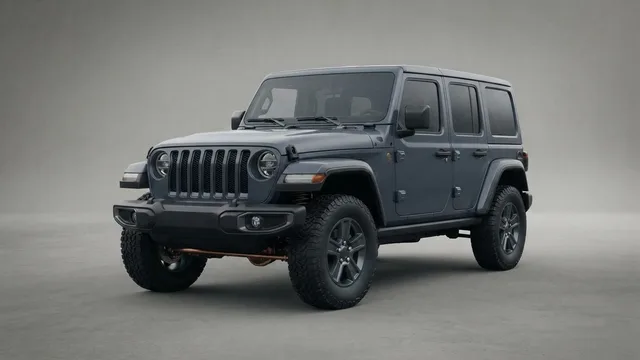
The 2026 Jeep Wrangler faces a recall for insufficient child seat anchor welds, alongside numerous service bulletins addressing issues like unresponsive power tops, degrading steering alignment, heated steering wheel malfunctions, and driver assistance system errors. This profile details known…
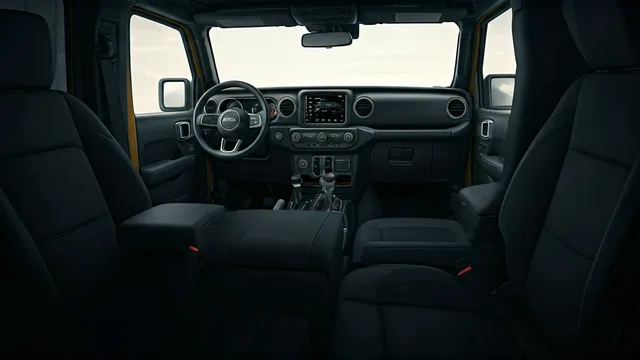
Chrysler (FCA US, LLC) has issued a recall (NHTSA ID: 26V224000, FCA ID: 27D) for certain 2026 Jeep Wrangler vehicles. The recall addresses insufficient welds on the second-row, right-side child seat tether anchors, which could reduce restraint effectiveness during a crash.

If your 2024-2026 Stellantis vehicle's Universal Garage Door Opener (UGDO) is inoperable or you have questions about its HomeLink® programming, Technical Service Bulletin (TSB) 08-134-26 provides guidance. Learn about DTC B251D1-00 and the recommended steps.

A Technical Service Bulletin (TSB 08-119-26) has been issued for the 2026 Jeep Wrangler regarding issues with the heated steering wheel not getting hot enough or not working. The fix involves a software update to the Comfort Seat Wheel Module (CSWM).
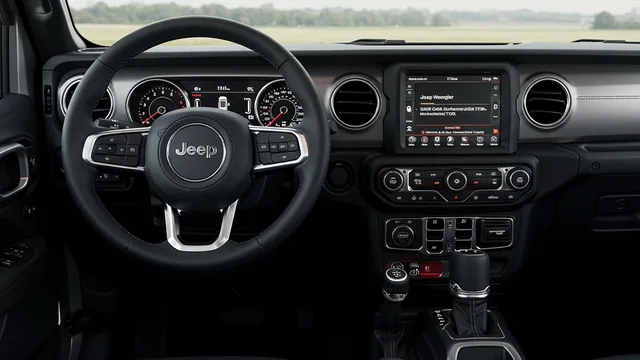
This TSB, identified as 2026 Jeep Wrangler manufacturer_communication, addresses Driver Assistant System Module (DASM) issues in the 2026 Jeep Wrangler. It covers DTCs like C2206-00 and C2318-49, which can cause warning messages such as 'ACC/FCW Unavailable Service Required'.

This Technical Service Bulletin (TSB) 08-114-26 addresses various Driver Assistant System Module (DASM) related issues in the 2026 Jeep Wrangler, including Malfunction Indicator Lamp (MIL) illumination, specific Diagnostic Trouble Codes (DTCs) like C2206-00 and C2318-49, and warning messages such…

Jeep has released Technical Service Bulletin 08-119-26 for 2026 Jeep Wrangler vehicles experiencing issues with the heated steering wheel not getting hot enough or not working at all. This TSB outlines a software update for the Comfort Seat Wheel Module (CSWM) to resolve the problem.
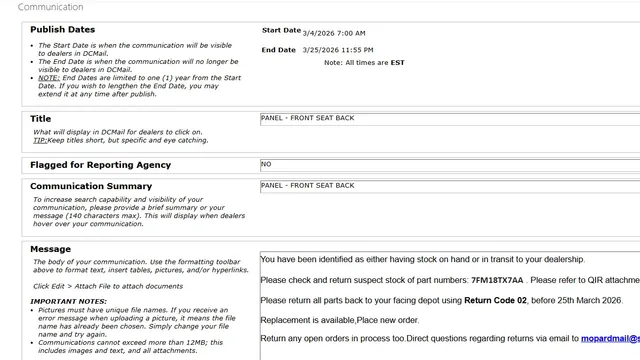
Jeep has identified certain front seat back panels (part number 7FM18TX7AA) in 2024-2026 Jeep Wrangler and Gladiator vehicles as suspect. This Quality Inspection Request (NHTSA ID 11030029, Communication ID 110626) instructs dealers to check and return these parts if manufactured before August 4…
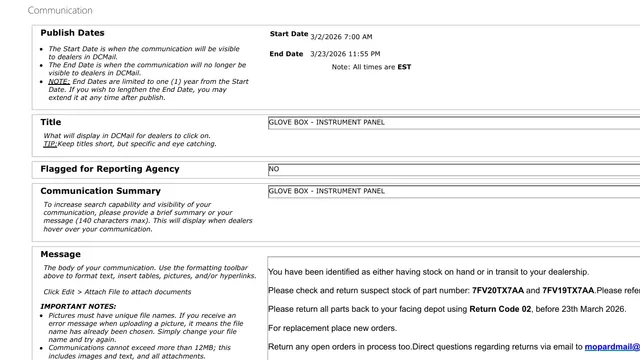
Mopar has issued Quality Inspection Request 110405 concerning suspect glove box and instrument panel parts (7FV20TX7AA, 7FV19TX7AA) for 2024-2026 Jeep Wrangler and Gladiator vehicles. Parts built before November 22, 2025, are affected and must be returned by dealers.
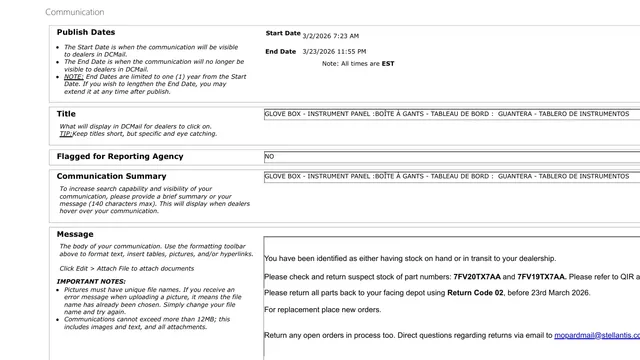
MOPAR has identified specific glove box and instrument panel parts for 2024-2026 Jeep Wrangler and Gladiator models as suspect if manufactured before November 22, 2025. Dealerships are instructed to return these parts to ensure quality.
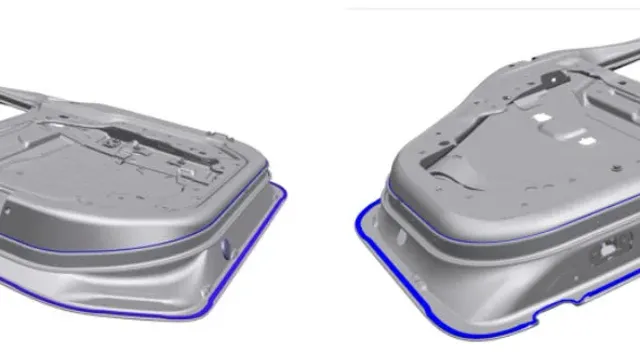
This Technical Service Bulletin (TSB 31-001-26) addresses filiform corrosion on the door hem area of 2021-2026 Jeep Wrangler and Gladiator vehicles. The TSB details a repair procedure involving corrosion removal, refinishing, and application of protective coatings to resolve the issue.
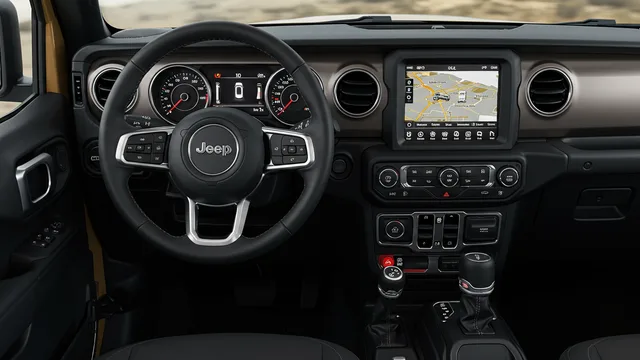
If your 2018-2026 Jeep Wrangler's retractable sky roof or power top is unresponsive, a manufacturer communication (TSB S2408000024 Rev. B) outlines a calibration procedure to resolve the issue, often without needing to replace parts.
Chrysler (FCA US, LLC) is recalling certain 2026 Jeep Gladiator and Jeep Wrangler vehicles. The walls for the steel wheels may be too thin, allowing them to crack or detach, which can result in a loss of vehicle control.
Chrysler (FCA US, LLC) is recalling certain 2026 Jeep Wrangler vehicles. The child seat tether welds on the second-row, right-side seat frame may be insufficient, which can reduce the seat's ability to properly restrain a child during a crash. As such, these vehicles fail to comply with the requirements of Federal Motor Vehicle Safety Standard number 225, "Child Restraint Anchorage Systems."
The contact owns a 2026 Jeep Wrangler equipped with Nexen Tires, Tire Line: Roadian HTX2, Tire Size: 245/75/R17, DOT Number: (N/A). The contact stated that while the vehicle was parked in the driveway, the contact became aware of a rock stuck in the tread of the front driver's-side tire. When removing the rock, the contact became aware of cracks in the tire. The contact became aware that the other three tires had similar cracks. The vehicle was taken to the dealer, and the tires were replaced with the same brand of tires. The contact stated that after driving less than 20 miles on the new tires, there were similar cracks found on two of the new replacement tires at approximately 3,000 miles. The contact owned more than one vehicle equipped with the same tires and ten of the tires had similar cracks. The manufacturer was informed of the failures and opened a case. The failure mileage was approximately 1,000.
No injuries · No fire · No crash
On Friday, July 10 at about 5 PM I was parking in front of one of my favorite restaurants in my new Jeep Wrangler. When shifting going to complete.the park job the gear shift locked the engine began revving and the vehicle lurched forward. I applied the brakes got push back the tevving increased the vehicle lurched forward again. I re applied the brakes the revving increased the shift was locked and I lurched forward impacting the rear of the car in front of me parked. The throttle then released I was able to shift to park the revving stopped.
On 06/20/2026, the same day I leased this new 2026 Jeep Wrangler Unlimited Rubicon, at 29 miles it displayed a "Power Steering System Hot - Performance May Be Limited" warning followed by an "Electric Power Steering Fail" warning. The Jeep mobile app and an email from Jeep Service both logged an Electric Power Steering failure that day and stated continued operation with reduced steering assist could pose a safety risk and to contact a dealer as soon as possible. The failed system is the electric power steering; the vehicle is available for inspection on request. On 06/23/2026 the selling dealer confirmed the problem by factory scan, recording stored fault codes in the electric power steering module (C2129-16) and related steering/cluster modules (B11C1-13 and U1464-00), plus numerous low/under-voltage codes, with system voltage as low as ~7.4V. The dealer characterized it only as "low battery voltage," reported no problem found, and performed no repair; their only action was to charge the 12V battery by driving, and the power steering connector was not inspected or replaced. The same "Power Steering System Hot" warning reappeared within about 10 minutes of leaving the dealer after that visit, which I documented on video, confirming the problem was not resolved. The manufacturer has not yet inspected the vehicle. These symptoms match Recall 26V363 and NHTSA investigation PE24024 concerning the electric hydraulic power steering pump connector overheating and causing fires, including while parked and off. This vehicle is a 2026, which appears to fall outside the currently published recall years (2021-2025); I am reporting it so a model-year 2026 incident is on record. The safety risks are loss of steering assist while driving and potential fire, including while parked and off. I park in a shared garage. No crash, fire, or injury has occurred... yet.
No injuries · No fire · No crash
Jeep purchased new on 28 January 2026. Fuel gauge only goes to 7/8 full after tank is full. Took it to dealer, they replaced gas tank, then 2 weeks later fuel pump twice, and fuel sensor unit. This solved the problem for 32 days now it’s doing the same thing. Took it back to dealership, they stated there was nothing they could do and engineering is aware and working on a fix. Called another Jeep service they said they weren’t aware of any updates or recalls.
No injuries · No fire · No crash
Noticed Drivers seat back does not move forward to allow back seat egress in the event of a collision. The problem was confirmed by a salesman at the dealership. It has not been inspected by any others. There were no electrical warnings or symptoms only the mechanical failure of the drivers seat back to move forward when trying to gain access to or from the back seat. Only the front passenger seat allows egress from the back seat. This is a safety hazard if the passenger side is blocked in a collision.
No injuries · No fire · No crash