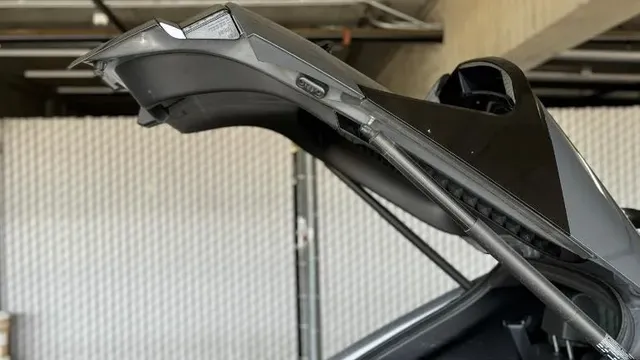
Hyundai has released Technical Service Bulletin (TSB) 24-BD-012H-1 to address rattle and friction noises emanating from the tailgate of certain 2022-2025 Hyundai Ioniq 5 and Ioniq 5 N vehicles. This bulletin outlines a procedure to adjust the gap between the tailgate and the vehicle body.
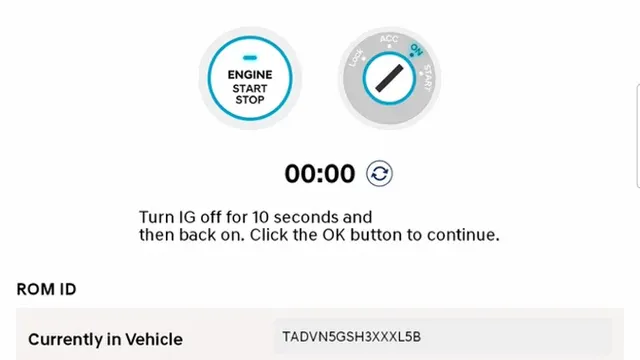
Hyundai TSB 24-01-051H-1 details a software update for the Vehicle Charging Management System (VCMS) in 2022-2024 Ioniq 5, 2023-2024 Ioniq 6, and 2024-2025 Kona Electric vehicles. This update resolves issues with interrupted Level 2 charging or reduced charging speeds.
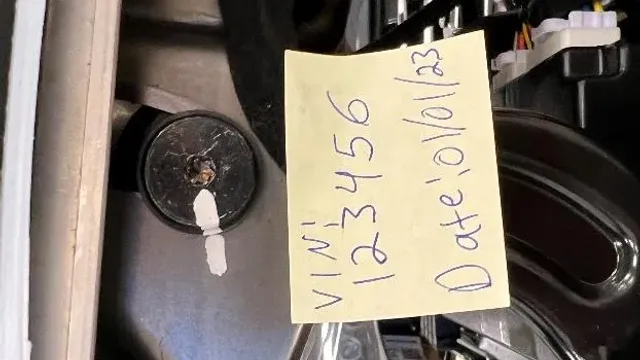
Hyundai has released Technical Service Bulletin 24-BD-006H to address a condition where the front driver's seat in certain 2022 Ioniq 5 vehicles exhibits minor play during acceleration or braking. The repair involves replacing seat track bolts and initializing the power seat module.
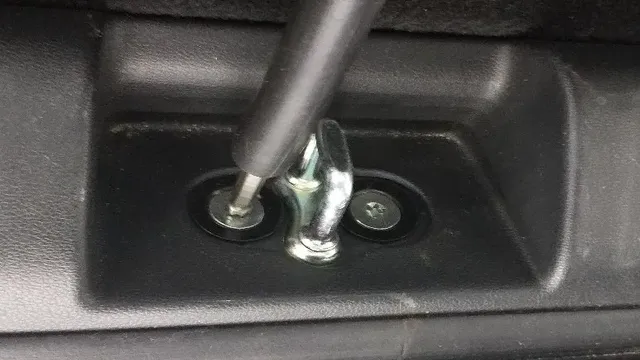
Hyundai has released Technical Service Bulletin 23-BD-006H-1 to address a common tailgate rattle noise in 2022-2023 Ioniq 5 vehicles. The repair involves installing washer pads and adjusting the tailgate striker.
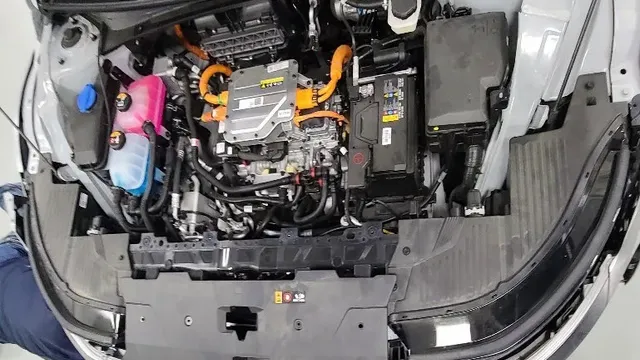
Hyundai has issued Technical Service Bulletin 23-01-075H to address Active Air Flap (AAF) actuator issues in certain 2022 Ioniq 5 vehicles. Owners may experience AAF warning signs and diagnostic trouble code U028400, indicating a problem with the air flap's operation.
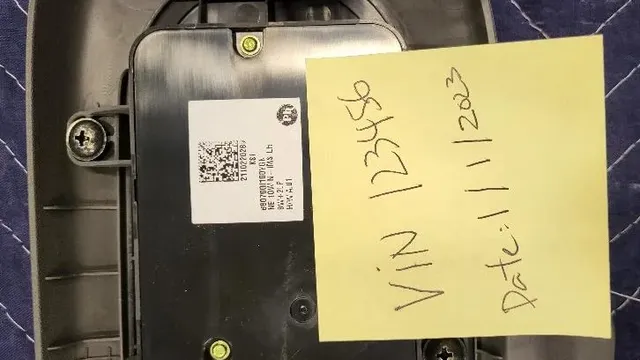
Some 2022 Hyundai Ioniq 5 vehicles may experience an inoperative front left (driver) power seat due to interference with the power seat switch wiring harness. Hyundai Technical Service Bulletin 23-01-066H details the replacement of the power seat switch and wiring revision.
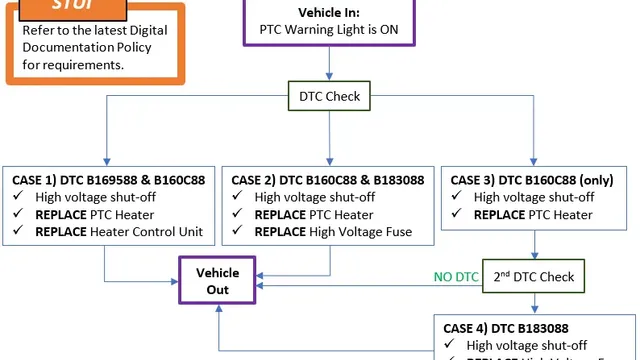
Hyundai Technical Service Bulletin 23-HA-002H details inspection and repair procedures for inoperative heater or air conditioning in 2022-2023 Ioniq 5 vehicles, addressing Diagnostic Trouble Codes B169588, B160C88, and B183088.
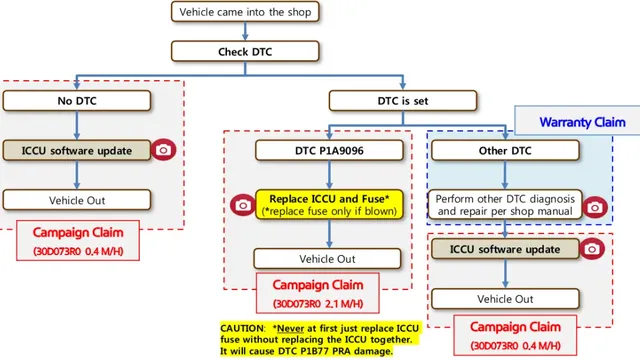
Hyundai has issued Service Campaign 997 to address a condition in 2022-2023 Ioniq 5 and Ioniq 6 vehicles where low 12V auxiliary battery charging can occur due to an Intelligent Charging Control Unit (ICCU) fault, setting DTC P1A9096. This can lead to reduced power mode and critical dashboard…
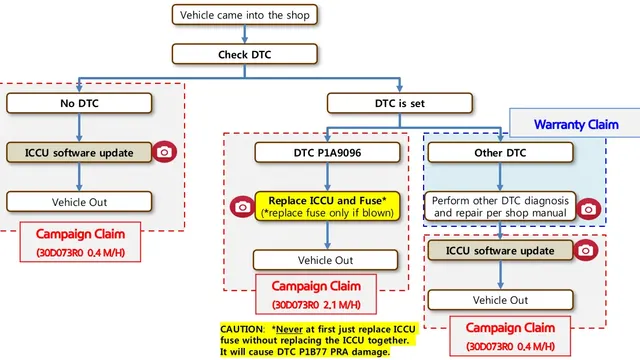
Hyundai has issued Technical Service Bulletin 23-01-060H (Service Campaign 997) for 2022-2023 Ioniq 5 and 2023 Ioniq 6 vehicles. This TSB addresses a condition where a low 12V auxiliary battery charging issue, indicated by DTC P1A9096, can lead to reduced power and warning messages.
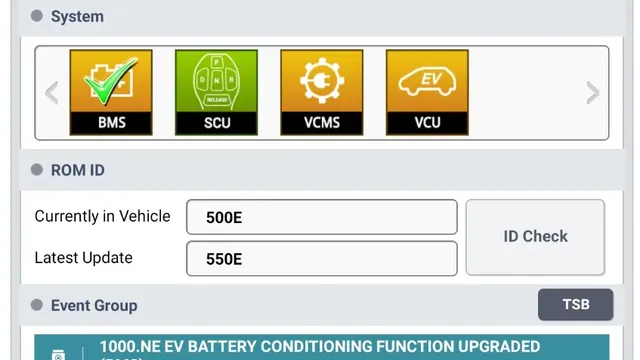
Hyundai has released Service Campaign T9Q (TSB 23-01-017H-1) for 2022 Ioniq 5 AWD models to improve cold weather DC charging performance. This involves Battery Management System (BMS) and Audio Video Navigation (AVN) software updates.
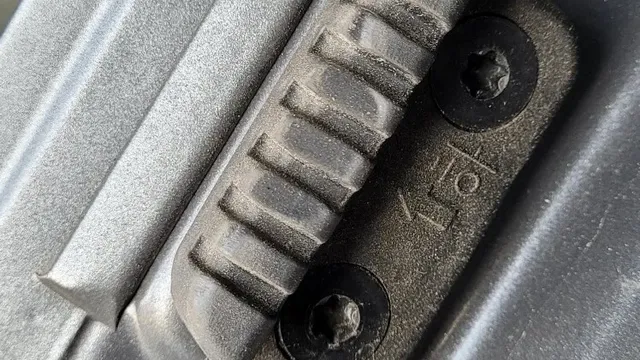
Hyundai has issued Technical Service Bulletin (TSB) 23-BD-006H to address a tailgate rattle noise in 2022-2023 Ioniq 5 vehicles. The repair involves installing washer pads and adjusting the tailgate striker.
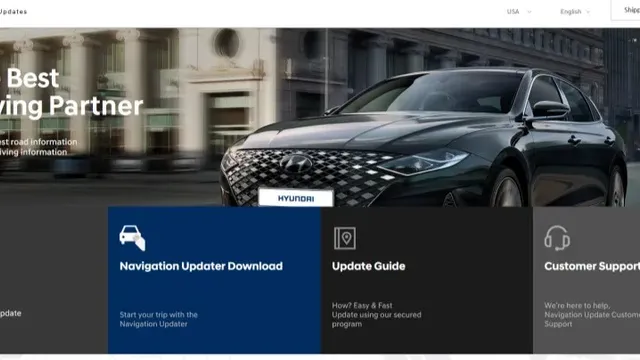
Hyundai Service Campaign T9Q (TSB 23-01-017H) addresses cold DC charging performance in 2022 Ioniq 5 AWD models by adding a Battery Conditioning function through software updates.
Active powertrain failure on my 2022 Ioniq 5 SE, which poses an immediate and severe safety risk. On May 18, 2026, the vehicle suffered a catastrophic loss of power and a complete failure to charge. At Murdock Hyundai of Lindon, technicians diagnosed it with trouble code P1AA600 and recommended a total high-voltage battery pack replacement at a cost of over $44,000. Immediate Fire & Safety Risk: The dealership technician explicitly warned me that if I continue to attempt to drive or plug in the vehicle, it will cause an electrical fire. Visible Electrical Arcing: The service technician stated that they physically witnessed an electrical arc occur when connecting the vehicle's high-voltage charging components. The technician's diagnosis strongly points to a catastrophic internal short circuit or a failed Power Relay Assembly (PRA) within the high-voltage housing. The company completely stopped working and Hyundai would not help. This has been an ongoing issue with other cars too. I tried multiple times working with both the deal and Hyudnai.
No injuries · No fire · No crash
While driving 70mph on the highway in Phoenix, multiple emergency lights illuminated on the dashboard and I lost all control over the steering wheel and braking mechanisms. The car has been serviced regularly with multiple check-ins focusing on battery efficiency.
No injuries · No fire · No crash
On June 3, 2026, my 2022 Hyundai Ioniq 5 SE Dual Motor AWD (approximately 31,000 miles) experienced a sudden and severe high-voltage battery failure. Prior to complete failure, I noticed “Check Electrical” warning sign occurring simultaneously: a sudden and dramatic drop in driving range, dashboard warning lights illuminating, and the vehicle failing to charge properly at both home and public charging stations. The vehicle was still drivable at the time I brought it to an authorized Hyundai dealership, but displayed serious warnings indicating the HV battery system was critically compromised. Upon inspection, the dealership confirmed the main high-voltage battery had failed and required full replacement. The dealership has advised that the repair will take several months due to parts availability. This failure is not an isolated incident. Hyundai issued a recall covering 2022–2024 Ioniq 5 models for HV battery and charging system defects (including ICCU failure). My vehicle’s failure is consistent with this known defect pattern. Despite the vehicle being subject to this known systemic issue, Hyundai Motor America has declined to offer a goodwill buyback, and my case manager has stated the vehicle does not qualify for lemon law relief. The sudden loss of range and charging capability while the vehicle is in motion or in use presents a serious safety concern — particularly on highways where unexpected power loss could lead to accidents. I am currently without a vehicle for what Hyundai estimates to be several months. I am requesting NHTSA investigate this failure pattern in 2022–2024 Hyundai Ioniq 5 vehicles and take appropriate action to protect consumers from this known defect.
No injuries · No fire · No crash
Complaint Summary: Mandated federal safety recall remedies performed on my vehicle have directly induced a cascading, critical safety failure of the vehicle's high-voltage propulsion management system. My 2022 Hyundai IONIQ 5 (VIN: [XXX]) was brought to an authorized dealer on XXX at 200,224 miles to complete safety recall Campaign 272 / NHTSA Recall 24V-204 (ICCU Software Update and Fuse Inspection). After receiving this software flash, the vehicle's electrical charging system failed (DTC P0D5C00), requiring a full hardware replacement of the Integrated Charging Control Unit (ICCU) on XXX. 142 miles after the physical replacement of the high-voltage ICCU, the vehicle displayed an emergency battery malfunction message on the dashboard. Diagnostic scans reveal active fault code P1BC700 in the Battery Management System. The manufacturer's dealership is now charging $1,909.77 out-of-pocket to replace the Power Relay Assembly (PRA).The current recall modifications for the E-GMP platform are failing to safely mitigate high-voltage current spikes. The electrical strain or servicing procedure required by the recall has directly compromised the adjacent power relays. This creates a severe safety hazard, leaving drivers exposed to subsequent high-voltage component failure immediately after completing mandated federal safety recalls. NHTSA should investigate cascading high-voltage component failures occurring in vehicles directly following the completion of Recall 24V-204. INFORMATION REDACTED PURSUANT TO THE FREEDOM OF INFORMATION ACT (FOIA), 5 U.S.C. 552(B)(6)
No injuries · No fire · No crash
Experienced ICCU failure under everyday conditions, driving home from an appointment. Car had sat in direct sun for 30 mins, and starting the car and driving away with the AC fully blasting is when the failure occurred.
No injuries · No fire · No crash