2021-2022 Audi Q7/Q8 Bank 2 Engine Misfire TSB
Audi has released Technical Service Bulletin PSS 01 3.0TFSI (01 23 64 2054182/7) for 2021-2022 Q7 and 2021 Q8 models experiencing Bank 2 engine misfires, often indicated by the MIL light. This issue, linked to software calibration and winter blend fuel, will be resolved with a future software…
 David Chen2021 Audi Q8
S'applique également à
- Audi Q7
- 2021–2022
Audi has issued Technical Service Bulletin PSS 01 3.0TFSI (01 23 64 2054182/7) to address instances of Bank 2 engine misfires in certain 2021-2022 Audi Q7 and 2021 Audi Q8 models equipped with the DCBD engine. This bulletin, which supersedes Group 01 number 23-47 dated March 9, 2023, identifies a software calibration issue as the root cause of the problem.
This issue primarily occurs when operating the vehicle with winter blend fuel, which has a higher vapor pressure. Owners may notice symptoms such as the Malfunction Indicator Lamp (MIL) illuminating or flashing, or a general report of engine misfires.
Symptoms
Owners of affected Audi Q7 or Q8 vehicles may observe the following conditions related to an Audi Q8 engine misfire:
- The Malfunction Indicator Lamp (MIL) is illuminated or flashing.
- The customer reports engine misfires.
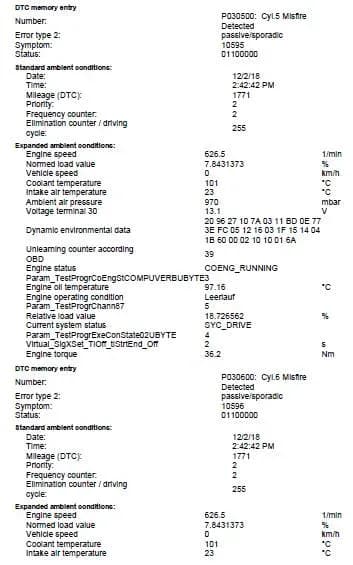
- Misfire Diagnostic Trouble Codes (DTCs) are stored for more than one cylinder on Bank 2 of the engine.
- DTC ambient conditions indicate misfires occurring at or near the same timestamp.
- Misfires are detected while the engine is operating at "Leerlauf" (idle).
- DTC ambient conditions show misfires when the vehicle speed is at or near 0 km/h.
It is important to note that this PSS only applies if the vehicle is not currently misfiring when examined in the workshop. If these specific criteria are not met, the vehicle should be diagnosed using the standard GFF process.
Fault Codes / DTCs
While the TSB provides examples, the issue is characterized by misfire DTCs on Bank 2. Examples of such codes include:
- P030500: Cyl.5 Misfire Detected
- P030600: Cyl.6 Misfire Detected
These codes indicate specific cylinder misfires within Bank 2 of the engine.
Technical Background
The underlying cause of the Audi Q8 engine misfire is a software calibration issue. This calibration problem leads to engine misfires under specific running conditions, particularly when using winter blend fuel, which has a higher vapor pressure. The condition is more prevalent during colder, winter months.
Audi is currently developing an improved software solution to address this issue. This production solution is anticipated to be released in the third quarter of 2023, though this timeline is subject to change.
Important Warnings
Owners and technicians should be aware of a critical advisory from Audi regarding this condition:
- "Do not replace any components for this condition since this will not resolve the customer's concern."
This means that replacing parts like spark plugs, ignition coils, or fuel injectors will not fix the underlying software problem and should not be performed.
Repair Procedure Summary
For vehicles exhibiting the symptoms and meeting the conditions outlined in Technical Service Bulletin PSS 01 3.0TFSI, the service procedure is as follows:
- If the vehicle's condition matches the criteria in the PSS TSB, clear any stored Diagnostic Trouble Codes (DTCs).
- Perform a test drive to confirm that no faults return after clearing the codes.
- If no faults reappear, inform the customer that a permanent solution, in the form of updated software, is forthcoming in the third quarter of 2023. Emphasize that no physical repairs are necessary at this time, and no components should be replaced as this will not resolve the issue.
- Create a PSS record in the PSS application via the Pending Service Solutions (PSS) link in Access Audi.
Owner Action
If your 2021-2022 Audi Q7 or 2021 Audi Q8 is experiencing an Audi Q8 engine misfire with the MIL light on or flashing, and especially if these symptoms occur at idle or low speeds, it is recommended to visit an authorized Audi dealership. The dealership will be able to confirm if your vehicle's symptoms align with this Technical Service Bulletin PSS 01 3.0TFSI (01 23 64 2054182/7).
At this time, no physical parts replacement is necessary or recommended. The fix will involve a software update once it becomes available. The TSB is for informational purposes and is not applicable to any Audi Warranty.
Source: NHTSA ID: 10240143
Frequently Asked Questions
- What causes the Audi Q8 engine misfire addressed by TSB PSS 01 3.0TFSI?
- The Audi Q8 engine misfire, also affecting the Q7, is caused by a software calibration issue that becomes apparent when using winter blend fuel, which has a higher vapor pressure. This condition is more likely to occur during colder months.
- What DTCs are associated with the Bank 2 engine misfire in Audi Q7/Q8 models?
- The Technical Service Bulletin PSS 01 3.0TFSI indicates that misfire DTCs will be stored for more than one cylinder on Bank 2. Examples of these codes include P030500 (Cyl.5 Misfire Detected) and P030600 (Cyl.6 Misfire Detected).
- What should I do if my 2021-2022 Audi Q7 or 2021 Audi Q8 has an engine misfire?
- If your vehicle is experiencing an engine misfire, especially with the MIL light on or flashing, you should take it to an authorized Audi dealership. They will diagnose the issue and confirm if it falls under TSB PSS 01 3.0TFSI. No parts should be replaced for this specific condition, as a software update is the planned solution.
- Is there a permanent fix for the Audi Q7/Q8 Bank 2 engine misfire?
- Yes, Audi is developing an improved software calibration to permanently resolve the Bank 2 engine misfire issue. This software update is expected to be released in the third quarter of 2023, though the exact timing may vary.
Autres révisions de ce TSB
- 2021-2022 Audi Q7 Q8 Engine Misfires TSBP030500, P030600
- 2021-2022 Audi 4.0 TFSI Misfire Valve Spring TSBP030500, P030600
- 2021-2022 Audi A6 / A7 3.0TFSI Engine Misfires TSBP030500, P030600
- 2021-2022 Audi Q7/Q8 3.0TFSI Engine Misfire PSS 01P030500, P030600
Related Articles
2021-2025 Audi Engine Control Module Software Update 53ZC
Audi has issued an update to its Engine Control Module (ECM) software campaign 53ZC / WARR EXT – U82, dated March 20, 2026. This dealer communication indicates that additional vehicles have been added to the affected chart for this important software update. Owners of 2021-2025 Audi Q8, A7, A6…
2021-2025 Audi Fuel System DTCs P014800 and P008700
Audi Technical Service Bulletin (TSB) 2079461/3 details diagnostic and repair procedures for 2021-2025 Audi vehicles experiencing a 'MIL light on' or 'limp-home function' due to fuel system DTCs P014800 or P008700. This bulletin guides technicians on diagnosing and potentially replacing the…
2021-2025 Audi Black Trim Discoloration TSB
Audi has issued Technical Service Bulletin 2078651/4 to address red, purple, gray, or metallic discoloration on black exterior trim strips in 2021-2025 Audi models. This TSB explains the cause (paint UV resistance issue) and outlines the replacement procedure for affected components.
2021 Audi Virtual Cockpit Display Fault TSB 2078439/2
Audi TSB 2078439/2 addresses issues with the virtual cockpit display in 2021 A6, A7, A8, Q7, Q8 models, including a black screen or "Instrument cluster: fault" message, often accompanied by DTC B200049.
2021-2026 Audi TFSI Engine Oil Leak TSB 2053278/10
Audi has released Technical Service Bulletin 2053278/10 to address oil leaks from the cylinder head on 2.9 and 3.0 TFSI engines in various 2021-2026 models. Learn about symptoms, diagnosis, and the recommended repair process.
Leave a comment
Comments are moderated and may take a moment to appear. Only your first name and the initial of your last name are shown publicly.
Comments
Be the first to comment.