2021-2022 Audi A6 / A7 3.0TFSI Engine Misfires TSB
Audi has issued Technical Service Bulletin (TSB) 01 21 02 2058038/3 for 2021-2022 A6 and A7 models equipped with the 3.0TFSI engine, addressing engine misfires. This condition is often related to software calibration and winter blend fuel, and owners are advised that component replacement will not…
 Sarah Mitchell2021 Audi A6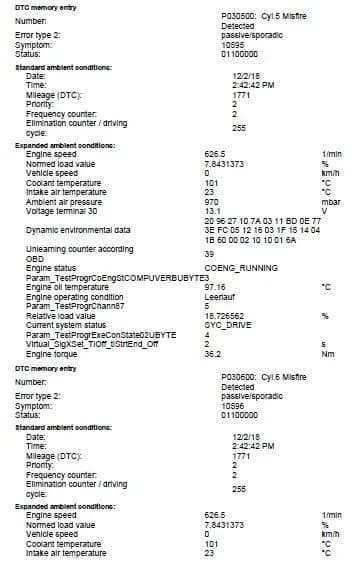
Gilt auch für
- Audi A6
- 2022
- Audi A6 allroad
- 2021
- Audi A7
- 2021–2022
Symptoms of Engine Misfires
Owners of 2021-2022 Audi A6, A6 Avant, A6 allroad, A7, and A7 Sportback models with the 3.0TFSI engine may experience specific symptoms indicating an engine misfire. These include the Malfunction Indicator Lamp (MIL) illuminating or flashing, or a general report of misfires by the customer. The Audi A6 3.0TFSI engine misfires are typically accompanied by misfire Diagnostic Trouble Codes (DTCs) stored for more than one cylinder on Bank 2.
Fault Codes / DTCs
When diagnosing misfires, specific DTCs may be stored in the vehicle's memory. Examples of misfire-related codes include:
- P030500: Cyl.5 Misfire Detected
- P030600: Cyl.6 Misfire Detected
These codes indicate misfires occurring on specific cylinders. The ambient conditions recorded with these DTCs often show misfires happening at or near the same timestamp.
Diagnosis and Trigger Conditions
This Technical Service Bulletin (TSB) 01 21 02 2058038/3 applies only if a specific set of conditions are met. These conditions help technicians accurately identify if the issue aligns with the known software calibration problem:
- The Malfunction Indicator Lamp (MIL) is on or flashing, or the customer reports misfires.
- Misfire DTCs are stored for more than one cylinder on Bank 2.
- DTC ambient conditions indicate misfires occurred at or near the same timestamp.
- DTC ambient conditions show misfires while the engine is operating at "Leerlauf" (idle).
- DTC ambient conditions show misfires when the vehicle speed is at or near 0 km/h.
- The vehicle is NOT currently misfiring when inspected in the workshop.
If these criteria are not met, the vehicle should be diagnosed using the standard GFF process.
Technical Background
The root cause of these Audi A6 3.0TFSI engine misfires is a software calibration issue. This problem is particularly noticeable under certain running conditions, especially when using winter blend fuel, which has a higher vapor pressure. The condition is most likely to occur during colder winter months.
Important Warnings for Owners
Audi explicitly states that owners should be aware of the following:
- "Do not replace any components for this condition since this will not resolve the customer’s concern."
This means that replacing parts like spark plugs, ignition coils, or injectors will not fix the underlying software issue causing the misfires and should be avoided.
Repair Procedure Summary
For vehicles exhibiting the conditions described in TSB 01 21 02 2058038/3, the current service procedure involves a diagnostic approach rather than immediate component replacement:
- If the customer's vehicle conditions match those outlined in this TSB, technicians should clear any stored DTCs.
- The vehicle should then be test-driven.
- If no faults return after the test drive, the customer should be informed that a solution, in the form of improved software, is expected in the fourth quarter of 2021. It is crucial to reiterate that no physical repairs are necessary at this point, as replacing components will not resolve the misfire issue.
- A Pending Service Solutions (PSS) record must be created in the PSS application via AccessAudi or the Technical Assistance Page in Elsa.
This TSB is for informational purposes only and does not fall under any specific Audi Warranty coverage.
Owner Action
If you own a 2021-2022 Audi A6, A6 Avant, A6 allroad, A7, or A7 Sportback with a 3.0TFSI engine and are experiencing Audi A6 3.0TFSI engine misfires, especially with the MIL on or flashing, it is recommended to visit an authorized Audi dealership. Inform them about the symptoms and mention Technical Service Bulletin 01 21 02 2058038/3. Be aware that a software solution is anticipated, and physical component replacement is not advised for this specific condition.
TSB Revision History
This bulletin has undergone several revisions to provide updated information:
- Revision 3 (April 7, 2021): Revised header (added model year information) and updated the estimate for the Revised Production Solution.
- Revision 2 (September 3, 2020): Revised the estimate for the Revised Production Solution and updated service steps and software release information. This revision supersedes Technical Service Bulletin Group 01 number 20-86 dated September 3, 2020.
- Revision 1 (December 13, 2019): Initial publication of the bulletin.
NHTSA ID: 10190236
Frequently Asked Questions
- What are the common symptoms of the 3.0TFSI engine misfire in 2021-2022 Audi A6/A7 models?
- Common symptoms include the Malfunction Indicator Lamp (MIL) turning on or flashing, and the customer reporting engine misfires. These misfires are often accompanied by specific DTCs like P030500 or P030600, indicating misfires on particular cylinders, especially at idle or low speeds.
- Will replacing parts fix the Audi A6 3.0TFSI engine misfires?
- No, Audi's Technical Service Bulletin 01 21 02 2058038/3 explicitly states, "Do not replace any components for this condition since this will not resolve the customer’s concern." The issue is related to software calibration, not faulty hardware.
- What is the cause of the 3.0TFSI engine misfires in these Audi models?
- The misfires are attributed to a software calibration issue, particularly when the engine operates under certain conditions with winter blend fuel, which has a higher vapor pressure. This condition is more prevalent during colder months.
- What should I do if my 2021-2022 Audi A6 or A7 experiences these misfires?
- If your vehicle exhibits these symptoms, you should take it to an authorized Audi dealership. They will clear any stored DTCs and test drive the vehicle. If the misfires do not return, they will inform you about a pending software solution, as no physical repair is currently recommended.
Weitere Revisionen dieses TSB
- 2021-2022 Audi Q7/Q8 Bank 2 Engine Misfire TSBP030500, P030600
- 2021-2022 Audi Q7 Q8 Engine Misfires TSBP030500, P030600
- 2021-2022 Audi 4.0 TFSI Misfire Valve Spring TSBP030500, P030600
- 2021-2022 Audi Q7/Q8 3.0TFSI Engine Misfire PSS 01P030500, P030600
Related Articles
2021 Audi A6 Problems: Recalls, Complaints & TSBs
The 2021 Audi A6 has been subject to several recalls, primarily concerning its electrical system and suspension components. While no owner complaints or federal investigations have been reported, numerous technical service bulletins address issues ranging from engine stalling and transmission…
2021 Audi A6/A7/S6/S7 Engine Coolant Service Action 19P9 Closure
Audi has issued a closure notice for Service Action 19P9, related to engine coolant concentration, affecting 2021 Audi A6, A7, S6, and S7 models. This notice sets deadlines for dealers to submit claims for completed work.
2021-2025 Audi A4, A6, Q5 Drive Belt Noise TSB 2061461/15
Audi Technical Service Bulletin 2061461/15 addresses grinding, squeaking, or tweeting noises from the starter/generator drive belt, or the belt falling off, in 2021-2025 Audi A4, A6, and Q5 models with the 2.0L TFSI engine. It also covers the 'Electrical system: Malfunction!' warning.
2019-2026 Audi A6/A7 Air Suspension Compressor TSB
Audi has issued Technical Service Bulletin 2062932/2 for 2019-2026 A6 and A7 models concerning inaccurate air suspension compressor pressure readings displayed by the J775 control module. This TSB outlines a diagnostic procedure using a special tool.
2019-2025 Audi Starter/Generator Belt Noise TSB 2061461/14
Audi TSB 2061641/14 addresses starter/generator drive belt noise or detachment in 2019-2025 A4, A5, A6, A7, and Q5 2.0TFSI mild Hybrid models. Symptoms include engine noises and the warning 'Electrical system: Malfunction! Please go to workshop'. The TSB details diagnostic and repair steps for…
Leave a comment
Comments are moderated and may take a moment to appear. Only your first name and the initial of your last name are shown publicly.
Comments
Be the first to comment.