2021-2022 Audi 4.0 TFSI Misfire Valve Spring TSB
Audi Technical Service Bulletin 2065684/1 addresses engine misfiring and rough running in 2021-2022 A6, A7, S6, S7, RS 6, and RS 7 models with the 4.0 TFSI EA825 engine. The issue is linked to possible broken valve springs and DTCs P030000 through P030800.
 David Chen2022 Audi A6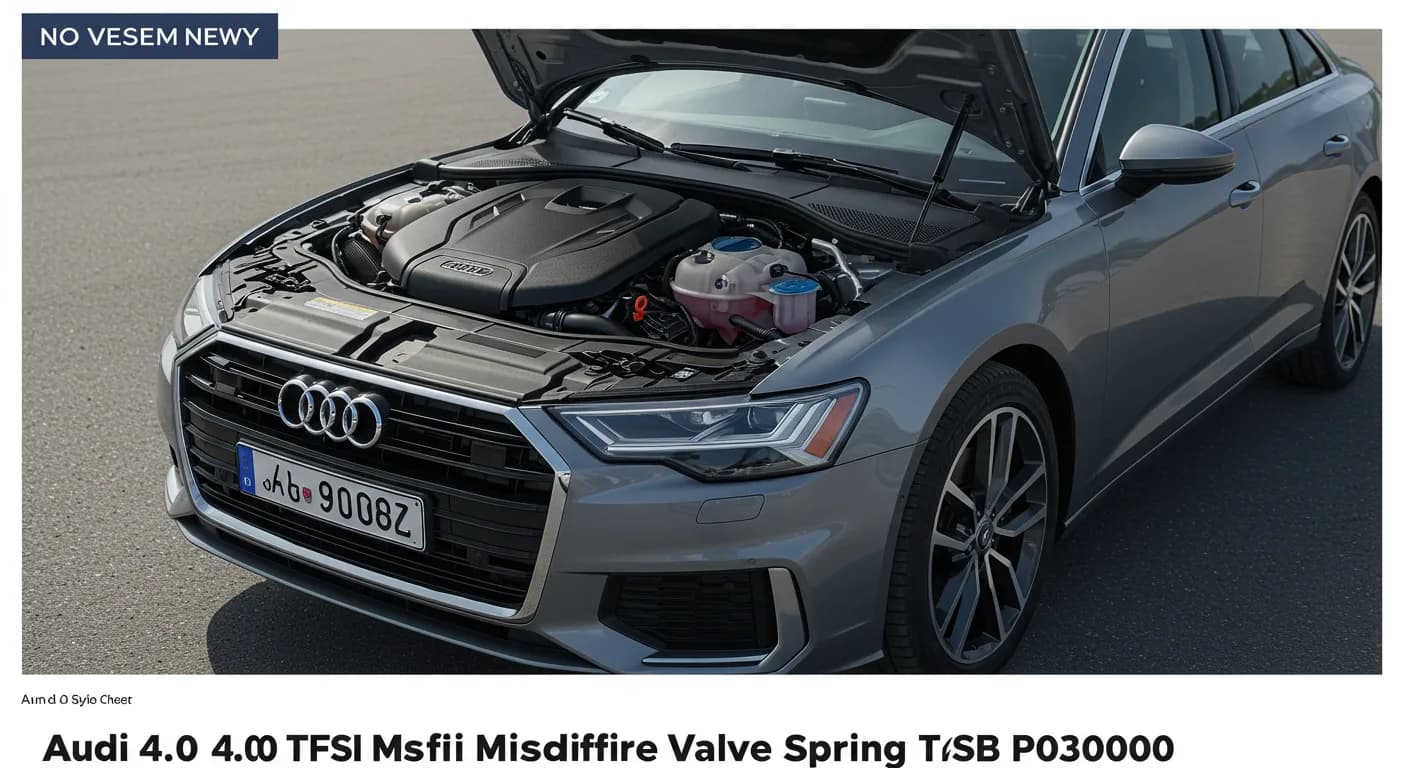
Also applies to
- Audi A6
- 2021
- Audi A6 allroad
- 2021
- Audi A7
- 2021–2022
- Audi A7 e
- 2021–2022
- Audi RS 6 Avant
- 2021–2022
- Audi RS 7
- 2021–2022
- Audi S6
- 2021–2022
- Audi S7
- 2021–2022
▸ Show 2 more▾ Show fewer
Symptoms
Owners of affected 2021-2022 Audi vehicles may experience their engine not running smoothly. This condition is often accompanied by the Malfunction Indicator Lamp (MIL) illuminating or flashing on the dashboard.
Fault Codes / DTCs
When diagnosing the issue of an Audi 4.0 TFSI misfiring P030000, technicians may find one or more of the following Diagnostic Trouble Codes (DTCs) stored in the engine control module:
| Code | Description |
|---|---|
| P030000 | Random/Multiple Cylinder Misfire Detected |
| P030100 | Cylinder 1 Misfire Detected |
| P030200 | Cylinder 2 Misfire Detected |
| P030300 | Cylinder 3 Misfire Detected |
| P030400 | Cylinder 4 Misfire Detected |
| P030500 | Cylinder 5 Misfire Detected |
| P030600 | Cylinder 6 Misfire Detected |
| P030700 | Cylinder 7 Misfire Detected |
| P030800 | Cylinder 8 Misfire Detected |
Diagnosis and Trigger Conditions
This issue stems from a raw material quality problem at the supplier, affecting valve springs in specific 4.0 TFSI EA825 engines. The affected engines were produced during various periods in 2021, depending on the engine code:
- Engine code CXYA: June 15, 2021, up to and including November 10, 2021
- Engine code CWWB: June 14, 2021, up to and including November 16, 2021
- Engine code DCUE: June 16, 2021, up to and including November 12, 2021
- Engine code DHUB: June 8, 2021, up to and including November 13, 2021
- Engine code DJPB: June 16, 2021, up to and including November 19, 2021
Improved valve springs were introduced in production after these dates. Diagnosis involves verifying the customer's complaint, performing a compression check on all cylinders, and inspecting valve springs in the cylinder with the lowest compression. A borescope is used to check for contact between the piston and valve head if a broken valve spring is identified.
Repair Procedure Summary
For vehicles exhibiting an Audi 4.0 TFSI misfiring P030000 and a broken valve spring, Audi Technical Service Bulletin 2065684/1 outlines the following steps:
- Verify Customer Complaint: Confirm the reported symptoms of engine not running smoothly or MIL illumination.
- Compression Check: Perform a compression test on all engine cylinders. This step follows instructions found in
Frequently Asked Questions
- What is Audi TSB 2065684/1 about?
- Audi Technical Service Bulletin 2065684/1 addresses engine misfiring and rough running conditions in certain 2021-2022 Audi A6, A7, S6, S7, RS 6, and RS 7 models equipped with the 4.0 TFSI EA825 engine. It identifies a possible broken valve spring as the root cause.
- What are the common symptoms of this issue?
- Owners may notice their engine not running smoothly, and the Malfunction Indicator Lamp (MIL) may illuminate or flash on the dashboard. These symptoms are typically associated with an Audi 4.0 TFSI misfiring P030000.
- Which DTCs are associated with a broken valve spring in the 4.0 TFSI engine?
- The TSB lists several Diagnostic Trouble Codes (DTCs) that may be stored in the engine control module, including P030000 (random/multiple cylinder misfire) and specific cylinder misfire codes from P030100 to P030800.
- Will my warranty cover the repair for a broken valve spring?
- The repair may be covered under Audi's New Vehicle Limited Warranty (up to 48 months/50,000 miles) or Certified Pre-Owned (CPO) warranty (G10). If the vehicle is outside of any warranty, this Technical Service Bulletin is for informational purposes only, and repair costs would typically be the owner's responsibility.
- What should I do if my Audi 4.0 TFSI engine is misfiring?
- If your 2021-2022 Audi with the 4.0 TFSI EA825 engine is experiencing misfires or the MIL light is on, it is recommended to take it to an authorized Audi dealership. They can diagnose the issue, check for related DTCs, and perform the necessary repairs as outlined in TSB 2065684/1.
Other revisions of this TSB
- 2021-2022 Audi Q7/Q8 Bank 2 Engine Misfire TSBP030500, P030600
- 2021-2022 Audi Q7 Q8 Engine Misfires TSBP030500, P030600
- 2021-2022 Audi A6 / A7 3.0TFSI Engine Misfires TSBP030500, P030600
- 2021-2022 Audi Q7/Q8 3.0TFSI Engine Misfire PSS 01P030500, P030600
- 2021 Audi V8 TFSI P030000 Misfire & Cylinder CorrosionP030000
Related Articles
2021-2024 Audi Gearbox P17EF00 Hydraulic Pump Adaptation
Audi Technical Service Bulletin 2074823/2 details a condition where the auxiliary hydraulic pump adaptation routine in the DL-382 gearbox control unit may not start automatically, logging DTC P17EF00. This TSB applies to various 2021-2024 Audi A4, A5, A6, A7, and Q5 models and requires a software…
2017-2025 Audi Models Droning/Vibrations TSB 2059057/13
Audi has released Technical Service Bulletin 2059057/13 to address customer complaints of droning, humming, and vibrations in various 2017-2025 Audi models equipped with Quattro Ultra. This TSB outlines a specific ATF drain and fill procedure for the all-wheel drive coupling 1.
2021-2025 Audi Starter/Generator Belt Noise P2BA300
Audi has released Technical Service Bulletin 2061461/13 to address grinding, squeaking, or tweeting noises from the engine compartment, or an "Electrical system: Malfunction!" warning, potentially linked to Diagnostic Trouble Code P2BA300 in 2021-2025 A4, A5, A6, and Q5 models.
2022-2023 Audi A6 / A7 Abrupt Shifting TSB
Audi has issued Technical Service Bulletin (TSB) 37 24 26 2075033/1 to address customer complaints of "rough" or "abrupt" shifting behavior in 2022-2023 Audi A6, A6 allroad, and A7 vehicles. This issue is caused by a software problem in the Transmission Electronics control module (J217) and is…
2021-2023 Audi Gearbox Malfunction DTC P17F900
Audi has released Technical Service Bulletin 2064312/6 to address a 'Gearbox Malfunction' warning and DTC P17F900 in 2021-2023 A4, A5, A6, A7, and Q5 models with DL382 transmissions. The issue often stems from loose bolts on the high-pressure filter cover, leading to a loss of drive.
Leave a comment
Comments are moderated and may take a moment to appear. Only your first name and the initial of your last name are shown publicly.
Comments
Be the first to comment.