2000-2025 Audi Foreign Objects in Headlights/Taillights TSB
Audi has issued TSB 2071954/1 addressing customer complaints of foreign objects, such as insects, inside headlight and taillight assemblies. This bulletin clarifies that these are visual complaints and provides technician procedures for removal without lamp replacement.
 Marcus Weber2022 Audi e-tron
S'applique également à
- Audi A3
- 2022–2025
- Audi A4
- 2021–2025
- Audi A4 allroad
- 2021–2025
- Audi A5
- 2021–2025
- Audi A6
- 2021–2025
- Audi A6 allroad
- 2021–2024
- Audi A7
- 2021–2025
- Audi A7 e
- 2021–2022
- Audi A8 L e
- 2021
- Audi e-tron
- 2021, 2023
- Audi e-tron GT
- 2022–2025
- Audi Q3
- 2021–2025
- Audi Q5
- 2021–2025
- Audi Q5 e
- 2024–2025
- Audi Q7
- 2021–2025
- Audi Q8
- 2021–2025
- Audi R8
- 2021–2023
- Audi RS 3
- 2022–2025
- Audi RS 5
- 2021–2025
- Audi RS 6 Avant
- 2021–2025
- Audi RS 7
- 2021–2025
- Audi RS e-tron GT
- 2022–2024
- Audi RS Q8
- 2021–2025
- Audi S e-tron GT
- 2026
- Audi S3
- 2022–2025
- Audi S4
- 2021–2025
- Audi S5
- 2021–2025
- Audi S6
- 2021–2025
- Audi S7
- 2021–2024
- Audi S8
- 2021–2025
- Audi SQ5
- 2021–2025
- Audi SQ7
- 2021–2025
- Audi SQ8
- 2021–2025
- Audi TT
- 2021–2023
- Audi TT RS
- 2021–2022
- Audi TTS
- 2021–2023
▸ Afficher 30 de plus▾ Afficher moins
Symptoms
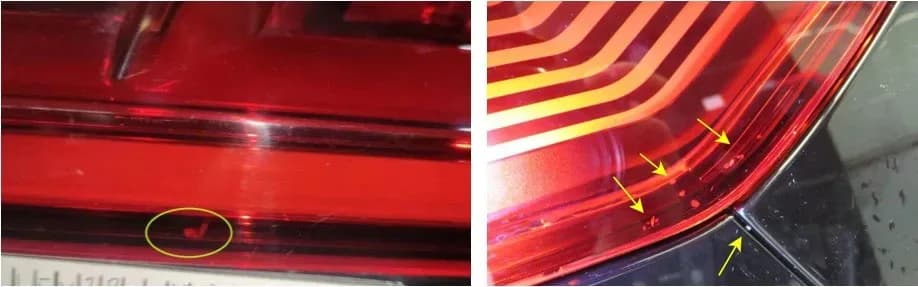
Owners of 2000-2025 Audi vehicles may observe Audi foreign objects in lights, such as insects or debris, visible inside the headlight or taillight assemblies. The customer statement often describes "Foreign objects inside a headlight or tail light." Workshop findings confirm that foreign object(s) are visible inside the lamp, and there is no evidence of external force having been applied. Figure 1 in the TSB illustrates examples of foreign objects, like insects, inside a taillight.
Technical Background
Audi designs its headlight and taillight systems as open systems to facilitate temperature exchange and sufficient air circulation. These assemblies incorporate ventilation openings in their housings. While these openings are subject to continuous improvement processes aimed at preventing foreign objects, such as insects, from entering, it is still possible for them to get inside.
Audi clarifies that these foreign objects have "absolutely no effect on the condition, function and service life" of the headlights and taillights. This issue is considered a visual complaint that is often difficult to see from a reasonable distance.
Important Warnings
Audi explicitly states that "Headlights or taillights replaced for this concern are subject to review, which may result in the warranty claim being denied." This indicates that lamp replacement is generally not the approved solution for this condition, and technicians are expected to attempt removal of the foreign objects first.
Repair Procedure Summary
This TSB outlines the specific steps technicians should follow to address Audi foreign objects in lights without replacing the entire lamp assembly. The goal is to remove the objects or reposition them where they are less visible.
For Headlights:
- Open the service flap(s) to access the headlight assembly.
- Remove any control units or attachments that obstruct access to the inside of the headlight.
- Carefully attempt to remove the foreign objects using a vacuum cleaner or a pneumatic gun. It is mandatory to use oil-free compressed air if a pneumatic gun is utilized.
- If direct removal is not possible, try to move the foreign objects to a location within the headlight where they cannot be seen.
For Taillights:
- Remove the taillight assembly that is subject to the complaint.
- If possible, remove the dust caps on the taillight housing.
- Carefully attempt to remove the foreign objects through the ventilation openings using a vacuum cleaner or a pneumatic gun. Again, oil-free compressed air is mandatory if a pneumatic gun is used.
- Gently shaking the taillight may assist in dislodging the objects.
- If direct removal is not possible, try to move the foreign objects to a location within the taillight where they cannot be seen.
Warranty Information
This Technical Service Bulletin (TSB) is for informational purposes only and is not applicable to any Audi Warranty. As noted, replacing headlights or taillights for this concern may lead to a warranty claim being denied, emphasizing that removal of the foreign object is the preferred solution.
Additional Information
All part and service references provided in this TSB (2071954) are subject to change and/or removal. Technicians should always consult their Parts Department and/or ETKA for the most current information and parts bulletins. Additionally, the Repair Manual should be checked for fasteners, bolts, nuts, and screws that require replacement during the repair process.
NHTSA ID: 10247656
Frequently Asked Questions
- Why are there foreign objects in my Audi's headlights or taillights?
- Audi designs its headlight and taillight assemblies as open systems with ventilation openings to allow for temperature exchange and air circulation. This design, while continuously improved, can sometimes allow foreign objects like insects to enter.
- Do foreign objects in my Audi's lights affect their function?
- According to Audi TSB 2071954/1, these foreign objects have "absolutely no effect on the condition, function and service life" of the headlights and taillights. It is primarily a visual complaint.
- Will Audi replace my headlight or taillight if there are foreign objects inside?
- Audi's technical service bulletin instructs technicians to first attempt to remove the foreign objects. The TSB explicitly states that "Headlights or taillights replaced for this concern are subject to review, which may result in the warranty claim being denied."
- What should I do if I notice foreign objects in my Audi's lights?
- If you observe foreign objects in your Audi's headlights or taillights, you should contact an authorized Audi service center. They will follow the procedures outlined in TSB 2071954/1 to attempt removal of the foreign objects using methods like vacuuming or oil-free compressed air.
- What is Audi TSB 2071954/1 about?
- Audi TSB 2071954/1 addresses customer complaints about "Foreign objects inside a headlight or tail light" for all Audi models from 2000 to 2025, providing guidance to technicians on how to remove these objects without replacing the lamp assembly.
Related Articles
2022 Audi e-tron Electrical System Problems: Complaints & TSBs
Owners of the 2022 Audi e-tron frequently report significant electrical system malfunctions, ranging from sudden power loss and charging hazards to software crashes. Braking issues and unexpected automatic emergency braking are also common concerns, alongside numerous technical service bulletins…
2022-2026 Audi Guided Fault Finding Reporting Obligation
Audi has issued Technical Service Bulletin TPI 2033392, also known as Transaction No. 2081531/1, regarding a reporting obligation for technicians when Guided Fault Finding produces an unexpected result. This TSB outlines the process for contacting Audi Product Support for diagnostic assistance.
2022-2026 Audi Infotainment System Complaints
Audi has released Technical Service Bulletin (TSB) 2081405/1 to address various customer complaints regarding infotainment systems in 2022-2026 Audi vehicles. This TSB helps technicians diagnose issues often caused by external media or mobile devices, rather than vehicle technology.
2018-2026 Audi Models Cracking Noise TSB 2061464/11
Audi Technical Service Bulletin 2061464/11 describes a cracking noise from the front or rear axle when changing direction in various 2018-2026 Audi models. The issue is due to stub axle movement and is resolved by bonding the stub axle to the wheel bearing with locking fluid.
2022-2026 Audi Parking Aid False Warnings TSB 2024323/13
Audi has released Technical Service Bulletin 2024323/13 to address customer complaints of false parking aid warnings. This bulletin details various environmental and vehicle-specific conditions that can cause the parking aid system to issue alerts even when no obstacles are present. It provides…
Leave a comment
Comments are moderated and may take a moment to appear. Only your first name and the initial of your last name are shown publicly.
Comments
Be the first to comment.