2023 Hyundai Ioniq 5 Charging Issue TSB: VCMS Update
Hyundai has released Technical Service Bulletin 23-EV-003H for 2023 Hyundai Ioniq 5 electric vehicles experiencing intermittent charging interruptions or an 'EV Light On' with DTC P1BAD 'Charger Coupler Temperature Too High'. A Vehicle Charge Management System (VCMS) software update is available.
 David Chen2023 Hyundai Ioniq 5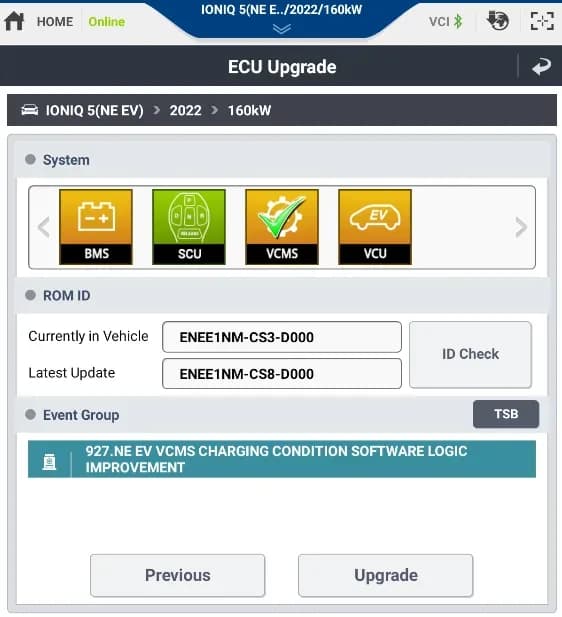
Hyundai has issued Technical Service Bulletin (TSB) 23-EV-003H to address a specific 2023 Hyundai Ioniq 5 charging issue. This bulletin outlines a necessary software update for the Vehicle Charge Management System (VCMS) in affected vehicles. The update aims to correct conditions that can lead to charging interruptions and diagnostic trouble codes.
Symptoms
Owners of 2023 Hyundai Ioniq 5 (NE1) electric vehicles may experience one or both of the following issues related to the 2023 Hyundai Ioniq 5 charging issue:
- The vehicle intermittently stops charging before the charging process is complete.
- The EV Light illuminates on the dashboard, accompanied by the diagnostic trouble code (DTC) P1BAD, indicating "Charger Coupler Temperature Too High".
Fault Codes / DTCs
This TSB specifically addresses the following diagnostic trouble code:
| Code | Description | Module |
|---|---|---|
| P1BAD | Charger Coupler Temperature Too High | VCMS |
Diagnosis / Trigger Conditions
Technicians will identify the need for this update if a 2023 Hyundai Ioniq 5 presents with the described symptoms or the DTC P1BAD. The update involves the Vehicle Charge Management System (VCMS) and is identified in the Global Diagnostic System (GDS) as Event #927, described as "NE EV VCMS CHARGING CONDITION SOFTWARE LOGIC IMPROVEMENT". This indicates a specific software logic improvement designed to optimize charging conditions.
Important Warnings
Before performing the ECU update, technicians must observe critical battery voltage conditions to prevent update failures. If the GDS displays a warning indicating low battery voltage, specifically: "Warning! lower Battery Voltage. BATTERY VOLTAGE: 10.8", the vehicle's 12V battery must be charged. The vehicle should be run for at least 15 minutes to achieve an adequate battery state of charge. The ignition must be cycled OFF/ON before attempting the ECU update again.
Repair Procedure Summary
The repair involves updating the VCMS software using the Global Diagnostic System (GDS). The general procedure is as follows:
- Initial Update Attempt: The GDS ECU update should first be attempted in Auto Mode.
- Troubleshooting Auto Mode Failure: If the update begins but fails in Auto Mode, the technician should attempt to recover by performing the update in Manual Mode. This may require turning off the ignition for 30 seconds before retrying.
- Advanced Recovery: If Manual Mode also fails, the 12V battery cables must be disconnected, and a cap discharge performed (connecting a bar or heavy wire between the positive and negative terminals) before re-attempting Manual Mode.
- ROM ID Verification: Before proceeding with the software update, the technician must use the Auto Mode ID Check function to verify the current VCMS ROM ID.
- Software Update: Perform the VCMS update in Auto Mode. The new ROM ID for the VCMS will be ENEE1NM-CS8-D000, replacing older versions such as ENEE1NM-CS1-D000, ENEE1NM-CS2-D000, ENEE1NM-CS3-D000, or ENEE1NM-CS4-D000.
- Post-Update Reset: Once the ECU Upgrade process shows 100% completion, the ignition key must be cycled to the OFF position for at least 10 seconds to properly reset the control unit.
- DTC Clearing: An All Systems Fault Code search must be performed, and any incidentally stored DTCs from the ECU update process must be erased.
- Final Verification: The vehicle should then be started in Ready mode to confirm proper operation.
ROM ID Information
The following table details the Vehicle Control Unit (VCU) part number and the ROM IDs involved in this update:
| VEHICLE | SYSTEM | MY | VCU P/No. | OLD ROM ID | NEW ROM ID |
|---|---|---|---|---|---|
| IONIQ5 (NE) | VCMS | 22-23MY | 39751-1XNN1 | ENEE1NM-CS1-D000, ENEE1NM-CS2-D000, ENEE1NM-CS3-D000, ENEE1NM-CS4-D000 | ENEE1NM-CS8-D000 |
Manual Mode Password
Should a manual update be required, the following password is used:
| MENU | PASSWORD |
|---|---|
| NE EV VCMS 35001-1XAA0 | 8000 |
Required Tools or Parts
The primary action is a software update, but the TSB references specific part numbers for warranty and identification purposes:
- VCU Part Number: 39751-1XNN1
- Causal Part for Warranty: 35001-1XAAO
Owner Action
If you own a 2023 Hyundai Ioniq 5 and are experiencing intermittent charging issues or have seen the "EV Light On" with a "Charger Coupler Temperature Too High" message, you should contact your authorized Hyundai dealer. This software update is typically covered under warranty. The repair operation code for this VCMS Upgrade is 35001Q0C, with an estimated labor time of 0.3 hours.
NHTSA ID: 10233558
Galería
1 imagen
Frequently Asked Questions
- What are the common symptoms of the 2023 Hyundai Ioniq 5 charging issue?
- Owners may notice their 2023 Hyundai Ioniq 5 intermittently stops charging before completion, or the EV Light illuminates on the dashboard, often with a message indicating "Charger Coupler Temperature Too High".
- What is DTC P1BAD and how does it relate to the Hyundai Ioniq 5 charging issue?
- DTC P1BAD, or "Charger Coupler Temperature Too High", is a diagnostic trouble code that can appear in 2023 Hyundai Ioniq 5 vehicles due to a software anomaly in the Vehicle Charge Management System (VCMS). This code indicates a potential problem with the charging process.
- How is the 2023 Hyundai Ioniq 5 charging issue resolved?
- The issue is resolved by performing a software update to the Vehicle Charge Management System (VCMS) using Hyundai's Global Diagnostic System (GDS), as outlined in TSB 23-EV-003H. This update installs new software logic to improve charging conditions.
- Is the VCMS software update for the 2023 Hyundai Ioniq 5 covered under warranty?
- Yes, this VCMS software update is typically covered under the vehicle's warranty. The operation code for this service is 35001Q0C, and it has an estimated labor time of 0.3 hours.
Related Articles
2022-2025 Hyundai Ioniq 5/6 DC Pin Cap Replacement TSB 25-EV-003H
Hyundai Technical Service Bulletin 25-EV-003H details the replacement of missing Inlet 5-Pin Combo DC insulation caps in 2022-2025 Hyundai Ioniq 5, Ioniq 6, and Ioniq 5 N vehicles. This repair prevents potential damage to the charge port.
2022-2023 Hyundai Ioniq 5 Spoiler Molding Separation TSB
Hyundai has issued Technical Service Bulletin 24-BD-009H for 2022-2023 Ioniq 5 vehicles experiencing spoiler molding lifting or separation near the Center High Mount Stop Lamp. This TSB outlines the repair procedure and required parts for certified dealers.
2022-2025 Hyundai Ioniq 5 / Ioniq 6 VCU Limp Home Enhancement
Hyundai service campaign 24-01-088H addresses a condition in 2022-2025 Ioniq 5 and Ioniq 6 vehicles where a low 12V battery voltage can trigger a 'fail-safe' mode. A VCU software update enhances limp home functionality, adjusting maximum speeds to prevent potential damage.
2022-2025 Hyundai Ioniq 5 Tailgate Rattle & Noise TSB 24-BD-012H
Hyundai has issued Technical Service Bulletin 24-BD-012H for 2022-2025 Ioniq 5 vehicles experiencing tailgate rattle and friction noises. The bulletin outlines a rework procedure involving guide bumper replacement and tailgate adjustment to resolve the issue.
2022-2024 Hyundai Ioniq ICCU Charging Fault TSB 24-EV-004H
Hyundai Technical Service Bulletin 24-EV-004H provides critical instructions for repairing Integrated Charge Control Unit (ICCU) charging issues in 2022-2024 Ioniq 5 and Ioniq 6 vehicles. Addresses DTCs P1A9096 and P1B77 related to DC-to-DC charging and inoperative AC charging.
Leave a comment
Comments are moderated and may take a moment to appear. Only your first name and the initial of your last name are shown publicly.
Comments
Be the first to comment.