2017-2026 Audi Electric Tailgate Malfunction TSB 2079214/2
Audi Technical Service Bulletin (TSB) 2079214/2 addresses common malfunctions of the electric tailgate across various 2017-2026 Audi models. This bulletin offers comprehensive fault finding and repair procedures for technicians, including diagnostic steps and component checks to resolve issues…
 David Chen2022 Audi e-tron
También aplica a
- Audi A3
- 2022–2026
- Audi A4
- 2021–2025
- Audi A4 allroad
- 2021–2025
- Audi A5
- 2021, 2022, 2023, 2024, 2026
- Audi A6
- 2021–2026
- Audi A6 allroad
- 2021–2025
- Audi A7
- 2021–2025
- Audi A7 e
- 2021–2022
- Audi A8 L e
- 2021
- Audi e-tron
- 2021, 2023
- Audi e-tron GT
- 2022–2025
- Audi e-tron Sportback
- 2021–2022
- Audi Q3
- 2021–2025
- Audi Q5
- 2021–2026
- Audi Q5 e
- 2021, 2023, 2024, 2025
- Audi Q7
- 2021–2026
- Audi Q8
- 2021–2026
- Audi RS 3
- 2022–2026
- Audi RS 5
- 2021–2024
- Audi RS 6 Avant
- 2021–2025
- Audi RS 7
- 2021–2026
- Audi RS e-tron GT
- 2022–2026
- Audi RS Q8
- 2021–2026
- Audi S e-tron GT
- 2026
- Audi S3
- 2022–2026
- Audi S4
- 2021–2025
- Audi S5
- 2021, 2022, 2023, 2024, 2026
- Audi S6
- 2021–2025
- Audi S7
- 2021–2025
- Audi S8
- 2021–2026
- Audi SQ5
- 2021–2026
- Audi SQ7
- 2021–2026
- Audi SQ8
- 2021–2026
▸ Mostrar 27 más▾ Mostrar menos
Symptoms of an Audi Electric Tailgate Malfunction
Owners of 2017-2026 Audi vehicles may experience an Audi electric tailgate malfunction where the tailgate "The electric tailgate does not work. It does not open or close as desired." This issue can manifest with or without corresponding event memory entries in the vehicle's diagnostic system. This Technical Service Bulletin (TSB) 2079214/2 aims to provide comprehensive guidance for diagnosing and resolving such issues.
Technical Background and Revision History
This TSB, identified as transaction number 2079214/2, was initially published on September 9, 2025 (Revision 1). A subsequent revision (Revision 2) was released on January 21, 2026, to include additional model years in the header. The document provides in-depth information on the operation of the electric tailgate system, offering detailed repair instructions and outlining methods for targeted identification of defective components. By utilizing event memory-based fault finding with the ODIS workshop tester, technicians can efficiently pinpoint the root cause of an Audi electric tailgate malfunction, thereby streamlining the repair process.
Audi Platform Overview for Electric Tailgates
Electric tailgates are integrated across various Audi vehicle platforms. Understanding these platforms and their associated models is crucial for proper diagnosis and repair. Figure 1 in the TSB illustrates the breakdown of electric tailgate usage by Group platform. The following table outlines the Group platforms and their respective models:
| Platform | Models |
|---|---|
| MQB | A3, Q3 |
| MEB | Q4 e-tron |
| MLB | A4, A5 (F5), A6 (4A), A7, A8, Q5 (FY), Q8 (4M), Q8 e-tron (GE), e-tron GT |
| PPE, PPC | A5 (FU), A6 (FN), A6 e-tron (GH), Q5 (GU), Q6 e-tron (GF) |
Functional Overview of the Electric Tailgate System
The electric tailgate system involves several control units and input points, varying slightly depending on the vehicle platform. Key abbreviations used in the TSB include BCM (Body Computer Module), ICAS (In-Car Application Server), SAM (Sensor Actor Module), SAR (Sensor Actor Rear), and HCP (High-Performance Computing platform).
MQB, MEB, and MLB Platforms
For MQB, MEB, and MLB platforms, as depicted in Figure 2, control points such as the remote key (A1) and interior door button (A2) communicate directly with the BCM (diagnostic address 0009), ICAS (diagnostic address 0019), or BCM2 (diagnostic address 0046). The optional sensor-controlled tailgate (A4) communicates via its dedicated control unit (B3, diagnostic address 064E) to the BCM/ICAS/BCM2. The handle (A3, soft touch) and tailgate interior button (A3) connect directly to the tailgate control unit (B2, diagnostic address 006D). The power latching system (C2) and tailgate drive (C3) also connect to the tailgate control unit, while the tailgate lock (C1) is directly connected to the BCM/ICAS/BCM2.
PPE and PPC Platforms
For the newer PPE and PPC platforms, which feature a modified architecture as shown in Figure 3, the HCP4 control unit (B4) replaces the BCM/ICAS/BCM2. The SAR (B5, diagnostic address 0046) replaces the tailgate control unit (B2). On these platforms, the tailgate lock (C1) connects directly to the SAR (B5).
Tailgate Opening and Closing Sequence
Understanding the precise sequence of signals during tailgate operation is essential for diagnosing an Audi electric tailgate malfunction.
Opening Sequence (Figure 4)
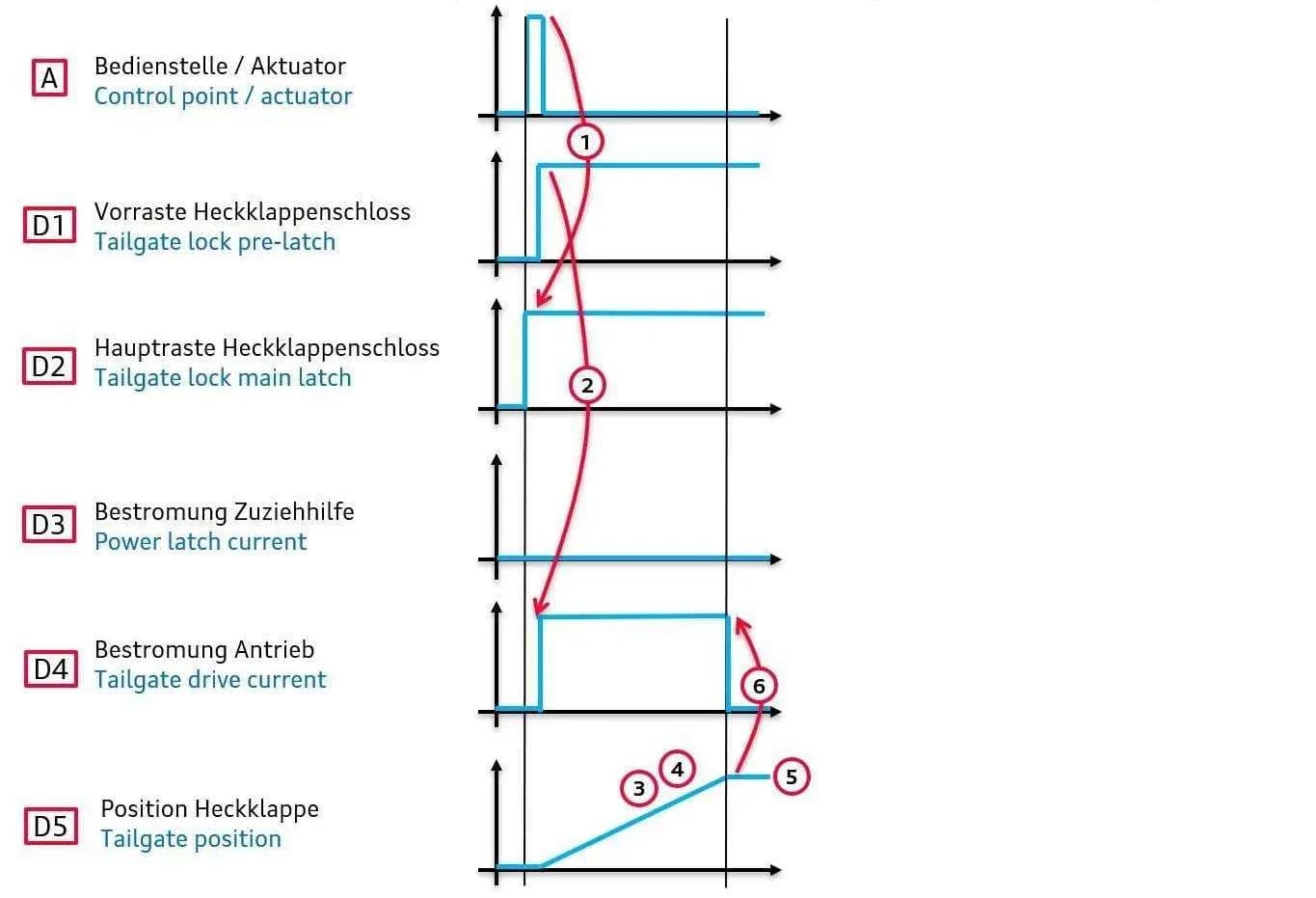
Figure 4 illustrates the functional sequence of the electric tailgate when it opens, showing the interaction of various signals (D1-D5) over time:
- A request to open the tailgate is sent from a control point (A) to the BCM/HCP4 (B1, B4). This action releases the tailgate lock main latch (D2). The spring pre-tension then pushes the tailgate out slightly, which activates the tailgate lock pre-latch (D1).
- The pre-latch signal (D1) is the most important signal, as it initiates and controls the tailgate movement. It regulates the tailgate drive current (D4) via the control units.
- Hall sensors in the tailgate drive measure the tailgate's current position (D5), guiding it towards the desired end position (soft stop position or adapted intermediate position/PUE - programmed upper end position).
- When the tailgate is approximately 15% from its final open position, its speed is reduced.
- Upon reaching the desired end position, the tailgate drive current (D4) stops.
- The tailgate has reached its target opening dimension, and the process is complete. The power latch current (D3) is not required during opening.
Closing Sequence (Figure 5)
Figure 5 illustrates the functional sequence of the electric tailgate when it closes, detailing the signal progression:
- A closing request is sent from a control point (A) to the BCM/HCP4.
- The BCM/HCP4 forwards this signal to the HDSG/SAR, which activates the rear lid drives (D4).
- Hall sensor values from the tailgate drive are processed by the tailgate control unit/SAR, guiding the tailgate to its desired end position (D5).
- When the tailgate is approximately 15% from its final closed position, its speed is reduced.
- As soon as the lock reaches the pre-latch (D1), the tailgate drive current (D4) is switched off. After a brief delay, the power latch (D3) engages to pull the tailgate lock into the main latch (D2).
- The main latch signal (D2) provides feedback to the tailgate control unit/SAR, confirming successful completion of the movement.
- Finally, the power latch (D3) returns to its starting position (S3 switch).
Manual Fault Finding for Tailgate Lock and Power Latch
If the ODIS workshop tester does not suggest a repair or provide event memory entries, manual fault finding can help identify defective parts, particularly if you are experiencing an Audi electric tailgate malfunction.
For MQB, MEB, and MLB Vehicles:
- Close the tailgate: Start by closing the tailgate from its fully open position.
- Manually press pre-latch: Use a screwdriver or pen to manually press the lock's pre-latch. This simulates the tailgate closing to a certain point.
- Observe movement: The tailgate should stop moving immediately. If it does not, this indicates a potential defect in the tailgate lock itself.
- Open tailgate: Open the tailgate again until the pre-latch pops out, resetting the mechanism.
- Second close and stop: Immediately close the tailgate again and stop it a second time via the pre-latch. This tests the power latch's function.
- Observe power latch: The power latch should activate after this second stop, pulling the tailgate lock into the main latch and returning to its original position. If this does not happen, the power latch may be defective.
Audi provides a video resource for these manual fault-finding steps for the Audi Q4 e-tron Sportback, accessible via QR code (Figure 6) or directly at https://audi-external.kzoplatform.com/player/medium/3090973936389723283.
For PPE and PPC Vehicles:
- Close the tailgate: Begin by closing the tailgate from its fully open position.
- Manually press pre-latch: Use a screwdriver or pen to manually press the lock's pre-latch.
- Observe movement: The tailgate should stop moving immediately. If it does not, the tailgate lock may be defective.
- Automatic power latch activation: If the remaining opening angle of the tailgate is less than 13%, the power latch automatically starts on PPE and PPC vehicles.
- Internal power latch test: To conveniently test the power latch from inside the vehicle, move the tailgate to a position with less than 13% opening angle remaining and then operate the tailgate lock pre-latch from the inside.
Audi also provides video resources for these manual fault-finding steps for the Audi A6 e-tron, accessible via QR codes (Figures 7 & 8) or directly at https://audi-external.kzoplatform.com/player/medium/3090976688507458783 and https://audi-external.kzoplatform.com/player/medium/3090979841575490871.
Important Warnings for Technicians and Owners
- WARNING: "NOTE: The basic setting of the tailgate must be performed, otherwise there is a risk of excessive force not being detected." This is crucial to prevent damage or incorrect operation and ensure the system functions as intended.
- NOTICE: "Note: The measured value blocks should be read out immediately after a customer complaint, otherwise the measured values will be overwritten." This emphasizes the importance of timely diagnosis to capture accurate data before it is lost or updated.
Fault Finding Using Measured Value Blocks
Further analysis of an Audi electric tailgate malfunction can be performed using complete measured value blocks from control unit data via the ODIS workshop tester. The control units for the tailgate and central locking addresses are of particular interest for comprehensive tailgate fault analysis.
Tailgate Control Unit Diagnostic Addresses and Measured Values
To diagnose issues related to the tailgate control unit, technicians should access the following diagnostic addresses:
- Diagnostic address 006D: This address is relevant for MQB vehicles (Audi A3, Q3), MEB vehicles (Audi Q4 e-tron), and MLB vehicles (Audi A4, A5, A6, A7, A8, Q5, Q7, Q8, Q8 e-tron, e-tron GT).
- Diagnostic address 0046: This address is relevant for PPE and PPC vehicles (new A5, new A6, A6 e-tron, new Q5, Q6 e-tron).
Details available in the measured value blocks from these addresses include:
- The last 5 reasons why the tailgate stopped moving, providing insight into intermittent issues.
- Whether the tailgate has been correctly initialized (basic setting done), indicating if a fundamental setup procedure was completed.
- The last 5 reasons why basic setting/initialization was aborted, which can point to underlying electrical or mechanical problems.
- The last 5 reasons why the luggage compartment cover malfunctioned, if applicable.
- The last 5 reasons why the power latch malfunctioned, crucial for diagnosing closing issues.
- The current lock status, power latch status, and control point status at the time of reading, offering a snapshot of the system's state.
Central Locking Addresses and Measured Values
For a complete picture, measured value blocks from the central locking addresses should also be examined:
- Diagnostic address 0019: Relevant for MEB (ICAS).
- Diagnostic address 0009: Relevant for MQB, PPE, PPC.
- Diagnostic address 0046: Relevant for MLB. It is important to note that diagnostic address 0046 contains all closing signals for the tailgate on PPE and PPC platforms.
Details available in the measured value blocks from these addresses include:
- The current lock status at the time of reading.
- A list of lock faults, which can indicate specific component failures.
- The last 20 control point entries, shown chronologically according to Greenwich Mean Time. This data is particularly useful for investigating instances where the rear lid appears to have opened automatically, often providing proof that the key was operated unintentionally. For more information on this subject, refer to TSB 2022032: "57 Vehicle locking system, diagnostic information."
Warranty Information
This Audi TSB 2079214/2 is provided for informational purposes only and is not applicable to any Audi Warranty claims. Owners should consult their dealership for specific warranty coverage details related to any repairs.
Source: NHTSA ID 11028439
Galería
4 imágenes
Frequently Asked Questions
- What are the common symptoms of an Audi electric tailgate malfunction?
- The primary symptom is when the electric tailgate "does not work. It does not open or close as desired." This can occur with or without associated error codes in the vehicle's diagnostic system.
- Which Audi models are covered by TSB 2079214/2 for electric tailgate issues?
- Audi TSB 2079214/2 applies to various 2017-2026 Audi models across MQB, MEB, MLB, PPE, and PPC platforms, including the A3, Q3, Q4 e-tron, A4, A5, A6, A7, A8, Q5, Q7, Q8, Q8 e-tron, e-tron GT, and Q6 e-tron.
- How do technicians diagnose an Audi electric tailgate malfunction?
- Technicians use the ODIS workshop tester to read measured value blocks from control units like the tailgate control unit (diagnostic addresses 006D, 0046) and central locking addresses (0019, 0009, 0046). Manual fault-finding steps involving checking the tailgate lock pre-latch and power latch are also performed, as detailed in TSB 2079214/2.
- Are there any critical warnings for diagnosing electric tailgate problems?
- Yes, Audi TSB 2079214/2 highlights two critical warnings: the basic setting of the tailgate must be performed to avoid excessive force detection, and measured value blocks should be read immediately after a customer complaint to prevent data from being overwritten.
- Does this TSB provide a repair procedure for the electric tailgate?
- Yes, TSB 2079214/2 details comprehensive fault finding and repair information, including functional overviews, manual diagnostic steps, and guidance on interpreting measured value blocks to identify and resolve the root cause of the electric tailgate malfunction.
Related Articles
2022 Audi e-tron Electrical System Problems: Complaints & TSBs
Owners of the 2022 Audi e-tron frequently report significant electrical system malfunctions, ranging from sudden power loss and charging hazards to software crashes. Braking issues and unexpected automatic emergency braking are also common concerns, alongside numerous technical service bulletins…
2022-2026 Audi Guided Fault Finding Reporting Obligation
Audi has issued Technical Service Bulletin TPI 2033392, also known as Transaction No. 2081531/1, regarding a reporting obligation for technicians when Guided Fault Finding produces an unexpected result. This TSB outlines the process for contacting Audi Product Support for diagnostic assistance.
2022-2026 Audi Infotainment System Complaints
Audi has released Technical Service Bulletin (TSB) 2081405/1 to address various customer complaints regarding infotainment systems in 2022-2026 Audi vehicles. This TSB helps technicians diagnose issues often caused by external media or mobile devices, rather than vehicle technology.
2018-2026 Audi Models Cracking Noise TSB 2061464/11
Audi Technical Service Bulletin 2061464/11 describes a cracking noise from the front or rear axle when changing direction in various 2018-2026 Audi models. The issue is due to stub axle movement and is resolved by bonding the stub axle to the wheel bearing with locking fluid.
2022-2026 Audi Parking Aid False Warnings TSB 2024323/13
Audi has released Technical Service Bulletin 2024323/13 to address customer complaints of false parking aid warnings. This bulletin details various environmental and vehicle-specific conditions that can cause the parking aid system to issue alerts even when no obstacles are present. It provides…
Leave a comment
Comments are moderated and may take a moment to appear. Only your first name and the initial of your last name are shown publicly.
Comments
Be the first to comment.