2017-2025 Tesla Model 3, Model Y Chassis Abnormalities TSB
A firmware diagnosis feature in 2017-2025 Tesla Model 3 and Model Y vehicles can detect chassis abnormalities related to wheel alignment, tire pressure, or suspension component wear. Tesla Service Bulletin SB-25-31-004 outlines the inspection and repair procedure for these issues.
 Sarah Mitchell2025 Tesla Model 3
Gilt auch für
- Tesla Model 3
- 2021–2024
- Tesla Model Y
- 2021–2025
Tesla has released Service Bulletin SB-25-31-004, issued on June 24, 2025, to address potential chassis abnormalities in 2017-2025 Model 3 and 2020-2025 Model Y vehicles. This bulletin describes a new firmware diagnosis feature designed to monitor wheel alignment and identify underlying suspension issues that could trigger a warning for the driver. This service bulletin provides instructions for trained professionals to inspect and correct these issues.
Symptoms
Your 2017-2025 Tesla Model 3 or Model Y is equipped with an advanced firmware feature that continuously monitors the vehicle's wheel alignment over time. If this system detects any significant changes or deviations, it will trigger a "customer-facing alert will appear on the touchscreen." This alert indicates that an inspection at a Tesla Service Center is necessary. The changes in wheel alignment that prompt this alert can be linked to several factors, including incorrect tire pressures, degraded ball joints, worn bushings, or damaged suspension links.
Important Warnings
During any repair procedure related to this service bulletin, technicians are advised of critical safety measures:
- CAUTION: All removed fasteners must be replaced with new ones. This ensures the integrity and safety of the reassembled suspension components.
- If a bolt rotates more than 180 degrees during torque checks, it must be removed, inspected for damage, and replaced with a new fastener, along with any damaged associated components.
Correction Codes and Labor Times
Tesla Service Bulletin SB-25-31-004 specifies several correction codes and associated labor times for different scenarios:
- S012531004: Customer Declined Inspection (0.00 hours)
- S022531004: Inspect Vehicle: No Replacement Needed (0.72 hours)
- S032531004: Inspect Vehicle: Customer Declined Repairs (0.72 hours)
- S042531004: Inspect Vehicle: Parts Replaced (0.72 hours)
- 31000000: Additional Suspension Link (Access Already Performed) (Remove and Replace) – used when more than one suspension part requires replacement and a pair/set correction code does not exist.
Technicians should refer to the Correction Code database for more information on pairing or setting correction codes, and the Parts Catalog for automatically populated or required parts.
Repair Procedure Summary
Tesla Service Bulletin SB-25-31-004 outlines a comprehensive inspection and potential repair process for addressing the detected Tesla Model 3 chassis abnormalities. The procedure begins with basic checks and progresses to detailed inspections of various suspension components.
Initial Steps and Front Suspension Inspection
- Check Tire Pressure: Technicians will check the vehicle's tire pressure and adjust it as needed.
- Remove Rear Wheels: The rear wheels are removed to allow access to the suspension system.
- Inspect Front Ball Joints: Inspect the ball joints in the LH and RH tie rod ends and front upper control arms. Technicians look for cracks, grease leakage, improperly seated boots, or punctured boots. A pry bar is used to verify that the ball joint does not rotate freely.
- Remove Front Aero Shield Panel: The front aero shield panel is removed.
- Inspect Front Bushings: Inspect the inner bushings in the LH and RH front compliance links and front lower lateral links for unusual cracks or excessive movement. If cracking is observed, the component must be replaced.
- Inspect Additional Front Ball Joints: Inspect the ball joints connecting the LH and RH front compliance link to the knuckle, and the LH and RH front lower lateral link to the knuckle, checking for cracks, grease leakage, and boot integrity.
Rear Suspension Inspection
- Remove Mid Aero Shield Panel: The mid aero shield panel is removed.
- Remove Rear Suspension Covers: The LH and RH rear suspension covers are removed.
- Inspect LH Rear Toe Link Bushings: Examine the inner bushing of the LH rear toe link to the subframe and the outer bushing of the LH rear toe link to the knuckle for unusual cracks or excessive movement.
- Inspect LH Rear Lower Aft Link Bushings: Inspect the inner bushing of the LH rear lower aft link to the subframe and the outer bushing of the LH rear lower aft link to the knuckle for similar issues.
- Inspect LH Rear Upper Aft Link Bushings: Check the inner bushing of the LH rear upper aft link to the subframe and the outer bushing of the LH rear upper aft link to the knuckle for unusual cracks or excessive movement.
- Repeat for RH Side: Steps 9 through 11 are repeated for the RH side of the vehicle.
Fastener Torque Checks
- Check Fastener Torque: Technicians must check the torque of various fasteners. If a fastener rotates less than 180 degrees, it is torqued to the standard value. If it rotates more than 180 degrees, it must be replaced with a new one after inspecting for damage. Specific fasteners include:
- The nut attaching the LH front upper control arm to the front knuckle.
- The bolt attaching the LH front lower compliance link to the front subframe.
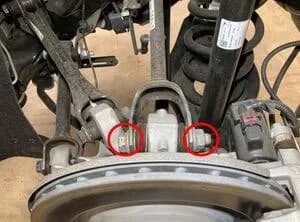
- The two bolts attaching the LH front lower lateral link to the front subframe. If these bolts rotate less than 180 degrees, they are retightened to 135 Nm.
- The nut attaching the LH rear toe link to the rear subframe.
- The bolt attaching the LH rear toe link to the rear knuckle.
- The bolt attaching the LH rear lower aft link to the rear subframe.
- The bolt attaching the LH rear lower aft link to the rear knuckle.
- The bolt attaching the LH rear upper aft link to the rear subframe.
- The bolt attaching the LH rear upper aft link to the rear knuckle.
- This step is repeated for the RH side of the vehicle.
Reassembly and Final Steps
- Install Rear Suspension Covers: Reinstall the LH and RH rear suspension covers.
- Install Front Aero Shield Panel: Reinstall the front aero shield panel.
- Install Rear Wheels: Reinstall the rear wheels.
- Connect Diagnostic Tool: Connect a laptop with "Toolbox 3" to the vehicle.
- Clear Alert: In Toolbox, search for "Clear Alert" and click "PROC_ICE_X_CLEAR-SERVICE-ALERT", then click Run to complete the routine.
- Disconnect Tool: Disconnect Toolbox and remove the laptop.
- Perform Alignment Check: If any suspension component was replaced, refer to the Alignment Requirement tables to determine if an alignment check is necessary. If no suspension component was replaced, a four-wheel alignment check is performed. An alignment correction code should be added to the Service Visit.
Owner Action
If you receive a "customer-facing alert will appear on the touchscreen" regarding Tesla Model 3 chassis abnormalities, it is recommended to schedule an inspection at a Tesla Service Center. The inspection and any necessary repairs will follow the detailed procedure outlined in Service Bulletin SB-25-31-004.
NHTSA Source: SB-25-31-004
Galerie
21 Bilder
Frequently Asked Questions
- What does a 'chassis abnormalities' alert mean on my Tesla?
- A 'chassis abnormalities' alert on your 2017-2025 Tesla Model 3 or Model Y indicates that the vehicle's firmware has detected changes in wheel alignment. This could be due to issues like incorrect tire pressure, degraded ball joints, worn bushings, or damaged suspension links, requiring an inspection as described in TSB SB-25-31-004.
- What is involved in the inspection for Tesla Model 3 chassis abnormalities?
- The inspection involves checking tire pressure, removing wheels and aero panels, and thoroughly examining ball joints, bushings, suspension links, and subframes for cracks, leaks, or excessive movement. Fasteners are also checked for proper torque, and any removed fasteners must be replaced with new ones.
- Will my Tesla require a wheel alignment after this service?
- If any suspension components are replaced during the service, an alignment check is necessary. Even if no components are replaced, a four-wheel alignment check is still performed to ensure proper vehicle dynamics and address the detected Tesla Model 3 chassis abnormalities.
- What are the correction codes associated with this service bulletin?
- Tesla Service Bulletin SB-25-31-004 uses several correction codes depending on the outcome of the inspection and repair. These include S012531004 (Customer Declined Inspection), S022531004 (No Replacement Needed), S032531004 (Customer Declined Repairs), S042531004 (Parts Replaced), and 31000000 for additional suspension link replacements.
Related Articles
2025-2026 Tesla Model 3 / Model Y TPMS Battery Drain TSB
Tesla has issued TSB 11026875 regarding an accelerated tire pressure monitoring system (TPMS) sensor battery drain in certain 2025-2026 Model 3 and Model Y vehicles. This technical service bulletin outlines the process for identifying and replacing affected sensors.
2025 Tesla Cybertruck Health Check: Service Bulletins
The 2025 Tesla Cybertruck currently has no reported recalls, owner complaints, or federal investigations. However, Tesla has issued several service bulletins addressing issues like halfshaft bolt grinding, door shaking, and illegible emission labels.
2026 Tesla Model Y Health Check: Recalls and Bulletins
The 2026 Tesla Model Y has been subject to 5 recalls, addressing issues from a potential loss of drive power to inoperable horns and windshield wiper problems. Additionally, two service bulletins detail concerns like seat blower noise and front fascia camera malfunctions, providing owners with a…
2024 Tesla Model 3 Health Check: Service Bulletins and Concerns
For 2024 Tesla Model 3 owners and prospective buyers, this detailed profile examines the vehicle's reliability based on official manufacturer service bulletins. Learn about potential issues like HV battery quality, misrouted wheel speed sensors, and rattling air vents.
2024 Tesla Model Y Health Check: Recalls and Bulletins
The 2024 Tesla Model Y has faced four safety recalls, including issues with front seat welds, hood latches, rearview camera loss, and warning light font size. Additionally, three service bulletins address camera transparency, HVIL alerts, and owner's manual access. No owner complaints or federal…
Leave a comment
Comments are moderated and may take a moment to appear. Only your first name and the initial of your last name are shown publicly.
Comments
Be the first to comment.