2022-2023 Hyundai Tucson, Santa Fe, Santa Cruz Brake Judder TSB
Hyundai has released Technical Service Bulletin 23-BR-004H addressing brake judder in certain 2022-2023 Tucson, Santa Cruz, and Santa Fe models. This TSB details the inspection, resurfacing, replacement, and burnishing procedures to resolve the issue.
 David Chen2023 Hyundai Tucson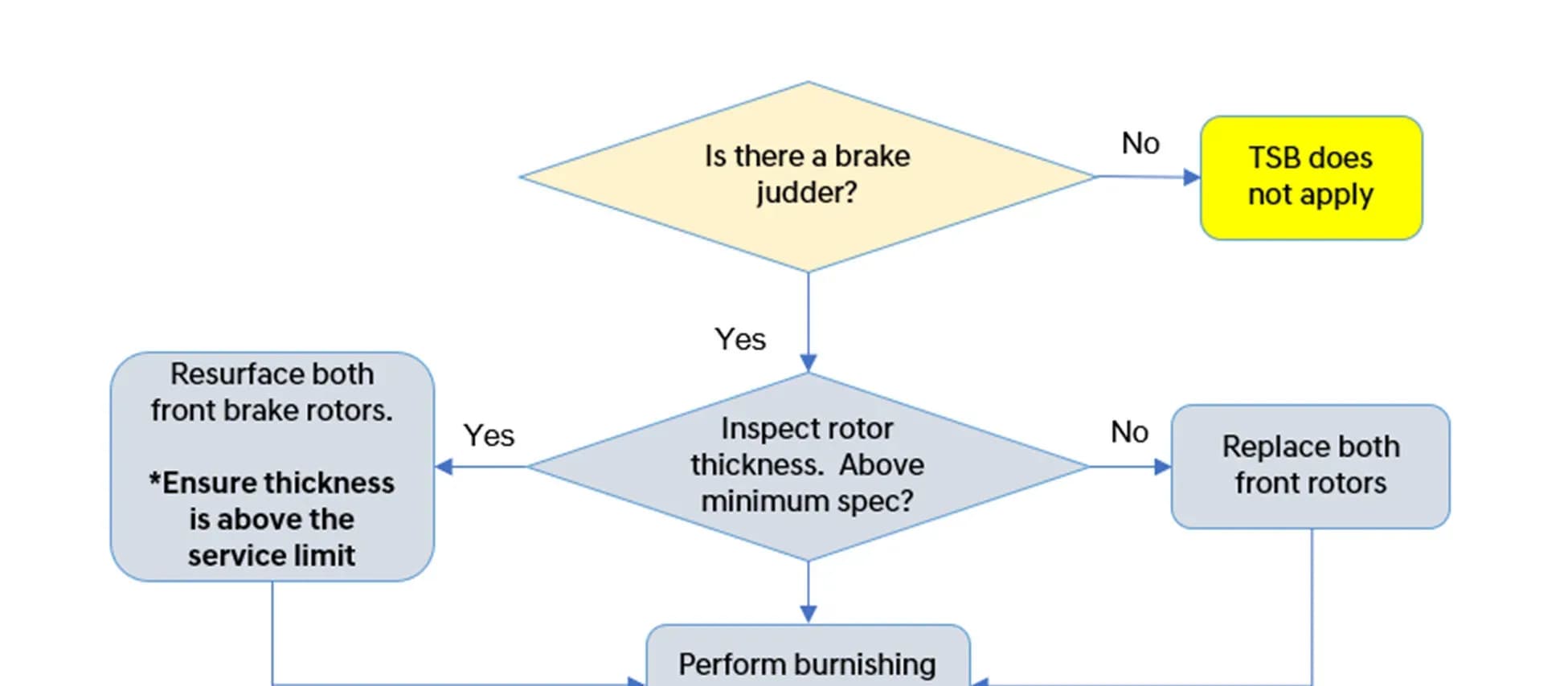
Gilt auch für
- Hyundai Santa Cruz
- 2022–2023
- Hyundai Santa Fe
- 2022–2023
- Hyundai Tucson
- 2022
Hyundai has issued Technical Service Bulletin (TSB) 23-BR-004H to address a brake judder condition that may affect certain 2022-2023 Hyundai Tucson (NX4A), Santa Cruz (NXT), Santa Fe (TMA), and Santa Fe Hybrid (TMA HEV) vehicles. This bulletin provides a comprehensive guide for technicians to inspect, service, and resolve the Hyundai brake judder issue. The TSB, dated November 2023, details procedures for brake inspection, resurfacing or replacement, and a crucial brake burnishing process.
Symptoms
Owners of affected vehicles may experience a Hyundai brake judder condition. This typically manifests as a vibration or pulsation felt through the brake pedal or steering wheel when applying the brakes. This sensation indicates an irregularity in the brake rotors, which can affect braking performance and driving comfort.
Diagnosis and Trigger Conditions
To diagnose the Hyundai brake judder, technicians will first confirm the presence of the judder. If confirmed, the front brake rotors will be inspected, with a critical step being the measurement of rotor thickness. The standard thickness for these brake discs is 30mm (1.18 inches), with a service limit of 28mm (1.10 inches). If the rotor thickness is below this service limit, replacement is necessary.
For accurate measurement, technicians are instructed to "remove all surface contamination and corrosion to ensure an accurate measurement." Measurements should be taken at "8 points (every 45 degrees)" around the rotor, specifically 5-10mm (0.2-0.4 inches) inboard from the outer edge. These measurements must be recorded on the repair order sheet.
Repair Procedure Summary
The repair process outlined in TSB 23-BR-004H involves several key steps:
- Initial Inspection: Verify the presence of brake judder. If no judder is present, the TSB does not apply.
- Rotor Thickness Inspection: Measure the thickness of both front brake rotors. If the thickness is above the 28mm service limit, the rotors can be resurfaced. If it is at or below the service limit, both front rotors must be replaced.
- Resurfacing or Replacement:
- If resurfacing, an on-car brake lathe is recommended. Technicians must measure rotor thickness both BEFORE and AFTER machining to ensure it remains within specification.
- If replacement is necessary, new front brake discs will be installed.
- Rotor Runout Inspection: With the brake rotors and calipers fully assembled, inspect the rotor runout. A dial indicator should be mounted on the brake rotor 5-10mm or 0.2-0.4 inches inboard of the outer edge, and the measurement recorded.
- Cleaning and Tightening: Verify that the rotors are free of grease or other contamination, cleaning with brake cleaner if needed. All bolts must be tightened to the torque specification recommended in the vehicle shop manual.
- Wheel Re-installation: When re-installing the wheels, lug nuts must be tightened in a star pattern to the specified torque to reduce the chance of runout.
- Brake Burnishing Procedure: After installing machined or new rotors, a specific brake burnishing procedure must be performed.
Brake Burnishing Procedure
This critical step ensures proper seating of the brake pads to the rotors:
- Drive the vehicle and accelerate to 50 mph. Apply the brakes using moderate force (approximately 0.3g deceleration rate) to slow the vehicle to 10 mph. This action should take approximately 6 seconds.
- With as little cooling time as possible between braking events, repeat this procedure 10 times.
Required Tools and Parts
For this service, an on-car brake lathe, such as the PFM 9.0 or higher version by PRO-CUT, is recommended. This tool is available through Bosch (contact at 1-866-539-4248).
Replacement front brake discs are available under the following new part numbers:
- Tucson (NX4A): 51712-L0100QQH (replaces 51712-L0100)
- Santa Cruz (NXT), Santa Fe (TMA), Santa Fe Hybrid (TMA HEV): 51712-R5000QQH (replaces 51712-R5000)
Two discs are required for each service.
Important Warnings and Warranty Information
- Rotor Replacement: "If either rotor's thickness is under the service limit (before or after machining), replace both front rotors." This ensures optimal braking performance and safety.
- Part Return Policy: "Claim is subject to debit if the part is not returned." Incident parts are subject to callback through the Warranty Technical Center (WTC) parts return process.
- Persistent Judder: If the rotors are machined and burnished, but the judder is still present, the rotors may be replaced under warranty. Dealers must submit a campaign claim ending in “R0” for the disc machining and burnishing.
- Claim Submission: Claims should be submitted on the Claim Entry Screen as “Campaign” type. If a part needs replacement and is still under warranty, a separate claim should be submitted using the same repair order.
- Documentation: This TSB requires repair validation photos, including VIN, mileage, and repair validation photos as outlined in the Digital Documentation Policy. Clear photos of freshly resurfaced or new brake rotors (both left and right), with the last 6 digits of the VIN and the repair date on paper, must be uploaded to STUI.
Owner Action
If you experience a Hyundai brake judder in your 2022-2023 Hyundai Tucson, Santa Cruz, or Santa Fe, contact your authorized Hyundai dealer. Referencing TSB 23-BR-004H will help ensure they are aware of the specific procedure for diagnosis and repair. This service is typically covered under warranty if the vehicle meets the specified conditions.
NHTSA ID: 10248882
Galerie
2 Bilder
Frequently Asked Questions
- What is brake judder and why is my Hyundai experiencing it?
- Brake judder is a vibration or pulsation felt when applying the brakes, often caused by uneven wear or thickness variations in the brake rotors. Hyundai TSB 23-BR-004H addresses this condition in certain 2022-2023 Tucson, Santa Cruz, and Santa Fe models, indicating a known issue with the front brake discs.
- How will my Hyundai dealer fix the brake judder?
- According to TSB 23-BR-004H, your dealer will inspect the front brake rotors. Depending on their thickness, they will either resurface both front rotors using an on-car brake lathe or replace them entirely. Following this, a specific brake burnishing procedure will be performed to properly seat the brake pads.
- Are there specific parts or tools required for this repair?
- Yes, the TSB specifies the use of an on-car brake lathe, such as the PFM 9.0 or higher version by PRO-CUT, available through Bosch. For replacement, specific front brake disc part numbers are used: 51712-L0100QQH for Tucson (NX4A) and 51712-R5000QQH for Santa Cruz (NXT), Santa Fe (TMA), and Santa Fe Hybrid (TMA HEV).
- What is the brake burnishing procedure mentioned in TSB 23-BR-004H?
- The brake burnishing procedure is a critical step after resurfacing or replacing rotors. It involves driving the vehicle to 50 mph, then applying moderate braking (around 0.3g deceleration) to slow to 10 mph. This action, taking approximately 6 seconds, must be repeated 10 times with as little cooling time as possible between repetitions.
- What happens if the brake judder returns after the repair?
- Hyundai TSB 23-BR-004H states that if the rotors are machined and burnished, but the judder is still present, the rotors may be replaced under warranty. Your dealer must also submit a specific campaign claim ending in “R0” for the disc machining and burnishing.
Related Articles
Should 2023 Hyundai Tucson Owners Worry? Fire Risk & TSBs
The 2023 Hyundai Tucson faces a significant fire risk recall (NHTSA ID 23V526000) related to its Idle Stop & Go oil pump. Additionally, owners may encounter various issues addressed by service bulletins, including engine misfires, Check Engine Light warnings, Bluelink connectivity problems, and…
2022-2023 Hyundai Tucson Check Engine Light DTC P218100
Hyundai has issued Technical Service Bulletin 26-EM-004H for 2022-2023 Tucson (NX4, NX4A) vehicles experiencing a Check Engine Light due to DTCs P218100, P2181F0, or P2181F1. The fix involves replacing the Integrated Thermal Management (ITM) module and updating the Engine Control Module (ECM) and…
2021-2023 Hyundai Misfire DTCs TSB 26-FL-001H
Hyundai Technical Service Bulletin 26-FL-001H addresses engine misfire diagnostic trouble codes (DTCs) P0300, P0301, P0302, P0303, and P0304 in certain 2021-2023 Hyundai Santa Fe, Santa Cruz, Sonata, and Tucson vehicles. The issue stems from internally leaking GDI fuel injectors.
2022-2024 Hyundai Santa Cruz / Tucson Manual Speed Limit Assist
This communication explains the Manual Speed Limit Assist (MSLA) feature in 2022-2024 Hyundai Santa Cruz and Tucson vehicles, detailing its function, activation, and how it helps drivers maintain speed limits.
2021-2025 Hyundai Bluelink Connectivity AVN Pinhole Reset
Hyundai has issued Service Campaign 25-01-024H to address a loss of Bluelink connectivity or interruptions in service functions. This issue, often linked to Verizon's network, is resolved by performing an AVN pinhole reset.
Leave a comment
Comments are moderated and may take a moment to appear. Only your first name and the initial of your last name are shown publicly.
Comments
Be the first to comment.