2025-2026 Audi A5/Q5 Drive System Fault TSB 2079998/3
Audi has released Technical Service Bulletin 2079998/3 for 2025-2026 A5, Q5, S5, and SQ5 models to address a "drive system fault" warning. This issue is often accompanied by diagnostic trouble codes P071100 and P270800, and is resolved through a combined software update.
 David Chen2026 Audi A5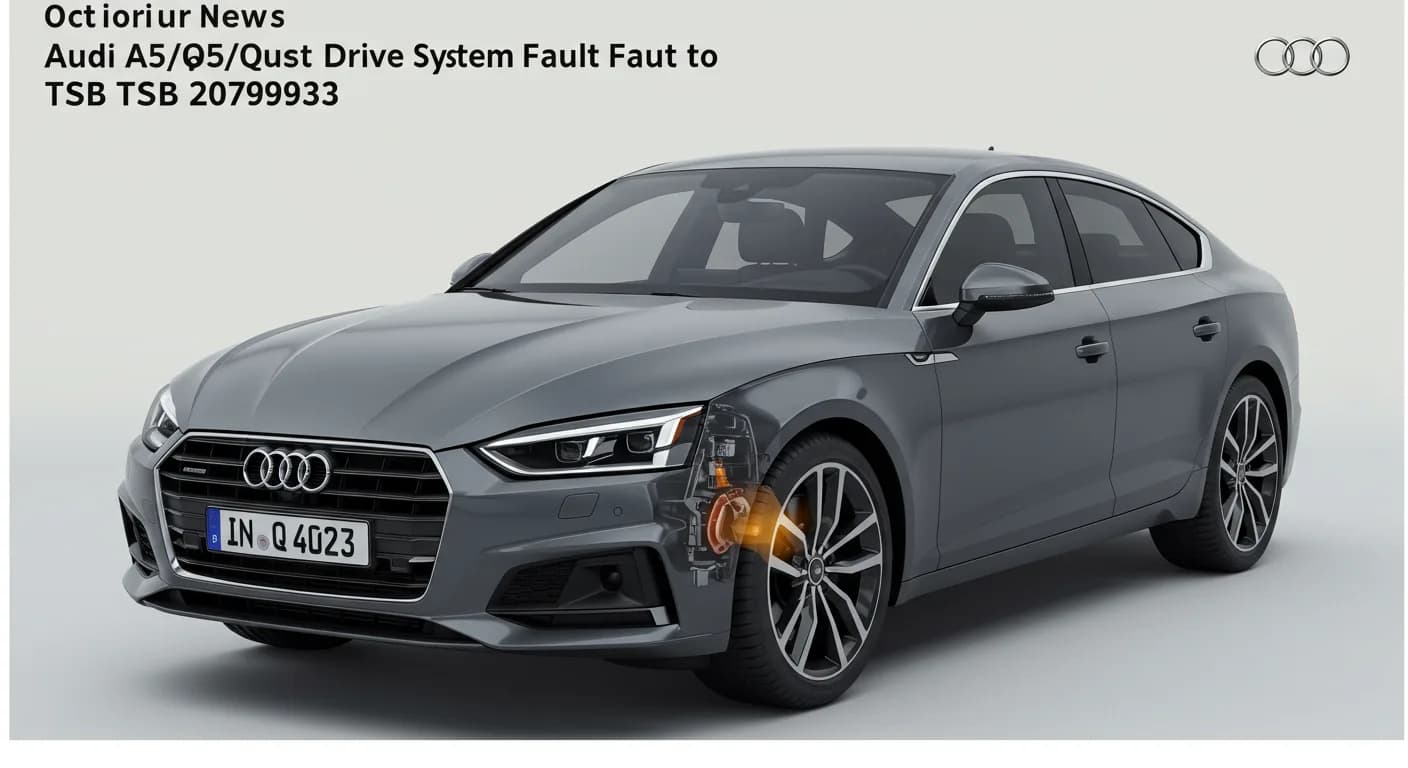
Gilt auch für
- Audi A5
- 2025
- Audi Q5
- 2025–2026
- Audi S5
- 2025–2026
- Audi SQ5
- 2025–2026
Audi has issued Technical Service Bulletin (TSB) 2079998/3 to address a specific "drive system fault" that may appear in the instrument cluster of certain 2025-2026 Audi A5, S5, Q5, and SQ5 models. This bulletin, released on December 18, 2025, provides a solution for customers experiencing this warning, which is often linked to specific diagnostic trouble codes (DTCs) related to the gearbox electronics.
This TSB supersedes PSS TSB 2078847 and highlights that the primary fix for the Audi A5 drive system fault is a combined software update. It's crucial for owners to be aware of this bulletin, as it outlines the proper diagnostic and repair procedures for this condition.
Revision History
Technical Service Bulletin 2079998/3 has undergone several revisions to ensure accuracy and completeness:
- Revision 1 (November 10, 2025): Initial publication of the bulletin.
- Revision 2 (November 10, 2025): Revised the condition description and corrected instructions.
- Revision 3 (December 18, 2025): Revised the header to add model years and updated warranty information, including labor operations.
Symptoms Owners May Notice
Owners of affected 2025-2026 Audi vehicles may observe the following symptom:
- "The drive system fault warning lamp lights up in the dash panel insert."
In some cases, there might not be a direct customer complaint, but the fault codes are found during routine service or in connection with other issues. The primary indication for the driver is the illumination of the warning lamp, signaling a potential Audi A5 drive system fault.
Fault Codes / DTCs
When a "drive system fault" is present, technicians may find one or both of the following event memory entries (DTCs) logged in the gearbox electronics control unit J217, specifically at diagnostic address 0002:
| Code | Description | Symptom Number |
|---|---|---|
| P071100 | "Transmission Fluid Temperature Sensor "A" Circuit Range/Performance" | 20756 |
| P270800 | "Solenoid Valve 6 is sticking on" | 20859 |
These codes indicate specific issues within the transmission system that trigger the overall Audi A5 drive system fault warning, pointing to potential problems with the transmission fluid temperature sensor or a solenoid valve.
Diagnosis and Trigger Conditions
To properly diagnose the issue and ensure it aligns with TSB 2079998/3, technicians are instructed to try and reproduce the customer complaint. This helps confirm that the observed symptoms and logged DTCs precisely match the conditions described in the bulletin. The repair procedure should only be carried out if all criteria, including model/type, chassis number, engine/motor, gearbox code, PR number(s), part number, and software version, are met. Failure to do so may not resolve the problem and could lead to repeat repairs or warranty claim rejections. It is also important to check if TSB 2079690, "00 Combined software update 03.10.00/C (28.13.01) KD2," is applicable to the specific vehicle, and if so, its described software update should be performed.
Repair Procedure Summary
The recommended repair for the Audi A5 drive system fault involves performing a combined software update. This update is designed to optimize the vehicle's software, specifically for the gearbox electronics control unit J217, to prevent the fault from occurring. The process includes:
- Connecting a battery charger: This ensures stable voltage during the software update process.
- Performing the software update: This is a fixed-rate operation that includes all necessary preliminary and follow-up work, such as bus sleep cycle management and calibration drives. The specific service number for this operation is 3730, with a damage code of KD02.
- Labor Operations:
- 0151 0010: Software update, including connecting the battery charger (refer to SRT for associated operations).
- 0151 0040: Fixed rate for software update, including all required preliminary and follow-up work (bus sleep cycle, calibration drives, additional work), allocated 130 time units (TU).
- 0150 9999: For additional attempts due to flash cancellation, an additional lump sum of 50 time units per documented attempt is possible.
When performing the combined software update, time stamps are not required for billing under warranty, allowing technicians to work on other vehicles simultaneously. This combined software update can also be performed by non-productive personnel.
Important Warnings for Owners
Owners should be aware of the following critical information regarding this software update and their vehicle's warranty:
- Warranty Coverage: If your vehicle is outside of its warranty period, this Technical Service Bulletin 2079998/3 is for informational purposes only. All warranty claims must adhere to the Audi Warranty Policies and Procedures Manual. Claims are subject to review or audit by Audi Warranty.
- Chip Tuning: If your vehicle's engine control unit software has been modified by chip tuning, you must inform the dealer. Updating the engine control unit software will render chip tuning ineffective. In certain circumstances, the engine control unit may even be damaged by the software update. Audi advises that you clarify with the tuning company in advance whether a software update is possible. Damage to the engine control unit resulting from chip tuning cannot be billed to AUDI AG under warranty. Neither AUDI AG nor the dealership can be held responsible for damage caused by the software update or for damage that occurs as the result of not having the update performed. It is crucial to make a note to this effect on the repair order before it is signed by the customer and include this information in the customer file.
Owner Action
If you own a 2025-2026 Audi A5, S5, Q5, or SQ5 and experience the "drive system fault warning lamp lights up in the dash panel insert" or suspect your vehicle may be affected by the P071100 or P270800 DTCs, you should schedule an appointment with an authorized Audi service center. The service center will diagnose the issue and perform the necessary combined software update as outlined in TSB 2079998/3. This service is typically covered under warranty if your vehicle qualifies.
Source: NHTSA ID: 11027421, Transaction No.: 2079998/3
Frequently Asked Questions
- What does the "drive system fault" warning mean in my 2025-2026 Audi?
- The "drive system fault" warning lamp in your instrument cluster indicates an issue with your vehicle's powertrain. According to Audi TSB 2079998/3, it's often related to specific diagnostic trouble codes (DTCs) like P071100 or P270800, which point to problems within the gearbox electronics control unit J217.
- How is the Audi A5 drive system fault typically repaired?
- The primary repair for the Audi A5 drive system fault, as per TSB 2079998/3, is a combined software update. This update optimizes the software for the gearbox electronics control unit to resolve the underlying issues causing the warning light and associated DTCs.
- Will a software update for DTC P071100 affect my vehicle's chip tuning?
- Yes, if your engine control unit has been modified by chip tuning, the software update for DTC P071100 and the "Audi A5 drive system fault" will render the chip tuning ineffective. It could also potentially damage the engine control unit. Audi advises discussing this with your dealer and the tuning company before proceeding with the update.
- Is the repair for the Audi A5 drive system fault covered by warranty?
- If your 2025-2026 Audi A5, S5, Q5, or SQ5 is still under warranty, the combined software update described in TSB 2079998/3 is typically covered. However, if your vehicle is outside of warranty, the bulletin is informational, and you may be responsible for the cost. All warranty claims must adhere to Audi's policies.
Weitere Revisionen dieses TSB
- 2025-2026 Audi Gearbox DTCs P187C00, P086900, P270800P270800
- 2025-2026 Audi Gearbox Functional Issue DTC P187C00P270800
- 2025 Audi A5/Q5/S5 Drive System Fault TSB 2079998/4P071100, P270800
- 2025 Audi A5/Q5/S5 Drive System Fault DTC P071100P071100, P270800
- 2025 Audi A5/Q5/S5 Drive System Fault DTC P071100P071100, P270800
- 2025 Audi A5/Q5 Gearbox Functional Issue TSB 2078831/1P270800
- 2025 Audi A5/Q5 Drive System Fault P071100 TSBP071100, P270800
Related Articles
2025-2026 Audi A5/Q5 Front Anti-Roll Bar Rattling TSB
Audi has released a manufacturer communication, TSB 2081444/1, addressing a metallic rattling noise from the front of 2025-2026 Audi A5, Q5, S5, and SQ5 models, often linked to a broken front anti-roll bar. This TSB outlines a reporting obligation for technicians to gather data.
2025-2026 Audi Rear Occupant Detection Alarm TSB
This Technical Service Bulletin (TSB) 2080144/3 addresses an issue in 2025-2026 Audi A5, S5, Q5, and SQ5 models where the rear occupant detection system can cause unwanted triggering of the anti-theft alarm, leading to horn sounding and lights flashing. A software update is available to resolve…
2025-2026 Audi A5/S5/Q5/SQ5 P-Lock & Engine Warning TSB
Audi has released Technical Service Bulletin (TSB) 2080044/3 to address issues where the transmission parking lock (P) cannot be selected, or a yellow engine warning lamp illuminates in 2025-2026 Audi A5, S5, Q5, and SQ5 models. This TSB provides a software update to resolve diagnostic trouble…
2025-2026 Audi myAudi App Range Display Issue TSB 2080573/1
Audi Technical Service Bulletin (TSB) 2080573/1 addresses an issue where the range displayed in the myAudi app changes significantly after parking, then corrects itself after the next vehicle start for 2025-2026 A5, S5, Q5, SQ5 models.
2025-2026 Audi A5/S5/Q5/SQ5 Drivetrain Clacking Noise TSB
Audi has issued Technical Service Bulletin (TSB) 2080535/1 for 2025-2026 A5, S5, Q5, and SQ5 models experiencing 'load-change clacking noises from drive train'. This TSB outlines a software update to resolve the issue, particularly noticeable at low speeds.
Leave a comment
Comments are moderated and may take a moment to appear. Only your first name and the initial of your last name are shown publicly.
Comments
Be the first to comment.