2022-2024 Toyota Models Missing Second Smart Key Program
Toyota has launched the Second Key Delivery Program (23TJ01) for 2022-2024 models, including the Toyota Camry, that were delivered with only one Smart Key due to a global semiconductor shortage. Owners will receive a second Smart Key free of charge.
 Ahmet Topcu2023 Toyota Camry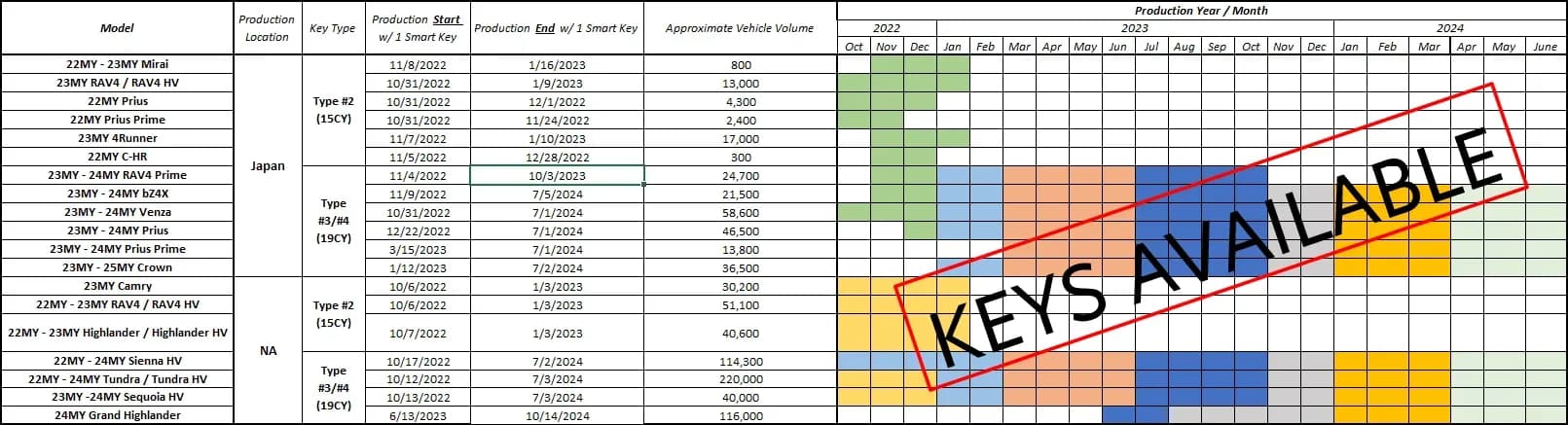
Also applies to
- Toyota 4Runner
- 2023
- Toyota bZ4X
- 2023–2024
- Toyota C-HR
- 2022
- Toyota Crown
- 2023–2024
- Toyota Grand Highlander
- 2024
- Toyota Highlander
- 2022–2023
- Toyota Mirai
- 2022–2023
- Toyota Prius
- 2022–2024
- Toyota RAV4
- 2022–2023
- Toyota Tundra
- 2022–2024
▸ Show 4 more▾ Show fewer
Program Overview and History
The "Second Key Delivery Program" (23TJ01) is a significant initiative by Toyota to address a widespread issue affecting numerous 2022-2024 models, including the Toyota Camry. This program was launched because a global semiconductor shortage led to many vehicles being delivered with only one Smart Key and a basic mechanical key. Toyota has committed to providing the missing second Smart Key "FREE OF CHARGE" to all eligible owners. The program designation "23TJ01" indicates it was launched in 2023, applies to Toyota vehicles (T), is a Customer Support Program (J), and is the first such field action of the year (01).
This program has undergone several updates since its inception, reflecting Toyota's dynamic response to the semiconductor supply chain challenges. The initial dealer letter was first updated on August 29, 2022, detailing the original scope and plans. Subsequent revisions progressively expanded the program's reach by adding vehicles in various phases. For instance, Phase 2 vehicles were added on October 12, 2023, encompassing approximately 150,000 units, and additional Phase 2 NAP vehicles were included on November 21, 2023. The program continued to expand with Phase 3 (approx. 60,000 vehicles), Phase 4 (approx. 132,000 vehicles), Phase 5 (approx. 142,000 vehicles), Phase 6 (approx. 113,000 vehicles), Phase 7 (approx. 99,000 vehicles), and Phase 8 (approx. 135,000 vehicles) being progressively added. The latest update on October 24, 2024, finalized the inclusion of Phase 8 vehicles, bringing the total number of covered vehicles to approximately 882,100 across the U.S. and Puerto Rico. This phased approach allowed Toyota to manage parts availability effectively while addressing the needs of a large volume of affected vehicles.
Understanding the Smart Key Issue
The core of the problem stems from a global semiconductor shortage that began impacting microchip availability in October 2022. These microchips are crucial components within the Smart Keys, enabling features like keyless entry and push-button start. As a direct consequence of this shortage, Toyota was forced to deliver affected vehicles with only one functional Smart Key and a second mechanical key. It's important for owners to understand that while the mechanical key can "open/close doors," it "cannot be used to start the engine," significantly limiting its utility compared to a fully functional Smart Key. This distinction is vital for owners who rely on the convenience and security of two Smart Keys.
Toyota utilizes different types of Smart Keys across its vehicle lineup, specifically Type #2 (15CY) and Type #3/#4 (19CY). These key types have distinct designs and incorporate different semiconductors. The specific models impacted by the shortage, and consequently the timelines for remedy availability, varied depending on which Smart Key type they used. This differentiation explains why the program was rolled out in phases, as supply chain improvements for one type of semiconductor might not immediately affect the other. Fortunately, the broader semiconductor shortage has largely resolved, and all affected models returned to production with two Smart Keys by July 2024, marking a significant milestone in overcoming this supply chain challenge.
How to Obtain Your Second Smart Key
Owners of eligible 2022-2024 Toyota models, including the Toyota Camry, are entitled to receive their second Smart Key at no cost. Toyota has begun a phased implementation of the remedy, with sufficient parts now available. To initiate the process, you should contact your authorized Toyota dealer to schedule an appointment. The dealer will need to order a new Smart Key specifically for your vehicle in advance of your visit.
During your appointment, the dealer will duplicate and program the new Smart Key. This process involves registering the new key with both the Vehicle Immobilizer System and the Wireless Door Lock Control System to ensure full functionality. The actual key pairing procedure is estimated to take approximately 45 minutes. However, depending on the dealer's workload and scheduling, the total time your vehicle may need to be at the dealership could be longer.
Important Warnings and Owner Information
Several critical points are highlighted by Toyota for owners regarding the Second Key Delivery Program:
- Notification Process: Toyota will notify affected customers by first-class mail when their second keys become available. The mailing schedule is phased, with Phase 1 notifications sent in July 2023, and subsequent phases extending through November 2024 for Phase 8.
- Eligibility Verification: If you are contacted by an owner who has not yet received a notification, or if you believe your vehicle is covered but haven't heard from Toyota, dealers are instructed to "verify eligibility by confirming through TIS prior to providing a second key to any guest."
- TCUV Sales: For Toyota Certified Used Vehicles (TCUV), the "Second Key Delivery Program will need to be completed prior to delivery to the customer." This means if you are purchasing a TCUV, ensure the second key has been provided.
- New Vehicle Delivery: For new or used vehicles currently in dealer inventory, Toyota requests that dealers deliver the second key prior to customer delivery. However, if the key is not immediately available, delivery is acceptable "provided that the guest is clearly informed that they will only be receiving one key at the time of delivery until the second key is available." The disclosure form explicitly states, "parts are not available and the second key has NOT been provided" for some vehicles at the time of sale.
- Multi-Information Display (MID) Message: After a new Smart Key is registered, a message on the Multi-Information Display (MID) about "a new key being registered" may appear. This message can display for up to 10 days and is a normal security feature designed to inform the owner and deter unauthorized vehicle theft.
- Not a Warranty Item: Toyota clarifies that this "Second Key Delivery Program" is "not considered part of Toyota's New Vehicle Limited Warranty." Instead, it is the delivery of a purchased item that was unavailable at the time of vehicle delivery due to the chip shortage.
Dealer Procedures and Technical Details
For authorized Toyota dealers, implementing the Second Key Delivery Program (23TJ01) involves specific procedural steps and requires specialized technician training. Dealers must first confirm a vehicle's eligibility using the Vehicle Inquiry System (TIS) to ensure it falls within the scope of the current program phase. The remedy procedure itself is precise, requiring the registration of the new Smart Key with both the vehicle's Immobilizer System and the Wireless Door Lock Control System. This dual registration is critical to ensure the new key is fully functional for all intended purposes, including starting the vehicle and remote locking/unlocking.
The key component for this program is the "TRANSMITTER SUBASSY, ELECTRICAL KEY," identified by the Part Number 04002-*****. Dealers are directed to refer to the Campaign Part Order Request (CPOR) or Manual Allocation Control (MAC) reports for precise ordering information, as part availability can be limited and managed through these systems. All technicians performing this key programming and delivery activity must have successfully completed specific E-Learning courses to ensure proper execution and quality. These required courses include "Safety Recall and Service Campaign Essentials" and "TIC206a Electrical Repair 1." Toyota emphasizes that dealerships must select technicians with the appropriate certification level to perform this activity.
For warranty reimbursement, dealers are instructed to use Op Code 23TJ01R1, which covers the provision of the second key and includes a flat rate of 0.4 hours. This flat rate also accounts for 0.1 hours of administrative cost per unit, acknowledging the overhead involved in processing the claim. To maintain repair quality and customer satisfaction, Toyota requires that at least one associate, other than the technician who performed the repair, verify the activity for every vehicle before customer delivery. This quality control step is crucial for ensuring the new Smart Key is correctly programmed and fully operational.
Owner Action and Next Steps
If you own a 2022-2024 Toyota model, such as a Toyota Camry, and were affected by the missing second Smart Key, your primary action is to await notification from Toyota. Once you receive your first-class mail notification, contact your authorized Toyota dealer to schedule your appointment. Remember to bring your vehicle and your original Smart Key, as it will be used to program the new key. The service will be performed at no charge to you.
For any additional questions or concerns, you can reach out to the Toyota Brand Engagement Center at 1-888-270-9371. They are available Monday through Friday from 8:00 AM to 8:00 PM EST and Saturday from 9:00 AM to 7:00 PM EST. You can also update your vehicle ownership or contact information online at www.toyota.com/owners.
Source: NHTSA ID 11010359
Gallery
4 images
Frequently Asked Questions
- Why did my 2022-2024 Toyota vehicle come with only one Smart Key?
- Your vehicle, like many 2022-2024 Toyota models, was delivered with only one Smart Key due to a global semiconductor shortage that affected the microchips needed for Smart Key production.
- How can I get my second Smart Key for my Toyota Camry?
- Toyota is providing a second Smart Key "FREE OF CHARGE" under the Second Key Delivery Program 23TJ01. You will be notified by mail when your key is available, after which you should schedule an appointment with your dealer to have it programmed.
- What should I do if I haven't received a notification but think my vehicle is affected?
- If you believe your 2022-2024 Toyota, such as a Toyota Camry, is part of this program but haven't been notified, contact your Toyota dealer. They can verify your vehicle's eligibility through their Technical Information System (TIS).
- What is the significance of the part number 04002-***** in this program?
- The part number 04002-***** refers to the "TRANSMITTER SUBASSY, ELECTRICAL KEY," which is the specific Smart Key component that dealers will order and program for affected vehicles under the 23TJ01 program.
- Will I see any messages on my dashboard after the new Smart Key is programmed?
- Yes, after a new Smart Key is registered, you might see a message on your Multi-Information Display (MID) stating "a new key being registered" for up to 10 days. This is a normal security feature to inform you of the new key registration.
Related Articles
2021-2024 Toyota Low Oil Pressure DTCs P05202A P052477
An obsolete Lexus Technical Service Bulletin (L-SB-0021-25) addressed issues in certain 2021-2024 Toyota models, including the Toyota Camry, related to low oil pressure DTCs P05202A and P052477, a MIL ON, and milky/discolored engine oil in freezing temperatures. This bulletin was declared obsolete…
2023-2026 Toyota Models AC Leak Detection TSB
Toyota has issued T-SB-0058-23 Rev1 to detail procedures for identifying and repairing air conditioning refrigerant leaks using dye injection and O-ring joint inspections for various 2023-2026 models.
2018-2024 Toyota Head Unit Data Download Instructions TSB
Toyota's Tech Tip T-TT-0780-25 provides detailed instructions for technicians to download Multimedia Recorder (MMR) data from the head unit of various 2018-2024 models. This data helps diagnose audio, connectivity, and screen-related concerns.
2021-2024 Toyota Navigation Map Update TSB
Toyota has issued Technical Service Bulletin T-SB-0106-22 detailing the process for updating navigation maps and system software on 2021-2024 Toyota vehicles equipped with Premium Audio and Dynamic Navigation Systems. This update requires a Special Service Tool (SST) USB flash drive and may…
2023-2025 Toyota Wheel Film for Brake Rotor Rust
Toyota Technical Service Bulletin T-SB-0038-24 describes the use of wheel film on 2023-2025 Toyota vehicles to prevent brake rotor rust during transportation and storage. This film should remain on the wheels until just before customer delivery. Learn about its purpose and removal.
Leave a comment
Comments are moderated and may take a moment to appear. Only your first name and the initial of your last name are shown publicly.
Comments
Be the first to comment.