2021-2023 Nissan 12V Battery Testing Guidelines
Nissan Technical Service Bulletin NTB23-049 provides essential guidelines for 12V battery testing in 2021-2023 Nissan vehicles. This bulletin aims to reduce incorrect 'Test with DCA' and 'Replace' results, ensuring accurate battery diagnosis and preventing premature battery replacement.
 Marcus Weber2023 Nissan Sentra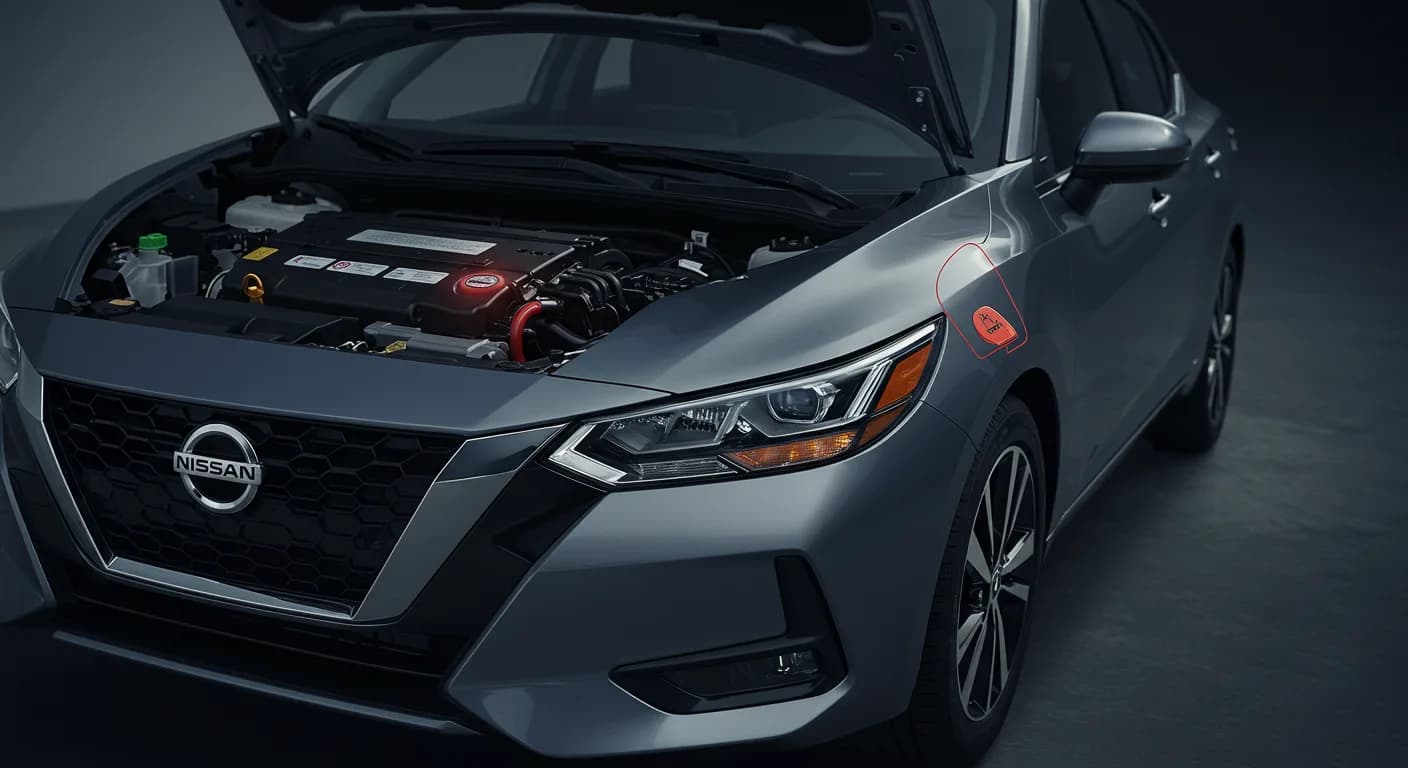
Also applies to
- Nissan Altima
- 2021–2023
- Nissan Armada
- 2021–2023
- Nissan Frontier
- 2021–2023
- Nissan GT-R
- 2021–2023
- Nissan Kicks
- 2021–2023
- Nissan Leaf
- 2021–2023
- Nissan Maxima
- 2021–2023
- Nissan Murano
- 2021–2023
- Nissan NV
- 2021
- Nissan NV200
- 2021
- Nissan Pathfinder
- 2021–2023
- Nissan Rogue
- 2021–2023
- Nissan Rogue Sport
- 2021–2022
- Nissan Sentra
- 2021–2022
- Nissan Titan
- 2021–2023
- Nissan Versa
- 2021–2023
▸ Show 10 more▾ Show fewer
Nissan Technical Service Bulletin (TSB) NTB23-049, issued on June 16, 2023, outlines critical procedural recommendations for performing 12V battery testing on in-service Nissan vehicles. This bulletin, classified as EL23-011, aims to standardize connection processes during testing. The primary goal is to reduce the number of incorrect "Test with DCA" and "Replace" results, ensuring more accurate battery diagnoses across all Nissan models from 2021 to 2023.
Symptoms and Potential Issues
Owners might experience premature battery failure or replacement due to improper testing and maintenance. If 12-volt batteries are allowed to discharge for an extended period, their lifespan can be significantly reduced, leading to customer dissatisfaction. Incorrect testing procedures can lead to unnecessary battery replacements, even when the battery is still functional.
Important Warnings for Owners
Nissan emphasizes several key warnings to ensure proper battery care and testing:
- Battery Discharge: "If 12 volt batteries are allowed to discharge for a prolonged period of time, battery life may be drastically reduced. This condition may lead to premature battery replacement and customer dissatisfaction."
- Engine Starting for Testing: "Dealers should discontinue the practice of starting an engine to see if the battery is 'good.'" Starting an engine with a low State Of Charge (SOC) battery can further damage it if not recharged immediately.
- Idle Charging: "Idling the engine to charge the battery is NOT recommended for most vehicles" as its effectiveness varies. However, for 2021 and newer Rogue (T33) and 2022 and newer Pathfinder (R53) models, idle charging can be used if the vehicle is properly prepared and in shipping mode with the extended storage switch confirmed.
- Cold Battery Testing: "Testing a 'cold' battery (below freezing) may result in incorrect test decisions." The DCA-8000 tool can warm a cold battery for more accurate testing.
- EFB/AGM Charging Safety: "To avoid the risk of death, severe personal injury or damage to the vehicle, do not use a battery charger that does not have an EFB specific charging profile." Similarly, for AGM batteries, a non-AGM diagnostic charge can cause damage.
- Charging Location: "To avoid the risk of death, severe personal injury or property damage, remove the battery from the vehicle and place it in a well-ventilated area before starting the charging cycle. Charging the battery while in the vehicle may cause battery acid to leak onto the vehicle and/or flammable gases to combust while charging."
- Negative Terminal Connection: When connecting testing tools, "DO NOT connect to the threaded stud for testing purposes." Instead, "Connect directly onto the battery terminal for testing purposes."
Recommended Testing Tools
Nissan recommends specific tools for accurate 12V battery testing:
- CPX-900: A hand-held testing tool, now an accepted option alongside or in place of the DSS-5000. Operating instructions are available at https://nissancpx900.midtronics.com/.
- DSS-5000: Another hand-held testing tool. Operating instructions are available at https://nissandss5000.midtronics.com/.
- DCA-8000: This stand-alone tool is now required for all warranty replacement decisions. It also functions as a more efficient charger for 12-volt lead-acid batteries. Operating instructions are at https://nissandca8000.midtronics.com/.
Proper Battery Connection Techniques
Accurate testing relies on establishing good connections. For hand-held tools, the positive lead should connect directly to the battery post or terminal. For the negative lead, connect directly to the battery post or a ground strap if equipped. It is crucial to avoid connecting the negative lead to any threaded studs, as this can lead to inaccurate readings. When using the DCA-8000, it is recommended to remove the battery from the vehicle and connect the tool directly to the battery posts for optimal testing.
Battery Maintenance for Stored Vehicles
For vehicles in storage or inventory, proper battery maintenance is essential to prevent discharge. Vehicles should be kept in "inventory-condition" (storage-mode) with transit mode and extended storage switch engaged to minimize battery drain. For vehicles stored on a dealer lot, the battery's State Of Charge (SOC) should be routinely checked every 30 days using the DSS-5000 or CPX-900, and charged with the DCA-8000 as needed.
Understanding Different Battery Types
Nissan vehicles are increasingly equipped with Enhanced Flooded Batteries (EFB) and Absorbent Glass Mat (AGM) batteries, which require specific testing and charging procedures. It's vital to verify the battery type to ensure correct tests are performed and to prevent damage to the battery or vehicle systems. EFBs require an equalization charge, and both EFB and AGM batteries need specialized charging profiles. Using a non-specific charger can lead to battery acid leaks or combustible gases. Technicians should check battery markings for designations like "EFB," "AGM," "VRLA," or consult the battery supplier if unsure.
Owner Action
If you own a 2021-2023 Nissan, including a Nissan Sentra, and are concerned about your 12V battery's health, ensure your service center is aware of and follows TSB NTB23-049. Discuss with your technician the specific battery type in your vehicle and the proper testing and charging procedures. Adhering to these guidelines will help ensure accurate diagnoses and prolong your battery's life, preventing premature replacements.
Source: NHTSA ID: 10239060
Frequently Asked Questions
- Why is proper 12V battery testing important for my 2021-2023 Nissan?
- Proper 12V battery testing, as outlined in Nissan TSB NTB23-049, is crucial to prevent incorrect diagnoses like "Test with DCA" and "Replace" results. This ensures your battery is accurately assessed, avoiding premature replacement and potential customer dissatisfaction.
- What are the risks of incorrect 12V battery testing or charging?
- Incorrect testing can lead to premature battery replacement. Improper charging, especially for Enhanced Flooded Batteries (EFB) or Absorbent Glass Mat (AGM) types, can cause severe personal injury, vehicle damage from battery acid leaks, or even combustion of flammable gases if the wrong charger profile is used or if the battery is charged inside the vehicle.
- What tools should my Nissan service center use for 12V battery testing?
- Nissan recommends using the CPX-900 or DSS-5000 hand-held testing tools. For all warranty replacement decisions, the DCA-8000 stand-alone testing and charging tool is required. These tools help ensure accurate battery assessments.
- How does my battery type (EFB/AGM) affect testing and charging?
- Enhanced Flooded Batteries (EFB) and Absorbent Glass Mat (AGM) batteries require specific charging profiles and procedures. It's critical to identify your battery type to ensure the correct tests are performed and that only compatible chargers with the appropriate EFB or AGM specific charging profiles are used to prevent damage.
- What should I do if my Nissan Sentra is stored for a long time?
- If your Nissan Sentra is stored for an extended period, ensure it's in 'inventory-condition' or 'storage-mode' to minimize battery drain. The battery's State Of Charge (SOC) should be checked every 30 days using a recommended tool like the DSS-5000 or CPX-900, and charged with the DCA-8000 if necessary.
Related Articles
2021-2024 Nissan ICC Inoperative with DTC C1A16 or C2582
Nissan has issued TSB NTB19-033G for 2021-2024 models experiencing Intelligent Cruise Control (ICC) malfunctions, AEB/FEB warning lights, or radar obstruction messages with DTCs C1A16 or C2582. The bulletin outlines diagnostic steps and potential ICC distance sensor replacement.
2020-2025 Nissan Sentra Loss of Power DTC P2100 P2101
Nissan has released TSB NTB25-005 for 2020-2025 Sentra models experiencing a loss of power. This issue is often accompanied by diagnostic trouble codes P2100 ('ETC MOT PWR-B1') or P2101 ('ETC FNCTN/CIRC-B1') stored in the Engine Control Module (ECM). The bulletin provides a revised diagnostic…
2020-2023 Nissan Models: DTC B2E1B-06 (Automatic eCall) Bulletin Inactive
Nissan Technical Service Bulletin NTB23-031A, concerning DTC B2E1B-06 (Automatic eCall) in various 2020-2023 models, has been declared inactive. Owners who previously encountered this diagnostic trouble code should note that this specific bulletin is no longer applicable.
2021-2024 Nissan Remote Command DTCs B2E4B-06, B2E60-06
Nissan has issued TSB NTB21-037D for 2021-2024 Sentra, Pathfinder, and Rogue models experiencing NissanConnect remote command issues with DTCs B2E4B-06, B2E60-06, B2E61-06. The problem is linked to a cloud-server, and replacing the TCU is not the solution. Learn what steps to take.
2021-2024 Nissan BCM Replacement Service Bulletin
Nissan TSB NTB20-074B provides crucial service information for replacing the Body Control Module (BCM) in 2021-2024 ARIYA, Pathfinder, Rogue, and Sentra vehicles. It outlines essential steps for module configuration and intelligent key pairing to prevent damage and ensure proper function.
Leave a comment
Comments are moderated and may take a moment to appear. Only your first name and the initial of your last name are shown publicly.
Comments
Be the first to comment.