2022-2024 Honda Civic Seat Belt Slow to Retract
If your 2022-2024 Honda Civic seat belt is slow to retract or stops retracting, dirt and contamination on the webbing and D-ring guide are likely culprits. Honda ServiceNews Article A24030A outlines a simple cleaning procedure to resolve this common issue and restore proper seat belt function.
 Ahmet Topcu2023 Honda Civic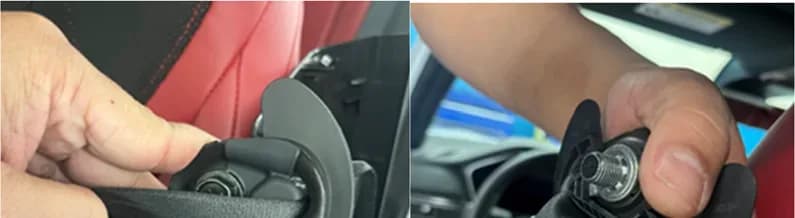
Also applies to
- Honda Civic
- 2022, 2024
Owners of 2022-2024 Honda Civic vehicles may notice that their seat belts are not retracting as quickly or smoothly as they should, or may even stop retracting entirely. This common issue, highlighted in Honda ServiceNews Article A24030A, is typically caused by the accumulation of dirt and debris on critical components of the seat belt system. Addressing this problem promptly is important for both convenience and safety, ensuring the seat belt functions correctly every time.
Symptoms
The primary symptom you will observe is a Honda Civic seat belt slow to retract. This means the seat belt webbing does not pull back into its housing efficiently after being unbuckled. In more severe cases, the seat belt may completely stop retracting, leaving excess slack or causing the belt to hang loosely. This can be a nuisance and may prevent the seat belt from properly securing an occupant.
Why Your Seat Belt Might Be Slow to Retract
The root cause of a Honda Civic seat belt slow to retract is often simple: contamination. Over time, dirt, dust, food particles, and other debris can build up on the seat belt webbing itself. This grime can also accumulate within the D-ring seat belt guide, which is the plastic or metal loop through which the seat belt passes near your shoulder. This buildup creates friction, restricting the smooth movement of the belt and hindering its retraction mechanism. The Honda ServiceNews Article A24030A specifically identifies this as the reason for the issue.
Repair Procedure Summary: Cleaning Your Seat Belt
Fortunately, resolving a Honda Civic seat belt slow to retract issue is often a straightforward cleaning process that can be performed at home. The procedure outlined in Honda ServiceNews Article A24030A involves preparing a gentle cleaning solution and carefully cleaning the affected areas.
- Prepare the Cleaning Solution: Mix a neutral detergent, such as common dishwashing liquid, with lukewarm water. The recommended ratio is 5% dishwashing liquid to 95% lukewarm water. This creates a mild solution that is effective at breaking down grime without being too harsh on the seat belt materials.
- Clean the Seat Belt Webbing: Dampen a cotton rag with the prepared cleaning solution. Carefully wipe down the seat belt webbing, focusing on areas that show visible dirt or feel sticky. Work your way along the entire length of the belt that is typically exposed or used.
- Address Gummy Deposits: For any stubborn or gummy deposits that the rag cannot remove, use a toothpick. Gently scrape away the hardened grime, being careful not to damage the webbing fibers.
- Clean the D-Ring Guide: The D-ring area, where the seat belt makes contact, is crucial. Clean both the front and back surfaces of the D-ring guide using the cotton rag and cleaning solution. This area is particularly prone to friction-causing buildup. In some cases, it may be necessary to remove the D-ring entirely to ensure a thorough cleaning of all contact surfaces.
- Allow to Dry: After cleaning, allow the seat belt and D-ring to air dry completely before using the vehicle. Ensure no moisture remains to prevent future issues or mildew.
Important Warnings
When cleaning your seat belts, it is crucial to follow specific guidelines to avoid damage. Honda ServiceNews Article A24030A explicitly states: "Do not use a microfiber rag as these rags may scratch and damage the surface treatment on the seat belts." Microfiber materials, while excellent for many cleaning tasks, can be abrasive to the delicate surface treatment applied to seat belts, potentially causing premature wear or affecting their performance. Always use a soft cotton rag as recommended.
Owner Action and Prevention
If you experience a Honda Civic seat belt slow to retract, performing the cleaning procedure described above is the recommended first step. This maintenance can significantly improve the retraction speed and overall function of your seat belts. Regular cleaning can also help prevent future buildup, ensuring your seat belts remain in optimal working condition. If, after cleaning, the issue persists, or if you are uncomfortable performing the cleaning yourself, it is advisable to contact a Honda service center for further inspection and assistance.
Gallery
1 image
Frequently Asked Questions
- What does 'Honda Civic seat belt slow to retract' mean?
- This means that after you unbuckle your seat belt, it does not pull back into its housing quickly or smoothly, or it may stop retracting altogether. This can leave the belt hanging loosely or create slack.
- What causes a Honda Civic seat belt to retract slowly?
- According to Honda ServiceNews Article A24030A, the primary cause is the accumulation of dirt, dust, and other contamination on the seat belt webbing and within the D-ring seat belt guide, which creates friction and restricts movement.
- How can I fix a slow retracting seat belt in my 2022-2024 Honda Civic?
- You can fix this by cleaning the seat belt webbing and the D-ring guide. Use a solution of 5% dishwashing liquid and 95% lukewarm water with a cotton rag. A toothpick can help remove stubborn deposits. Ensure you do NOT use a microfiber rag.
- Why should I avoid using a microfiber rag to clean my Honda Civic seat belt?
- Honda ServiceNews Article A24030A specifically warns against using microfiber rags because they can scratch and damage the surface treatment on the seat belts, potentially leading to further issues or premature wear.
- Is the 'Honda Civic seat belt slow to retract' issue covered by a recall?
- This particular issue is addressed by a manufacturer communication (TSB A24030A), which provides a cleaning procedure for technicians and owners. It is not identified as a safety recall, but rather a common maintenance item.
Related Articles
2023 Honda Civic Health Check: Recalls and Bulletins
The 2023 Honda Civic has faced two safety recalls, including issues with the driver's seat and VSA modulator. Additionally, numerous service bulletins address potential problems like engine oil leaks, electric power steering concerns, and rearview mirror detachment.
2022-2025 Honda Rearview Mirror Bracket Detached/Loose
Honda is actively investigating customer complaints regarding a "Rearview Mirror Bracket Detached/Loose" condition in certain 2022-2025 Accord, Civic, and Odyssey vehicles. This manufacturer communication outlines the criteria for vehicles to qualify for a parts collection program to understand…
2022-2025 Honda Rearview Mirror Bracket Detached/Loose
Honda is actively seeking specific 2022-2025 Accord, Civic, and Odyssey vehicles with a detached or loose rearview mirror bracket/slug from the windshield. This initiative aims to collect parts to understand the root cause of the issue before any repairs are attempted.
2022-2025 Honda Rearview Mirror Bracket Loose
American Honda Motor Co., Inc. (AHM) is seeking information on 2022-2025 Honda Accord, Civic, and Odyssey vehicles experiencing a loose or detached rearview mirror bracket from the windshield. This initiative aims to understand the root cause of the problem before any repair attempts.
2022-2025 Honda Rearview Mirror Bracket Loose/Detached
Honda is actively collecting parts from 2022-2025 Accord, Civic, and Odyssey vehicles experiencing a loose or detached rearview mirror bracket/slug from the windshield. This initiative aims to understand the root cause of the issue.
Leave a comment
Comments are moderated and may take a moment to appear. Only your first name and the initial of your last name are shown publicly.
Comments
Be the first to comment.