2022-2024 Audi e-tron GT Brake Disc Hotspots TSB
Audi Technical Service Bulletin 46 24 56 2073824/1 clarifies that hotspots and discoloration on the tungsten carbide brake discs of 2022-2024 Audi e-tron GT and RS e-tron GT models are a visual complaint due to thermal stress and do not affect brake function, requiring no repair.
 Ahmet Topcu2024 Audi RS e-tron GT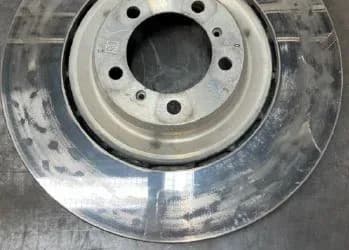
Also applies to
- Audi e-tron GT
- 2022–2024
- Audi RS e-tron GT
- 2022–2023
Symptoms
Owners of 2022-2024 Audi e-tron GT and RS e-tron GT models equipped with tungsten carbide brake discs may observe visible "Hotspots / discoloration visible on the friction surface of the brake disc." This condition is purely aesthetic and does not indicate a functional problem with the braking system. Workshop inspections confirm that when checking the brake disc axial run-out, no abnormalities are identified, further supporting that the brake performance is not compromised.
Technical Background
Audi Technical Service Bulletin 46 24 56 2073824/1 explains that the friction brake is constantly exposed to various influences during operation. One significant factor is the thermal stress on the friction surfaces, which occurs due to the use of the brake. Depending on individual driving style, temperatures can rise sufficiently to cause discoloration on the top layer of the tungsten carbide brake disc. This phenomenon is an inherent characteristic of the brake disc's design.
It is crucial to understand that these visible "Hotspots on friction surface of tungsten carbide brake discs" are considered a purely visual complaint. They do not affect the overall function or performance of the brake system. Therefore, the presence of these hotspots or discoloration does not warrant any repair action.
Important Warnings for Owners
Audi has issued specific guidance regarding this condition. For the 2022-2024 Audi e-tron GT brake hotspots, no measures are required to address the phenomenon on the friction surface of the brake discs. Replacement of parts due to this phenomenon is not justified.
Furthermore, Audi explicitly states that if parts are replaced for this visual condition, they may reject the warranty claim and charge back the cost of the parts. This Technical Service Bulletin (TSB) 2073824 is informational only and is not applicable to any Audi Warranty. Owners should be aware that attempting to have these discs replaced under warranty for cosmetic reasons will likely be denied.
What Owners Should Know
If you notice "Hotspots / discoloration visible on the friction surface of the brake disc" on your 2022-2024 Audi e-tron GT or RS e-tron GT, rest assured that this is a normal visual characteristic resulting from thermal stress. The condition does not impact the safety or performance of your vehicle's braking system. No repair or replacement of the brake discs is necessary or recommended by Audi.
This TSB, identified as 46 24 56 2073824/1, serves to inform technicians and owners that the observed discoloration is a cosmetic issue, not a functional defect. Do not pursue replacement of brake components solely for this visual concern, as it will not resolve any underlying problem and may result in charges.
Source: NHTSA ID: 11002128
Frequently Asked Questions
- What is Audi TSB 46 24 56 2073824/1 about?
- Audi Technical Service Bulletin 46 24 56 2073824/1 addresses the appearance of hotspots and discoloration on the tungsten carbide brake discs of 2022-2024 Audi e-tron GT and RS e-tron GT models, clarifying that this is a visual complaint and not a functional defect.
- Are the hotspots on my Audi e-tron GT's brake discs a safety concern?
- No, according to Audi, the hotspots and discoloration on the tungsten carbide brake discs are a visual complaint caused by thermal stress from driving style. They do not affect the function or safety of the brake system, meaning your Audi e-tron GT brake hotspots are not a safety concern.
- Will Audi cover the cost if I replace the brake discs due to these hotspots?
- Audi TSB 46 24 56 2073824/1 explicitly states that replacement of parts for this phenomenon is not justified and that warranty claims for this visual issue may be rejected, with the cost of parts charged back to the owner. This TSB is informational and not covered under Audi's warranty.
Related Articles
2022-2024 Audi e-tron GT Scraping/Knocking Noise TSB 2073030/2
Owners of 2022-2024 Audi e-tron GT and RS e-tron GT models may hear scraping or knocking noises from the front wheel housing. Audi Technical Service Bulletin 2073030/2 identifies the cause as dirt and debris accumulating around the radiator fans and provides a cleaning solution.
2024 Audi e-tron GT MyAudi App Charging & Climate Fault
This Technical Service Bulletin (TSB) 2075406/2 addresses an issue where 2024 Audi e-tron GT and RS e-tron GT owners cannot set air conditioning, charging timers, or charging locations using the myAudi app, resulting in error code BFF.4002. Audi has resolved this problem with a backend software…
2022-2025 Audi e-tron GT Power System Fault P000000 TSB
Audi has issued TSB 2080377/1 for 2022-2025 e-tron GT and RS e-tron GT models concerning a yellow or red instrument cluster warning fault. This issue is often accompanied by DTC P000000 in the hybrid battery manager, indicating an on-board power system fault.
2024-2025 Audi e-tron GT Electrical System Fault TSB
A Technical Service Bulletin (TSB 2080127/1) has been issued for 2024-2025 Audi e-tron GT and RS e-tron GT models regarding a 'Electrical system: fault' warning message. This issue prevents driving and is resolved by a software update.
2024-2025 Audi e-tron GT MMI Emergency Call Fault TSB 2079980/1
Audi has released Technical Service Bulletin (TSB) 2079980/1 to address various MMI function problems and an 'Emergency call fault' message that may appear in 2024-2025 e-tron GT and RS e-tron GT vehicles. This software update targets the MIB3 system and related control units.
Leave a comment
Comments are moderated and may take a moment to appear. Only your first name and the initial of your last name are shown publicly.
Comments
Be the first to comment.