2018-2026 Audi V6 TFSI Drive System Malfunction TSB
Audi Technical Service Bulletin 2081342/1 addresses a "Drive system fault active in instrument cluster" message and associated knock sensor DTCs (P032700, P033200, P032800, P033300) in 2018-2026 V6 TFSI models. This issue is often caused by temporary moisture absorption in the knock sensor housing.
 Marcus Weber2025 Audi Q8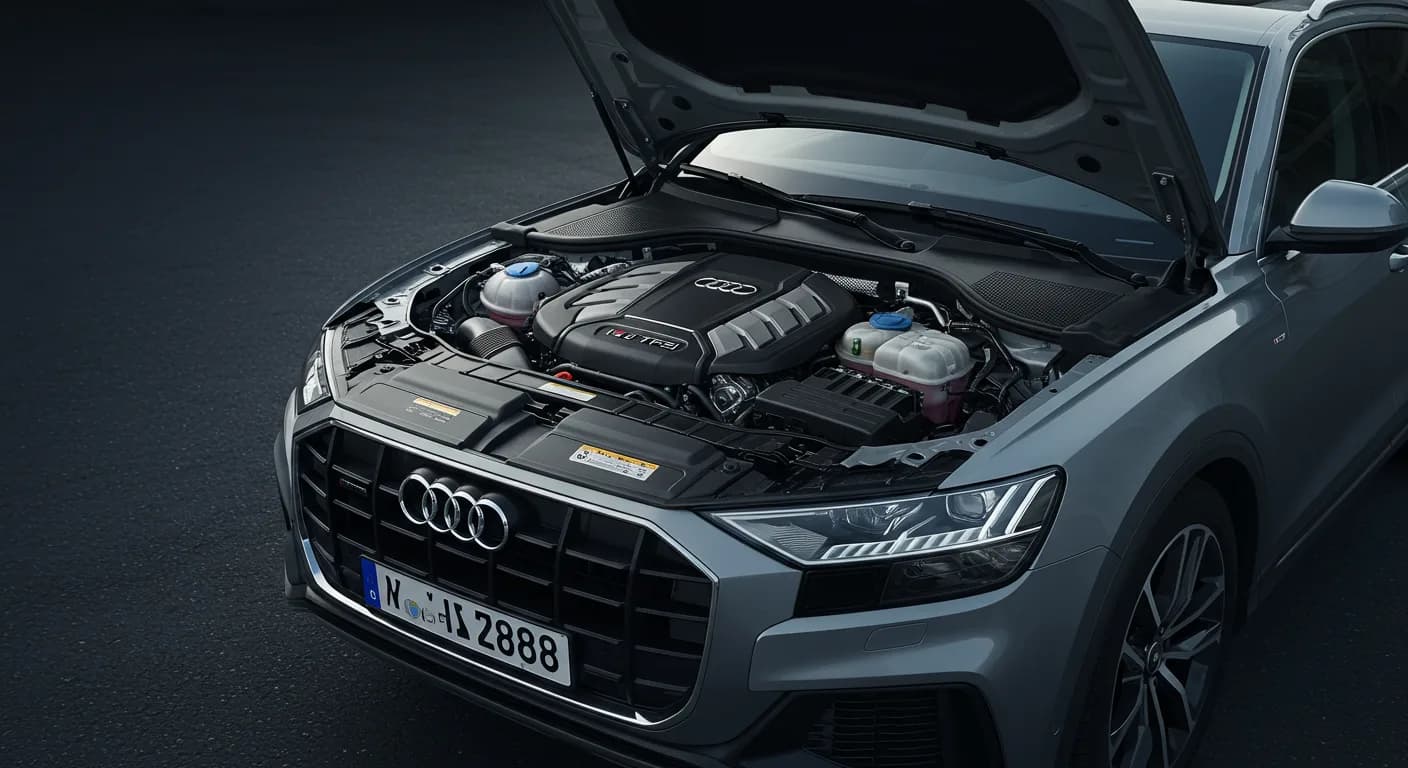
Also applies to
- Audi A6
- 2021–2025
- Audi A6 allroad
- 2021–2026
- Audi A7
- 2021–2025
- Audi A8 L e
- 2021
- Audi Q7
- 2021–2026
- Audi Q8
- 2021, 2022, 2023, 2024, 2026
- Audi S4
- 2021–2025
- Audi S5
- 2021–2024
- Audi SQ5
- 2021–2025
▸ Show 3 more▾ Show fewer
Owners of certain 2018-2026 Audi models equipped with the V6 TFSI engine may encounter a "Drive system fault active in instrument cluster" message. This condition is often accompanied by specific diagnostic trouble codes (DTCs) related to the knock sensors. Audi Technical Service Bulletin (TSB) 2081342/1 provides guidance for technicians on how to address this infrequent issue.
This TSB clarifies that the underlying cause for this Audi V6 TFSI drive system malfunction is typically temporary and does not require parts replacement.
Symptoms
Owners will primarily notice the following symptom:
- A warning message stating: "Drive system fault active in instrument cluster"
This message indicates a detected issue within the vehicle's drive system, prompting the driver to seek service.
Fault Codes / DTCs
When diagnosing the "Drive system fault active in instrument cluster" message, technicians may find one or more of the following DTCs logged in the Engine Control Module -J623- (address word 0001):
| Code | Description | Module |
|---|---|---|
| P032700 | Knock Sensor 1 Circuit Low Input | Engine Control Module -J623- |
| P033200 | Knock Sensor 2 Circuit Low Input | Engine Control Module -J623- |
| P032800 | Knock Sensor 1 Circuit High Input | Engine Control Module -J623- |
| P033300 | Knock Sensor 2 Circuit High Input | Engine Control Module -J623- |
These codes point to an electrical anomaly within the knock sensor circuits.
Diagnosis / Trigger Conditions
The technical background provided in TSB 2081342/1 explains that the knock sensor housing can absorb an increased amount of moisture from its surroundings. This is particularly common after lengthy stationary periods, such as during vehicle transportation. The absorbed moisture alters the sensor's electrical properties, specifically its internal resistance, which can impair signal quality. The engine control unit then misinterprets this as a malfunction, leading to the logging of an event memory entry.
It is important to note that this complaint occurs very rarely and irregularly. The absorbed moisture typically dissipates on its own after the vehicle has been driven for an extended period, and the sensor is considered fully functional and compliant with requirements.
Important Warnings
Audi explicitly states a critical warning regarding this specific Audi V6 TFSI drive system malfunction:
- "Replacing parts will not fix the problem. Please erase the intermittent event memory entry and continue to observe the vehicle."
This means that replacing the knock sensors or related components will not resolve the underlying issue and is an unnecessary expense. Owners should be aware of this to avoid potentially costly and ineffective repairs.
Repair Procedure Summary
Given the nature of the issue, the recommended procedure for addressing the Audi V6 TFSI drive system malfunction outlined in TSB 2081342/1 is straightforward and does not involve replacing any parts. Technicians are advised to:
- Reproduce the customer complaint to confirm the issue. This ensures the TSB applies to the specific vehicle and condition.
- Verify that all vehicle-specific criteria (model, year, engine, etc.) are met before proceeding.
- Erase the intermittent event memory entry from the Engine Control Module -J623-.
- Continue to observe the vehicle. Since the moisture dissipates after driving, the fault is expected to clear and not return.
This approach prevents unnecessary part replacements and ensures that the vehicle's fully functional knock sensors are not mistakenly swapped out.
Warranty Information
For vehicles still under warranty, claims for this issue must adhere to the Audi Warranty Policies and Procedures Manual. The TSB specifies the following details for warranty claims:
- Claim Type: Informational only if the vehicle is outside of warranty.
- Service Number: 2872
- Damage Code: 0055
- Labor Operations:
- GFF/ Guided Functions: 0150 0010 (See SRT with associated operations)
- GFF/ Guided Functions: 0150 0060 (Time stated on the diagnostic protocol)
- Claim Comment: As per TSB 2081342/1
All submitted claims are subject to review and audit by Audi Warranty.
NHTSA ID: 11031044 Source: manufacturer_communication
Frequently Asked Questions
- What does "Drive system fault active in instrument cluster" mean for my Audi V6 TFSI?
- This message in your 2018-2026 Audi V6 TFSI, often accompanied by knock sensor DTCs like P032700, indicates a temporary issue with the knock sensor due to moisture. According to TSB 2081342/1, the sensor is likely functional, and the fault usually clears after driving.
- Should I replace my knock sensors if I see DTC P032700 or P033200?
- No, Audi Technical Service Bulletin 2081342/1 explicitly states that "Replacing parts will not fix the problem." The issue is typically caused by temporary moisture absorption, which dissipates after driving. The recommended action is to clear the fault codes and continue to observe the vehicle.
- What is the cause of the Audi V6 TFSI drive system malfunction related to knock sensors?
- The malfunction is caused by moisture absorption into the knock sensor housing, particularly after long periods of inactivity. This moisture temporarily alters the sensor's electrical properties, leading the Engine Control Module -J623- to log a fault code, even though the sensor itself is fully functional.
- How is the Audi V6 TFSI drive system malfunction addressed by a dealer?
- Dealers will follow TSB 2081342/1, which involves confirming the complaint, ensuring the TSB applies, erasing the intermittent event memory entries for DTCs like P032700, P033200, P032800, or P033300, and then observing the vehicle. No parts replacement is typically required.
Related Articles
2024-2026 Audi MMI Weather Widget 'An error has occurred' TSB
Audi Technical Service Bulletin 2081500/1 addresses the 'An error has occurred' message on the MMI weather widget in 2024-2026 Audi models. This issue typically indicates a missing data plan for the Audi Application Store.
2024-2026 Audi Q8 48V Starter Generator DTCs P0A1A00 P19F800
Audi has released Technical Service Bulletin (TSB) 2076994/7 to address issues with the 48V starter generator (BSG) in 2024-2026 Audi Q8, A6, A7, Q7, and A6 allroad models equipped with MHEV. Owners may experience an illuminated engine warning lamp and various diagnostic trouble codes (DTCs)…
2025 Audi Q8 Bluetooth/Smartphone Interface Connection TSB
Audi Technical Service Bulletin 2079837/2 addresses customer complaints regarding slow or interrupted Bluetooth and Audi smartphone interface connections in 2025 Audi models, including the Q8. The issue stems from a software fault in the emergency call module control unit (DA 0075). The…
2023-2025 Audi On-Car Analysis List for Technicians
Audi's TSB 2066297 outlines an on-car analysis list for technicians, addressing common concerns such as the 48V battery cooling fan DTC P0A8200, B&O extendable tweeter operational issues, and PPE/PPC vehicle time synchronization problems for 2023-2025 Audi models.
2024-2025 Audi MMI Emergency Call Fault Software Update TSB
Audi has released Technical Service Bulletin 2079681/2 to address MMI function problems and the 'Emergency call fault' message in 2024-2025 A6, A7, A8, Q7, Q8, and e-tron models. This update resolves software issues affecting the MIB3 infotainment and connectivity box.
Leave a comment
Comments are moderated and may take a moment to appear. Only your first name and the initial of your last name are shown publicly.
Comments
Be the first to comment.