2023-2025 Audi Instrument Cluster Warning Lamps TSB
Audi has released Technical Service Bulletin (TSB) 2077819/3 to address various warning lamps illuminating in the instrument cluster of 2023-2025 Audi vehicles. This TSB provides a software update for the data bus diagnostic interface (gateway J533) to resolve communication issues.
 Marcus Weber2025 Audi Q8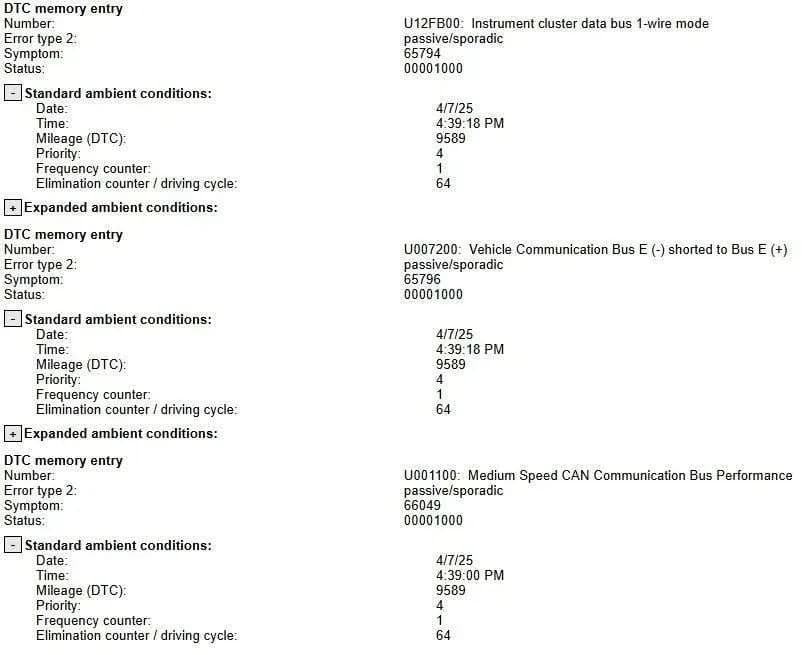
Also applies to
- Audi A4
- 2024–2025
- Audi A4 allroad
- 2024–2025
- Audi A5
- 2024
- Audi A6
- 2024–2025
- Audi A6 allroad
- 2024–2025
- Audi A7
- 2024–2025
- Audi e-tron GT
- 2024–2025
- Audi Q5
- 2024–2025
- Audi Q5 e
- 2024–2025
- Audi Q7
- 2023–2025
- Audi Q8
- 2023–2024
- Audi RS 5
- 2024
- Audi RS 6 Avant
- 2024–2025
- Audi RS 7
- 2024–2025
- Audi RS e-tron GT
- 2024
- Audi RS Q8
- 2023–2025
- Audi S e-tron GT
- 2026
- Audi S4
- 2024–2025
- Audi S5
- 2024
- Audi S6
- 2024–2025
- Audi S7
- 2024–2025
- Audi S8
- 2024–2025
- Audi SQ5
- 2024–2025
- Audi SQ7
- 2023–2025
- Audi SQ8
- 2023–2025
▸ Show 19 more▾ Show fewer
Revision History
Audi Technical Service Bulletin (TSB) 2077819/3 has undergone several revisions to ensure accuracy and comprehensive coverage:
- Revision 3: Updated the header to include a PR number filter and revised model years.
- Revision 2 (August 1, 2025): Revised the header, updated control units, added to the DTC list in the Condition section, and updated the Service section with new software numbers and SVM codes.
- Revision 1 (May 12, 2025): Initial publication of the TSB.
Symptoms
Owners of 2023-2025 Audi vehicles may observe various warning lamps illuminating in the instrument cluster after starting the vehicle or while driving. These warning lamps indicate malfunctions in different vehicle systems. The issue often presents as multiple Audi instrument cluster warning lamps for different vehicle systems lighting up.
Specific messages or faults that may appear include:
- "information, navigation, communication, entertainment -> malfunction display symbols -> engine start malfunction indicator"
- "information, navigation, communication, entertainment -> malfunction display symbols -> power steering malfunction display"
- "information, navigation, communication, entertainment -> malfunction display symbols -> ABS malfunction display"
- "information, navigation, communication, entertainment -> malfunction display symbols -> shock absorber control system malfunction display"
- "information, navigation, communication, entertainment -> malfunction display symbols -> driver assistance malfunction display"
- "information, navigation, communication, entertainment -> malfunction display symbols -> interference display for emergency call service"
- "information, navigation, communication, entertainment -> malfunction display symbols -> transmission malfunction display"
- "Vehicle lights: fault."
- "Emergency call function: fault."
- "Start/stop system: fault."
- "Stabilization control (ESC): fault."
In some cases, various warning lamps are active, and the side windows may lower automatically.
Fault Codes / DTCs
Technicians may find various intermittent Diagnostic Trouble Codes (DTCs) logged across different bus systems in diagnosis address 0019, indicating communication issues. The underlying complaints often relate to the data bus on board diagnostic interface, such as:
- "power, vehicle electrical system, data transfer -> databus systems -> databus on board diagnostic interface" with "control modules, services -> with fault stored in the DTC memory"
- "power, vehicle electrical system, data transfer -> databus systems -> databus on board diagnostic interface" with "functionality -> no function"
- "power, vehicle electrical system, data transfer -> databus systems -> databus on board diagnostic interface" with "control modules, services -> communication malfunction"
- "power, vehicle electrical system, data transfer -> databus systems -> databus on board diagnostic interface" with "functionality -> operation sequence incorrect"
- "power, vehicle electrical system, data transfer -> databus systems -> databus on board diagnostic interface" with "control modules, services -> communication interrupted"
Common DTCs that may be stored in the event memory of the data bus diagnostic interface J533 (address word 0019) include:
| Code | Description | Module |
|---|---|---|
| U12FB00 | "Instrument cluster data bus 1-wire mode" | Data Bus Diagnostic Interface (0019) |
| U007200 | "Infotainment CAN 1-wire mode" | Data Bus Diagnostic Interface (0019) |
| U005400 | "Extended CAN single wire mode" | Data Bus Diagnostic Interface (0019) |
| U001100 | "Medium Speed CAN Communication Bus Performance" | Data Bus Diagnostic Interface (0019) |
| U10AB00 | "Instrument Cluster CAN data bus no communication." | Data Bus Diagnostic Interface (0019) |
These DTC entries can vary, but often indicate communication, single-wire, or signal faults (e.g., "implausible signal"; "CAN single wire mode"; "no communication or function limitation due to missing message"). Figure 1 in the TSB illustrates a sample of CAN bus and communication DTCs stored with the same timestamp.
Diagnosis / Trigger Conditions
This condition is characterized by various DTC entries on different bus systems being logged intermittently in diagnosis address 0019 due to a single occurrence of an event memory entry. Intermittent faults in CAN and FlexRay communication are logged in some control units and the diagnostic interface. All symptoms and DTC entries indicate a temporary failure of the gateway J533. The data bus diagnostic interface may become stuck for approximately 30 seconds before automatically resetting. Despite the warning lamps, the complaint often cannot be reproduced in the workshop, and all systems may continue to function without restrictions. The critical factor for diagnosis is the identical time stamp in the event memory entry in DA0019.
This issue stems from an online data campaign that, under certain circumstances, caused a sporadic reset of the data bus diagnostic interface J533. Although this campaign concluded in week 38/2024, individual vehicles continue to experience this complaint.
Important Warnings for Owners
- High-Voltage Battery Safety: For vehicles equipped with high-voltage components, the high-voltage charging cable must be unplugged BEFORE the SVM code is entered during the software update. Charging the high-voltage battery during a software update can cause damage to the high-voltage components.
- Tuned Vehicles and Warranty: Damage to the control unit(s) resulting from chip tuning or other third-party modifications is not covered under warranty. If your vehicle has been modified or "tuned," updating the software may render these modifications ineffective or even damage the control unit. Audi advises that if you decline the software update on a tuned vehicle, this could lead to issues or restrictions with the use of the vehicle or individual components. Dealers are instructed to make a note of this on the order before it is signed by the customer.
- SVM Code Entry Precision: The SVM code
ZGDOIP,19A027,19B027must be input exactly as written, including commas and without spaces. Copying and pasting is strongly recommended to prevent errors.
Repair Procedure Summary
Audi Technical Service Bulletin (TSB) 2077819/3 outlines a software update for the diagnostic interface control unit (DA0019) to address the issue of multiple Audi instrument cluster warning lamps. This update supersedes TSB 2075405: "90 Reporting Obligation pre repair - Various Warning Messages w/ Faults stored for CAN bus Communication."
The core of the repair is a software update to SW 0052 for the diagnostic interface control unit (DA0019). The procedure involves the following steps:
- Vehicle Preparation: For vehicles with high-voltage components, the high-voltage charging cable must be unplugged before any SVM code is entered to prevent damage to high-voltage components during the software update.
- Access Diagnostic System: Technicians must follow all instructions provided in TSB 2011732: "00 Software Version Management (SVM), operating instructions."
- Software Update Initiation: The Data Bus On Board Diagnostic interface, J533 (diagnostic address 0019), must be updated using the specified SVM action code. This update is performed in "Flash" mode on the ODIS tester.
- SVM Code Entry: Use the "Authorized Multiple Code Entry" function within ODIS. The new test program for software updates is included in ODIS software, available as of April 16, 2025. The SVM code
ZGDOIP,19A027,19B027must be input precisely as written, including commas and without spaces. - Monitoring the Update: The vehicle will provide acoustic signals and flashing lights to indicate when user input is required and at the completion of the test program.
- Post-Update Steps: After the software update is complete, it is crucial to unplug both the diagnostic connector and the charger from the vehicle. Then, start the engine and let it run for one minute. Following this, lock the vehicle and wait for five minutes.
- Finalization: Conclude the diagnostic procedure via ODIS to ensure all event memory entries created during the flashing process are deleted.
Required Tools or Parts
To perform this repair, technicians will need:
- ODIS software, with the latest version available as of April 16, 2025, which includes the new test program for software updates.
- The specific SVM action code:
ZGDOIP,19A027,19B027. - The target software update is SW 0052 for the diagnostic interface control unit (DA0019). The control units involved include various software and hardware part numbers such as 4KR.907.468.N (SW 3039, HW H06), 8W0.907.468.N (SW 3039, HW H06), 4KL.907.468.Q (SW 0042, HW H06), and others as listed in the TSB's "Control units" section.
Warranty Information
This Technical Service Bulletin provides informational guidance if the vehicle is outside of its warranty period. All warranty claims submitted for payment must strictly adhere to the Audi Warranty Policies and Procedures Manual and are subject to review and audit by Audi Warranty.
- Claim Type: Informational only if the vehicle is outside of warranty.
- Service Number: 9035
- Damage Code: 0039
- Labor Operations:
- Software Update: 0151 0010 (See SRT with associated operations)
- Software Update: 0151 0060 (Time stated on the diagnostic protocol)
Audi emphasizes that damage to control units resulting from chip tuning or other third-party software modifications is not covered under warranty. Customers with modified vehicles should be informed that the software update may neutralize previous modifications or potentially cause damage. If a customer declines the software update, they should be advised of potential issues or restrictions with vehicle components, and this decision must be documented in the customer file.
Source: NHTSA ID: 11025315
Frequently Asked Questions
- What causes multiple warning lights in my 2023-2025 Audi instrument cluster?
- Multiple warning lights, such as "engine start malfunction indicator" or "ABS malfunction display," appearing in your Audi instrument cluster are often caused by a temporary failure of the gateway J533, which is the data bus diagnostic interface. This can lead to intermittent communication faults across the vehicle's bus systems, as detailed in Audi TSB 2077819/3.
- What is Audi TSB 2077819/3?
- Audi TSB 2077819/3 is a Technical Service Bulletin that addresses various warning lamps illuminating in the instrument cluster of 2023-2025 Audi vehicles. It outlines a software update (SW 0052) for the data bus diagnostic interface (diagnostic address 0019) to resolve underlying communication issues causing these warnings, superseding TSB 2075405.
- How is the Audi gateway fault, indicated by DTCs like U12FB00, fixed?
- The Audi gateway fault, which can trigger DTCs such as U12FB00, U007200, U005400, U001100, and U10AB00, is fixed by updating the software of the Data Bus On Board Diagnostic interface (J533) to SW 0052. This is done using the SVM action code ZGDOIP,19A027,19B027 via the ODIS diagnostic system in "Flash" mode, as described in TSB 2077819/3.
- Will this software update affect my Audi's warranty if it has been tuned?
- Yes, if your Audi has been modified or "tuned," the software update may render these modifications ineffective. Furthermore, damage to the control unit(s) resulting from chip tuning is explicitly not covered under warranty. Audi advises that declining the update on a tuned vehicle could lead to further issues, and this must be documented by the dealer.
- What are the specific warnings for high-voltage Audi vehicles during this software update?
- For high-voltage Audi vehicles, it is critical to unplug the high-voltage charging cable before entering the SVM code for the software update. This is a safety measure, as charging the high-voltage battery during the update process can cause damage to the high-voltage components.
Other revisions of this TSB
- 2024-2026 Audi Warning Lamps Instrument Cluster TSBU12FB00, U007200, U005400
Related Articles
2024-2026 Audi MMI Weather Widget 'An error has occurred' TSB
Audi Technical Service Bulletin 2081500/1 addresses the 'An error has occurred' message on the MMI weather widget in 2024-2026 Audi models. This issue typically indicates a missing data plan for the Audi Application Store.
2018-2026 Audi V6 TFSI Drive System Malfunction TSB
Audi Technical Service Bulletin 2081342/1 addresses a "Drive system fault active in instrument cluster" message and associated knock sensor DTCs (P032700, P033200, P032800, P033300) in 2018-2026 V6 TFSI models. This issue is often caused by temporary moisture absorption in the knock sensor housing.
2024-2026 Audi Q8 48V Starter Generator DTCs P0A1A00 P19F800
Audi has released Technical Service Bulletin (TSB) 2076994/7 to address issues with the 48V starter generator (BSG) in 2024-2026 Audi Q8, A6, A7, Q7, and A6 allroad models equipped with MHEV. Owners may experience an illuminated engine warning lamp and various diagnostic trouble codes (DTCs)…
2025 Audi Q8 Bluetooth/Smartphone Interface Connection TSB
Audi Technical Service Bulletin 2079837/2 addresses customer complaints regarding slow or interrupted Bluetooth and Audi smartphone interface connections in 2025 Audi models, including the Q8. The issue stems from a software fault in the emergency call module control unit (DA 0075). The…
2023-2025 Audi On-Car Analysis List for Technicians
Audi's TSB 2066297 outlines an on-car analysis list for technicians, addressing common concerns such as the 48V battery cooling fan DTC P0A8200, B&O extendable tweeter operational issues, and PPE/PPC vehicle time synchronization problems for 2023-2025 Audi models.
Leave a comment
Comments are moderated and may take a moment to appear. Only your first name and the initial of your last name are shown publicly.
Comments
Be the first to comment.