2017-2025 Audi EPC Light On: Fuel Level Sender DTCs B10581B, B103E1B
Audi owners may encounter an 'EPC Light on' warning or fuel system malfunction due to high resistance in the fuel level sender, triggering DTCs B10581B and B103E1B. This TSB outlines software updates and potential part replacements for 2017-2025 A6, A7, Q7, and Q8 models.
 David Chen2025 Audi Q8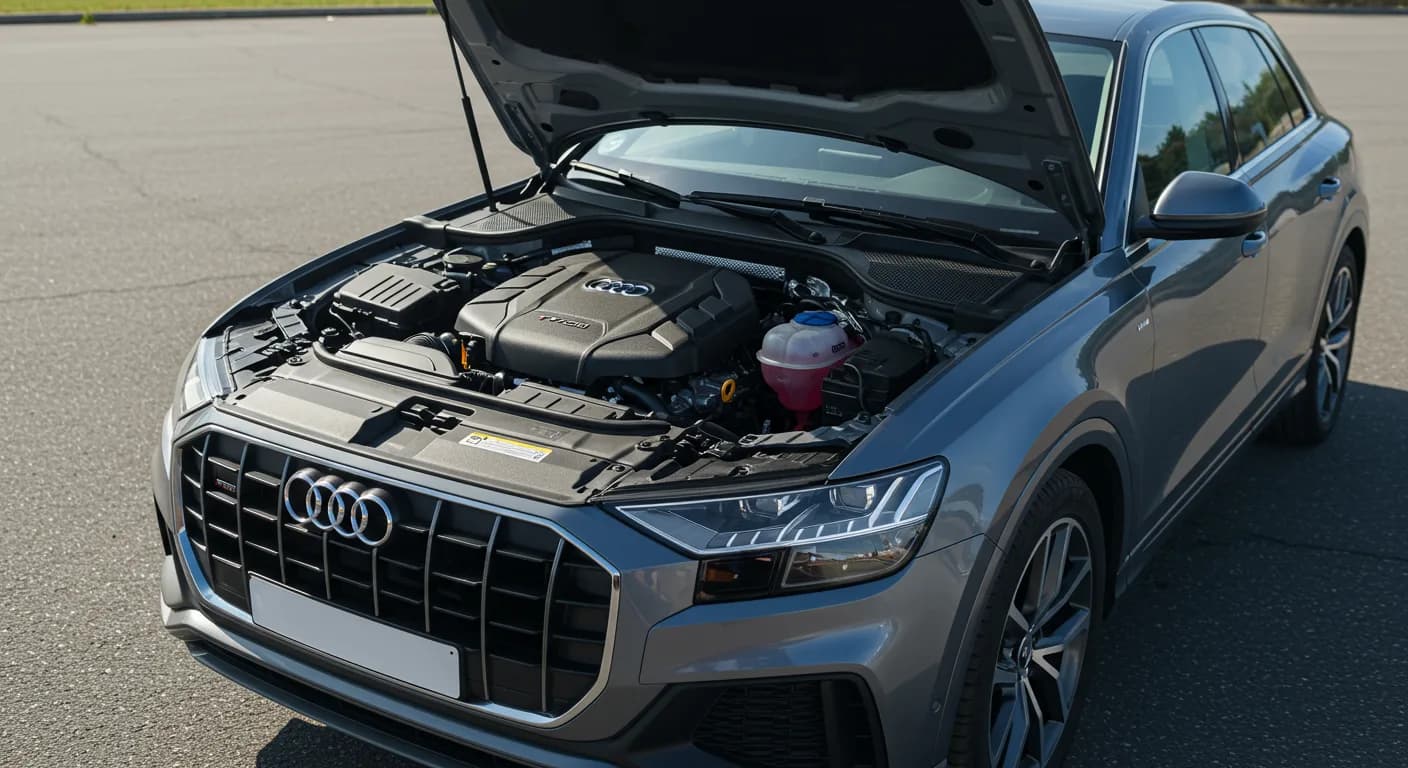
Also applies to
- Audi A6
- 2021–2025
- Audi A6 allroad
- 2021–2025
- Audi A7
- 2021–2025
- Audi A7 e
- 2021–2022
- Audi Q7
- 2021–2025
- Audi Q8
- 2021–2024
- Audi RS 6 Avant
- 2021–2025
- Audi RS 7
- 2021–2025
- Audi RS Q8
- 2021–2025
- Audi S6
- 2021–2025
- Audi S7
- 2021–2025
- Audi SQ7
- 2021–2025
- Audi SQ8
- 2021–2025
▸ Show 7 more▾ Show fewer
Owners of certain 2017-2025 Audi A6, A7, Q7, and Q8 models may experience an illuminated "EPC Light on" warning on their instrument cluster, accompanied by a general fuel system malfunction message. This issue is typically linked to Diagnostic Trouble Codes (DTCs) B10581B or B103E1B, which point to a resistance problem in the fuel level sender unit. This technical service bulletin, TSB 2070211/5, provides detailed diagnostic and repair procedures for technicians to resolve this condition.
The underlying cause of the Audi EPC light fuel level sender DTC B10581B and related issues is often a hardware problem involving deposits accumulating on the fuel gauge sender. Audi has implemented production changes, specifically SVM 46A033, and optimized software latency and debounce times to mitigate this issue in newer vehicles.
Revision History
Technical Service Bulletin 2070211/5 has undergone several revisions to update information and repair procedures:
- Revision 5: Updated software versions were incorporated into the header.
- Revision 4 (June 27, 2025): The header was revised to include updated models and model years, and the service section was revised with updated repair directions.
- Revision 3 (April 24, 2025): The service section was revised to include an updated software table.
Symptoms You Might Notice
If your Audi is affected by this issue, you will typically observe the following:
- An "EPC Light on" warning illuminated on your instrument cluster.
- A general "fuel system warning" message displayed.
- Potential issues with the fuel supply, specifically related to low pressure.
- Malfunction display symbols related to emissions control, which may activate with or without cause, or fail to switch off/disconnect.
These symptoms are often triggered by the fuel level sender experiencing high resistance, which the vehicle's control modules detect and report.
Fault Codes / DTCs
When diagnosing this issue, technicians will find specific Diagnostic Trouble Codes stored in the Comfort System Central Control Module (J393, address word 0046). These codes indicate a problem with the fuel level sensors:
| Code | Description | Symptom Number |
|---|---|---|
| B10581B | Fuel level sensor 2 Resistance too high | 65698 |
| B103E1B | Fuel level sensor 1 Resistance too high | 65694 |
These DTCs confirm that the fuel level sender is not providing accurate resistance readings, leading to the warnings displayed to the driver.
Technical Background
The root cause of the high resistance in the fuel level sender is identified as a hardware issue. Over time, deposits can build up on the fuel gauge sender, impeding its proper function and leading to inaccurate readings. This can cause the vehicle's engine control unit to misinterpret fuel levels and trigger the "EPC Light on" and fuel system warnings.
Audi has implemented a production solution involving optimized software latency and debounce time, starting from calendar week 50/2023, under production change SVM 46A033. This aims to improve how the system processes signals from the fuel level sender, potentially reducing the occurrence of these fault codes.
Specific production changes include:
- Audi A6, A7: Software part number 4K8.909.501.BC [0005] implemented in production from week 50/23 onward.
- Audi Q7: Software part numbers 4M0.909.501BB [0009] implemented from week 48/23 onward, and 4M0.909.501BD [0011] implemented from week 29/24 onward.
- Audi Q8: Software part numbers 4M8.909.501BC [0009] and 4M8.909.501BD [0006] implemented from week 50/23 onward, and 4M8.909.501BE [0011] implemented from week 32/24 onward.
Repair Procedure Summary
The repair process for the Audi EPC light fuel level sender DTC B10581B involves a series of software updates and, if necessary, the replacement of the fuel level sender or even the entire fuel tank. The procedure varies slightly depending on the vehicle's model year and current software version. Technicians must follow instructions from TSB 2011732: "00 Software Version Management (SVM), operating instructions" and TSB 2047812: "00 MC: how to set up and use the FMC for obtaining vehicle software updates (SD Creator decommissioned)" for proper software management.
First, the J393 Comfort System Central Control Module (address 0046) must be updated using the specified SVM action code. The specific steps are as follows:
For Vehicles from Model Years 2017-2020
- Issue with tank sender 1: Technicians should run SVM code 46A033. If the complaint persists after the software update, the tank sender 1 must be replaced.
- Issue with tank sender 2: Run SVM code 46A033. If the issue is not remedied, both the fuel tank and tank sender 1 should be replaced.
For Vehicles from Model Year 2021
- These models are expected to receive the necessary software update via recall 90VC.
For Vehicles from Model Years 2022-2023
- Important Warning for High-Voltage Vehicles: Before entering the SVM code, the high-voltage charging cable must be unplugged BEFORE the SVM code is entered. This is critical because charging the high-voltage battery during a software update can cause damage to the high-voltage components.
- Issue with tank sender 1: Use SVM code 46A033. Technicians must also check the software version of the Audi virtual cockpit (diagnostic address 0017).
- If the virtual cockpit has software versions 0107, 0111, 0115, 0116, 0117, 0118, or 0119, it must be updated to version 0122 using SVM code 17A053. This requires a USB stick, part number 8W6 906 961 AF, or a compatible USB 2.0 stick with the software downloaded onto it.
- The update process involves selecting "flash" on the workshop tester, entering the SVM code, and inserting the USB stick when prompted by the message "... please insert update medium with the following part number...". If a message "... Hold the vehicle key to the transponder..." appears, the key must be held against the marked area in the center console until the update is complete. If the complaint is not resolved, tank sender 1 should be replaced.
- Issue with tank sender 2: Use SVM code 46A033. Technicians must also check the software version of the Audi virtual cockpit (diagnostic address 0017).
- If the virtual cockpit has software versions 0107, 0111, 0115, 0116, 0117, 0118, or 0119, it must be updated to version 0122 using SVM code 17A053. This requires a USB stick, part number 8W6 906 961 AF, or a compatible USB 2.0 stick.
- The update procedure is similar to tank sender 1. If the complaint is not remedied after the software update, both the fuel tank and tank sender 1 should be replaced.
For Vehicles from Model Years 2024
- Issue with tank sender 1: Run SVM code 46A033.
- If the virtual cockpit has software versions 0260, 0261, 0262, 0264, 0265, or 0266, it must be updated to version 0268 using SVM code 17A053. This requires the FMC (Flash Media Creator) and a USB stick, part number 8W6 906 961 AG, or a compatible USB 2.0 stick.
- The update procedure is similar to the 2022-2023 models, involving the workshop tester, SVM code entry, USB stick insertion, and holding the vehicle key during the process. If the message ". Hold the vehicle key to the transponder. (or similar) subsequently appears..." is shown, the key must be held until the update is complete. If the issue persists, tank sender 1 needs replacement.
- Issue with tank sender 2: Run SVM code 46A033.
- If the virtual cockpit has software versions 0260, 0261, 0262, 0264, 0265, or 0266, it must be updated to version 0268 using SVM code 17A053, using the FMC and USB stick 8W6 906 961 AG. If the complaint is not remedied, both the fuel tank and tank sender 1 should be replaced.
For Vehicles from Model Years 2025
- If the virtual cockpit has software versions 032, 0321, 0356, or 0357, it must be updated to version 0358 using SVM code 17A053. This requires the FMC and a USB stick, part number 8W6 906 961 AH.
- The update procedure follows the same steps as previous model years, including the workshop tester, SVM code entry, USB stick insertion, and holding the vehicle key if prompted. If the complaint remains unresolved, both the fuel tank and tank sender 1 should be replaced.
After any repair, all relevant GFF logs must be uploaded to GFF paperless. It's crucial to ensure that no event memory entries for "resistance too high" for tank sender 1 or 2 are logged after the software update, and the event memory log should be attached.
Required Tools and Parts
To perform these repairs, technicians may need the following:
- Fasteners, Bolts, Nuts, and Screws: As specified in ETKA/ELSA and the repair manual.
- Fuel level sender 1: If replacement is necessary (Quantity: 01).
- Fuel tank: If replacement is necessary (Quantity: 01).
- USB stick: Specific part numbers vary by model year and software version:
- 8W6 906 961 AF (for 2022-2023 models updating to virtual cockpit software 0122)
- 8W6 906 961 AG (for 2024 models updating to virtual cockpit software 0268)
- 8W6 906 961 AH (for 2025 models updating to virtual cockpit software 0358)
- FMC (Flash Media Creator): Required for certain software downloads.
Warranty Information
Warranty claims for this issue, identified by TSB 2070211/5, must adhere to the Audi Warranty Policies and Procedures Manual. Claims are subject to review and audit by Audi Warranty. The Service Number for this bulletin is 2010, and the Damage Code is 0010.
Labor operations are categorized based on the repair performed:
- Only software update performed:
- Software update: Labor operation code 0151 0010 (See SRT with associated operations).
- Software update: Labor operation code 01510 0060 (Labor according to the diagnostic log).
- Software update and tank sender replacement:
- Remove and install fuel gauge sender: Labor operation code 2015 19xx (See SRT with associated operations).
- Software update: Labor operation code 01510 0060 (Labor according to the diagnostic log).
- Software update and tank replacement:
- Replace fuel tank: Labor operation code 2010 55XX (See SRT with associated operations).
- Remove and install fuel gauge sender: Labor operation code 2015 19xx (See SRT with associated operations).
- Software update: Labor operation code 01510 0060 (Labor according to the diagnostic log).
If the vehicle is outside of any warranty, this Technical Service Bulletin is informational only, meaning repair costs may not be covered by Audi.
Important Warnings
For 2022-2023 Audi vehicles equipped with high-voltage components, it is critical to unplug the high-voltage charging cable before entering the SVM code for a software update. Failure to do so could result in damage to the high-voltage battery or other components during the update process.
Source: NHTSA ID: 11025271
Frequently Asked Questions
- What does the 'EPC Light on' mean in my Audi with DTC B10581B?
- The 'EPC Light on' warning, especially when accompanied by Diagnostic Trouble Code B10581B or B103E1B, typically indicates a problem with the fuel level sender. This TSB 2070211/5 suggests that high resistance in the fuel level sensor, often due to deposits, is causing the malfunction.
- How is the Audi EPC light fuel level sender DTC B10581B issue fixed?
- The primary fix involves updating the Comfort System Central Control Module (J393) and potentially the Audi virtual cockpit software using specific SVM codes like 46A033 or 17A053. If software updates do not resolve the high resistance issue, the fuel level sender or even the entire fuel tank may need to be replaced, depending on the specific fault and model year.
- Are there any special precautions for high-voltage Audi models during this repair?
- Yes, for 2022-2023 Audi models with high-voltage components, it is crucial to unplug the high-voltage charging cable before initiating any software updates. This prevents potential damage to the high-voltage battery or other components during the update process.
- Will Audi cover the cost of repairing the fuel level sender issue?
- If your vehicle is still under warranty, the repair outlined in TSB 2070211/5 should be covered by Audi. However, all warranty claims are subject to review and must comply with Audi's warranty policies. If your vehicle is outside of warranty, the bulletin serves as informational guidance, and you may be responsible for repair costs.
Other revisions of this TSB
Related Articles
2024-2026 Audi MMI Weather Widget 'An error has occurred' TSB
Audi Technical Service Bulletin 2081500/1 addresses the 'An error has occurred' message on the MMI weather widget in 2024-2026 Audi models. This issue typically indicates a missing data plan for the Audi Application Store.
2018-2026 Audi V6 TFSI Drive System Malfunction TSB
Audi Technical Service Bulletin 2081342/1 addresses a "Drive system fault active in instrument cluster" message and associated knock sensor DTCs (P032700, P033200, P032800, P033300) in 2018-2026 V6 TFSI models. This issue is often caused by temporary moisture absorption in the knock sensor housing.
2024-2026 Audi Q8 48V Starter Generator DTCs P0A1A00 P19F800
Audi has released Technical Service Bulletin (TSB) 2076994/7 to address issues with the 48V starter generator (BSG) in 2024-2026 Audi Q8, A6, A7, Q7, and A6 allroad models equipped with MHEV. Owners may experience an illuminated engine warning lamp and various diagnostic trouble codes (DTCs)…
2025 Audi Q8 Bluetooth/Smartphone Interface Connection TSB
Audi Technical Service Bulletin 2079837/2 addresses customer complaints regarding slow or interrupted Bluetooth and Audi smartphone interface connections in 2025 Audi models, including the Q8. The issue stems from a software fault in the emergency call module control unit (DA 0075). The…
2023-2025 Audi On-Car Analysis List for Technicians
Audi's TSB 2066297 outlines an on-car analysis list for technicians, addressing common concerns such as the 48V battery cooling fan DTC P0A8200, B&O extendable tweeter operational issues, and PPE/PPC vehicle time synchronization problems for 2023-2025 Audi models.
Leave a comment
Comments are moderated and may take a moment to appear. Only your first name and the initial of your last name are shown publicly.
Comments
Be the first to comment.