2017-2025 Audi A6, A7, Q7, Q8 EPC Light On: DTC B10581B, B103E1B
Audi has issued Technical Service Bulletin 2070211/4 to address instances of the "EPC Light on" and fuel system warnings in 2017-2025 A6, A7, Q7, and Q8 models. This issue is often accompanied by Diagnostic Trouble Codes B10581B or B103E1B, indicating high resistance in the fuel level senders.
 Sarah Mitchell2022 Audi Q8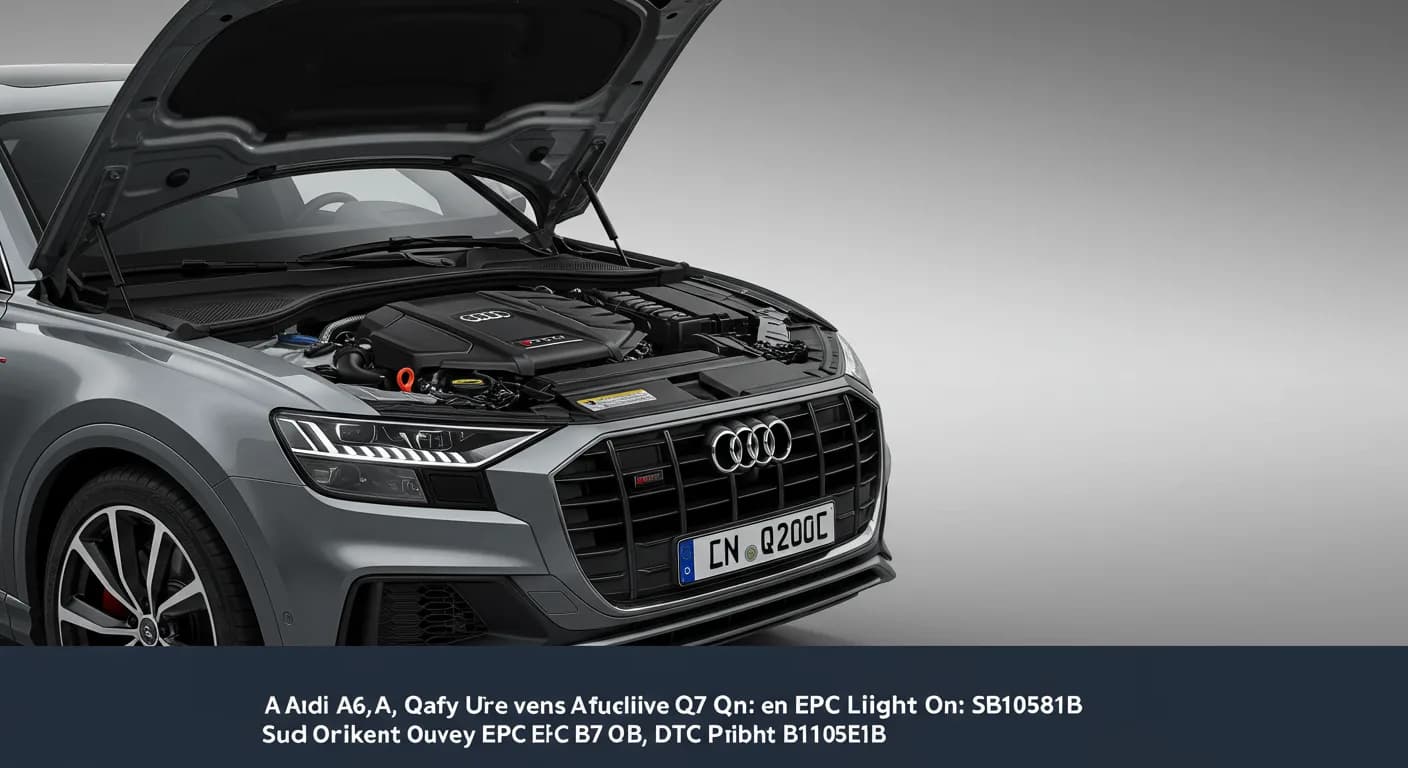
Also applies to
- Audi A6
- 2021–2025
- Audi A6 allroad
- 2021–2025
- Audi A7
- 2021–2025
- Audi A7 e
- 2021–2022
- Audi Q7
- 2021–2025
- Audi Q8
- 2021, 2023, 2024, 2025
- Audi RS 6 Avant
- 2021–2025
- Audi RS 7
- 2021–2025
- Audi RS Q8
- 2021–2025
- Audi S6
- 2021–2025
- Audi S7
- 2021–2025
- Audi SQ7
- 2021–2025
- Audi SQ8
- 2021–2025
▸ Show 7 more▾ Show fewer
Owners of 2017-2025 Audi A6, A7, Q7, and Q8 models might encounter an "EPC Light on" warning in their instrument cluster, often accompanied by a fuel system warning. This issue is detailed in Audi Technical Service Bulletin (TSB) 2070211/4, which addresses Diagnostic Trouble Codes (DTCs) B10581B and B103E1B.
This TSB, released on June 27, 2025, provides guidance for technicians to diagnose and resolve the problem, which stems from deposits accumulating on the fuel tank senders. For example, if you own an Audi Q8 EPC light B10581B might be the specific fault you're encountering.
Revision History
Technical Service Bulletin 2070211/4 has undergone several revisions to refine its guidance. Revision 4 updated models and model years and revised repair directions. Revision 3, dated April 24, 2025, updated the software table and service instructions. Revision 2, dated July 10, 2024, added model years, revised condition and technical background information, updated product solution introduction dates, revised service and warranty table details, and included parts and tools lists.
Symptoms
Owners typically report seeing an "EPC warning" and a "fuel system warning" displayed in the instrument cluster. These warnings indicate an issue with the engine's power control and fuel delivery system. The malfunction display symbols related to the emissions control system may also activate, sometimes without cause or failing to switch off/disconnect. The underlying cause is often related to the fuel level senders.
Fault Codes / DTCs
When diagnosing this issue, technicians may find the following Diagnostic Trouble Codes (DTCs) stored in the Comfort System Central Control Module (J393, address word 0046):
- B10581B: Fuel level sensor 2 Resistance too high with symptom number 65698.
- B103E1B: Fuel level sensor 1 Resistance too high with symptom number 65694.
These codes specifically point to an electrical resistance issue within the fuel level sensors, which are critical for accurate fuel gauge readings and engine management. Technicians may also observe electrical short circuits to positive or ground for the fuel level sensor.
Technical Background
The root cause of the
Frequently Asked Questions
- What does an EPC light on my Audi A6, A7, Q7, or Q8 mean?
- An EPC (Electronic Power Control) light indicates an issue with your vehicle's engine management system. In the context of TSB 2070211/4, it's often linked to problems with the fuel level senders, potentially alongside a fuel system warning.
- What are DTC B10581B and B103E1B?
- DTC B10581B (Fuel level sensor 2 Resistance too high) and B103E1B (Fuel level sensor 1 Resistance too high) are diagnostic trouble codes indicating that the fuel level sensors in your Audi are reporting abnormally high electrical resistance. This can be caused by deposits on the tank senders.
- How is the "Audi Q8 EPC light B10581B" issue resolved?
- The resolution typically involves a software update to the Comfort System Central Control Module (J393) using SVM code 46A033 or 17A053. If the software update does not resolve the issue, the fuel level sender(s) and potentially the fuel tank may need to be replaced, as detailed in TSB 2070211/4.
- Are there any special precautions for high-voltage Audi models during this repair?
- Yes, for 2021-2023 Audi vehicles with high-voltage components, the high-voltage charging cable must be unplugged before entering the SVM code for the software update. This prevents potential damage to the high-voltage components if the battery charges during the update.
- What parts or tools are needed for this repair?
- The repair may require a USB stick with part number 8W6 906 961 AE for software updates. If physical replacement is necessary, new fasteners, a fuel level sender 1, and potentially a new fuel tank may be required.
Other revisions of this TSB
Related Articles
2021-2024 Audi Coolant Pump Leak & DTC P0299 TSB
This Audi Technical Service Bulletin 2070349/6 addresses coolant loss, warning lights, and DTC P0299 related to the mechanical coolant pump in 2021-2024 Audi models with 2.9L or 3.0L V6 TFSI engines. Learn about symptoms, diagnosis, and repair procedures.
2021-2026 Audi Q8 Rear Compartment Noise TSB 2067759/4
Audi has issued Technical Service Bulletin (TSB) 2067759/4 for 2021-2026 Audi Q8 vehicles experiencing a ticking or thumping noise in the rear passenger compartment, especially at idle. The noise is caused by vibrations from the activated charcoal filter solenoid valve (N80) against the EVAP line.
2021-2026 Audi Tensioner Part Number Update SM 63-2025
Audi Special Notice SM 63-2025 informs dealers about an updated tensioner part number. Old part 059-109-467-BB must be returned by December 16, 2025, and replaced with new part 059-109-467-BD to ensure proper inventory.
2022-2024 Audi MLBevo Emergency Call System Warning TSB
Audi Technical Service Bulletin 2079649/1 details a software issue causing an 'Emergency call function: fault' warning in the instrument cluster of 2022-2024 MLBevo vehicles. This TSB provides a software update solution for intermittent communication errors.
2022-2025 Audi Q7/Q8 Third Row Seat Malfunction TSB
Owners of 2022-2025 Audi Q7, SQ7, Q8, SQ8, and RS Q8 vehicles may experience a third row seat malfunction where seats do not fold or lock. Audi TSB 2079211/1 explains this is often due to external blockages and is not covered under warranty.
Leave a comment
Comments are moderated and may take a moment to appear. Only your first name and the initial of your last name are shown publicly.
Comments
Be the first to comment.