2021 Audi Q5 / SQ5 AC Not Cooling TSB 2063575/1
Owners of 2021 Audi Q5 and SQ5 vehicles may experience their air conditioning not blowing cold or taking a long time to cool. This Technical Service Bulletin (TSB 2063575/1) details diagnosis for refrigerant leaks, often linked to DTC B10AE21, and outlines repair steps focusing on the expansion…
 David Chen2021 Audi Q5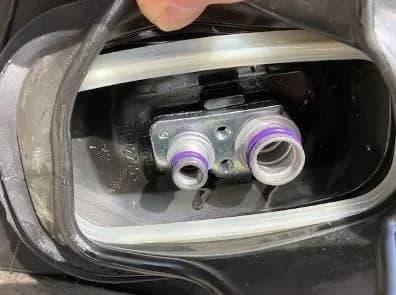
Also applies to
- Audi SQ5
- 2021
Owners of 2021 Audi Q5 and SQ5 models may notice that their vehicle's air conditioning system is not blowing cold air, takes an unusually long time to cool the cabin, or provides no cooling at all. This issue, often described as an "Air conditioning does not cool" symptom, points to a problem within the refrigerant circuit.
Symptoms
If you own a 2021 Audi Q5 or SQ5, you might observe that the air conditioning does not blow cold enough, requires a long period to cool the interior, or fails to cool at all. This is a primary indicator of a refrigerant system malfunction.
Fault Codes / DTCs
When diagnosing the issue, technicians may find that the refrigerant volume in the circuit is very low or empty. This condition can lead to the storage of the following diagnostic trouble code (DTC):
- B10AE21: High-pressure sensor Lower limit not reached
This DTC is typically stored in the Heating/Air Conditioning Electronics control module, designated as E87 (address word 0008).
Diagnosis / Trigger Conditions
The diagnostic process begins by checking the refrigerant circuit head pressures. If the refrigerant volume is found to be very low or empty, a leak is suspected. Initial leak detection methods, such as adding leak identification dye and performing a test drive, or using an electronic refrigerant leak detector on connections, may not immediately reveal the source. However, testing the central vents and condensate drain often indicates that the evaporator core might be the leak source. Historically, replacing the evaporator core would restore normal HVAC operation.
However, further investigation has shown that the root cause of the leak is often not the evaporator core itself, but rather a compromised connection at the expansion valve. This could be at the evaporator-to-expansion valve junction, or from either of the refrigerant hose connections to the expansion valve. This can lead to a false positive reading, making it seem like the evaporator core is leaking when the actual issue is a connection problem.
Audi has implemented production improvements to the evaporator core, making it a more robust unit that is resistant to refrigerant leaks.
Repair Procedure Summary
The repair procedure for the "Audi Q5 AC not cooling" issue focuses on accurately identifying the leak source:
- Initial Leak Exclusion: Technicians must systematically exclude all other possible refrigerant leaks. If the only confirmed leak is detected at the evaporator core, a high level of scrutiny is required for the connection junction at the evaporator core, expansion valve, and refrigerant lines.
- Expansion Valve and O-rings Replacement: If a refrigerant leak is detected at the evaporator core/expansion valve/refrigerant line junction, the expansion valve and all four O-rings should be replaced. The evaporator core itself should not be replaced at this stage. After replacement, the system is re-tested to ensure the leak is resolved.
- Evaporator Core Replacement (if necessary): If, after excluding all other leak possibilities, an electronic refrigerant leak detector still confirms a leak from the evaporator core, then the evaporator, along with all four original O-ring seals and the expansion valve, should be replaced. It is crucial to replace the entire assembly (evaporator, O-rings, and expansion valve) together, ensuring careful reassembly and secure packaging for potential laboratory analysis.
Required Tools or Parts
To properly diagnose and repair the air conditioning system, technicians will utilize specific tools:
- Electronic Refrigerant Leak Detector: Used to pinpoint refrigerant leaks.
- Automotive A/C Nitrogen Leak Test Kit (NITROKITG): For pressure testing the system.
- VAS tester with ODIS (Windows 10) (VAS 6160/VAS 6150): For diagnostic procedures and system checks.
Important Warnings for Owners
Owners should be aware of specific conditions related to this service bulletin 2063575/1:
- Warranty Coverage: This Technical Service Bulletin is informational only and is not applicable to any Audi Warranty. This means that repairs performed under the guidance of this TSB may not be covered by your vehicle's warranty.
- Proper Repair is Critical: If a repair involves replacing the evaporator core, it is essential that the accompanying O-rings and expansion valve are also replaced and correctly reassembled. Evaporators replaced without these accompanying parts, or if returned incomplete or unassembled, or found to contain non-original components, may result in the dealer being debited, which could impact your warranty claim or repair cost.
NHTSA ID: 10198163
Gallery
3 images
Other revisions of this TSB
Related Articles
2021 Audi Q5 Health Check: Service Bulletins and Common Issues
The 2021 Audi Q5 has no recalls, owner complaints, or federal investigations. However, Audi has issued numerous service bulletins addressing common issues such as slow window operation, cylinder head oil leaks, airbag warning lights, and MMI screen noises. Owners should be aware of these potential…
2021-2024 Audi Q5 Door Window Moves Slowly TSB
Audi has released Technical Service Bulletin (TSB) 2071472/3 to address customer complaints regarding door windows that move slowly, are not smooth, or cannot be closed properly in certain 2021-2024 Audi Q5, Q5 e, and SQ5 models. The TSB indicates that the root cause is often an incorrectly…
2021-2024 Audi Q5 Cylinder Head Oil Leak TSB 2072716/6
Audi has issued Technical Service Bulletin (TSB) 2072716/6 for 2021-2024 Audi Q5 vehicles equipped with the 2.0L TFSI engine. This TSB addresses instances of oil residue and leaks found around the cylinder head cover, often due to loose bolts. The repair involves checking and re-tightening or…
2021-2025 Audi Q5 Front Seat Squeaking Noise TSB
Audi has issued manufacturer communication 11013724 to address a squeaking noise originating from the front seat height adjuster in 2021-2025 Audi Q5, Q5 e, and SQ5 models. This technical service bulletin provides guidance for technicians to diagnose and resolve the issue.
2021-2023 Audi Q5/SQ5 Panoramic Sunroof Water Leak TSB
Audi TSB 2075969/2 details how water can enter the cabin of 2021-2023 Audi Q5 and SQ5 vehicles through the panoramic sliding sunroof. This issue, often resulting in soaked carpets, is typically caused by kinked or blocked water drain hoses. The bulletin outlines inspection and repair procedures…
Leave a comment
Comments are moderated and may take a moment to appear. Only your first name and the initial of your last name are shown publicly.
Comments
Be the first to comment.