2017-2026 Audi Electric Tailgate Fault Finding TSB 2079214/3
This Audi Technical Service Bulletin (TSB 2079214/3) provides comprehensive fault finding and repair information for electric tailgates in 2017-2026 Audi vehicles. Learn about common symptoms, diagnostic steps, and how to identify defective components.
 David Chen2022 Audi e-tron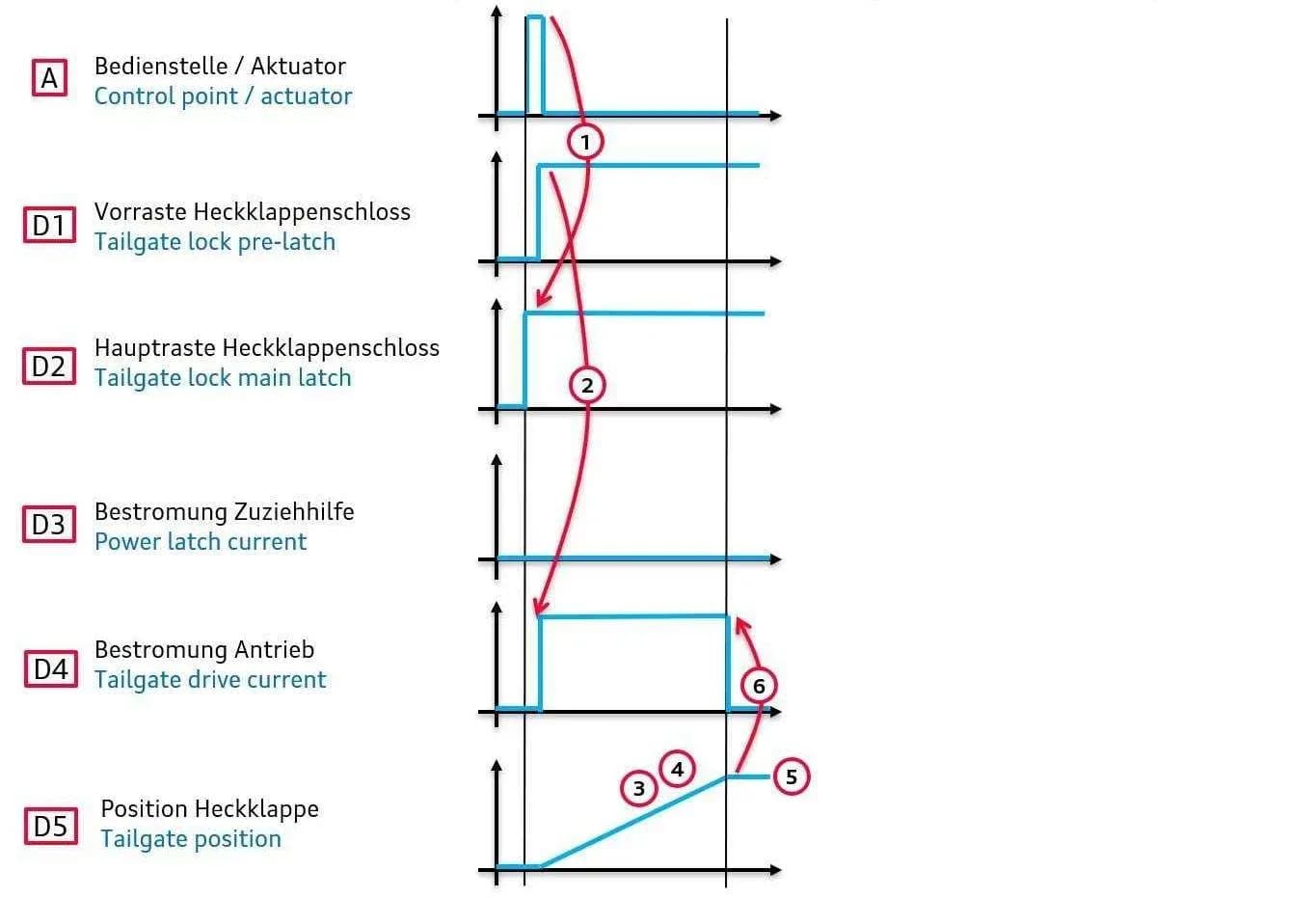
Also applies to
- Audi A3
- 2022–2026
- Audi A4
- 2021–2025
- Audi A4 allroad
- 2021–2025
- Audi A5
- 2021, 2022, 2023, 2024, 2026
- Audi A6
- 2021–2026
- Audi A6 allroad
- 2021–2026
- Audi A7
- 2021–2025
- Audi A7 e
- 2021–2022
- Audi A8 L e
- 2021
- Audi e-tron
- 2021, 2023
- Audi e-tron GT
- 2022–2025
- Audi e-tron Sportback
- 2021–2022
- Audi Q3
- 2021–2025
- Audi Q5
- 2021–2026
- Audi Q5 e
- 2021, 2023, 2024, 2025
- Audi Q7
- 2021–2026
- Audi Q8
- 2021–2026
- Audi RS 3
- 2022–2026
- Audi RS 5
- 2021–2024
- Audi RS 6 Avant
- 2021–2026
- Audi RS 7
- 2021–2026
- Audi RS e-tron GT
- 2022–2026
- Audi RS Q8
- 2021–2026
- Audi S e-tron GT
- 2026
- Audi S3
- 2022–2026
- Audi S4
- 2021–2025
- Audi S5
- 2021, 2022, 2023, 2024, 2026
- Audi S6
- 2021–2025
- Audi S7
- 2021–2025
- Audi S8
- 2021–2026
- Audi SQ5
- 2021–2026
- Audi SQ7
- 2021–2026
- Audi SQ8
- 2021–2026
▸ Show 27 more▾ Show fewer
Audi has released Technical Service Bulletin (TSB) 2079214/3 to address issues with electric tailgates that may not open or close as desired. This bulletin provides comprehensive information for technicians on fault finding and repair procedures for the electric tailgate system. It applies to various Audi models from 2017 to 2026 equipped with power closing tailgates (PR codes 4E6 or 4E7).
If you are experiencing an Audi electric tailgate fault, this TSB outlines the diagnostic steps your service center will follow to identify the root cause, whether it's a defective component or an issue with the system's basic settings.
Revision History
This Technical Service Bulletin has undergone several revisions to ensure accuracy and expand its applicability:
- Revision 1: Initial publication on September 9, 2025.
- Revision 2: Released on January 21, 2026, with a revised header to add model years.
- Revision 3: Further revised the header to add more model years.
Symptoms of an Electric Tailgate Fault
Owners may notice the following symptoms related to an Audi electric tailgate fault:
- The electric tailgate does not work.
- It does not open or close as desired.
- Event memory entries related to the tailgate system may be present in the vehicle's diagnostic logs.
Technical Background
This TSB, 2079214/3, provides a detailed explanation of how the electric tailgate system operates. It includes comprehensive repair instructions to assist technicians in diagnosing and resolving issues. By utilizing event memory-based fault finding with the ODIS workshop tester, the document aims to facilitate the precise identification of defective components within the electric tailgate system, thereby streamlining the repair process.
Understanding Your Audi's Electric Tailgate System
Audi's electric tailgate system is complex, integrating various control units and components across different vehicle platforms. The TSB details the functional overview for MQB, MEB, MLB, PPE, and PPC platforms.
Key Components and Control Units
The system relies on several control points and units to function correctly. The following abbreviations are used:
- BCM: Body Computer Module
- ICAS: In-Car Application Server
- SAM: Sensor Actor Module
- SAR: Sensor Actor Rear
- HCP: High-Performance Computing platform
Control points (labeled 'A' in diagrams) include:
- A1: Remote key (Funkschlüssel)
- A2: Interior door button (Türinnentaster)
- A3: Handle (soft touch) and tailgate interior button (Griffstück (Softtouch) & Heckklappeninnentaster)
- A4: Sensor-controlled tailgate (virtual pedal) (Sensorgesteuerte Heckklappe)
Key control units and components (labeled 'B' and 'C' in diagrams) include:
- B1: BCM (MQB), SAM/ICAS (MEB), BCM2 (MLB)
- B2: Tailgate control unit (Heckdeckel-Steuergerät / HDSG) (Diagnostic address 006D)
- B3: Control unit for sensor-controlled tailgate (Steuergerät für sensorgesteuerte Heckklappe) (Diagnostic address 064E)
- B4: HCP4 (PPE & PPC)
- B5: SAR (Sensor Actor Rear) (Diagnostic address 0046) (for PPE/PPC platforms)
- C1: Tailgate lock (Heckklappenschloss)
- C2: Power latching system (closing aid) (Zuziehhilfe)
- C3: Tailgate drive (Heckklappenantriebe)
Platform-Specific Architectures
The TSB details how the electric tailgate system is integrated across different Audi platforms:
- MQB (Modular Transverse Matrix): Found in models like the A3 and Q3.
- MEB (Modular Electric Drive Matrix): Used in the Q4 e-tron.
- MLB (Modular Longitudinal Matrix): Applies to A4, A5, A6, A7, A8, Q5, Q7, Q8, Q8 e-tron, and e-tron GT.
- PPE (Premium Platform Electric): For vehicles such as the A6 e-tron (GH) and Q6 e-tron (GF).
- PPC (Premium Platform Combustion): Found in models like the A5 (FU), A6 (FN), and Q5 (GU).
For MQB, MEB, and MLB platforms, control points A1 and A2 communicate with the BCM (diagnostic address 0009), ICAS (diagnostic address 0019), or BCM2 (diagnostic address 0046). The sensor-controlled tailgate (A4) communicates via its control unit (B3, diagnostic address 064E). The handle (A3), power latching system (C2), and tailgate drive (C3) are directly connected to the tailgate control unit (B2, diagnostic address 006D). The tailgate lock (C1) is directly connected to the BCM, ICAS, or BCM2.
For the newer PPE and PPC platforms, the architecture is modified. The HCP4 control unit (B4) replaces the BCM, ICAS, and BCM2 (B1). The tailgate control unit (B2) is replaced by the SAR (B5, diagnostic address 0046). Additionally, the tailgate lock (C1) is connected directly to the SAR (B5).
Functional Sequence During Opening (Figure 4)
The TSB illustrates the precise sequence of events when the electric tailgate opens:
- Request Initiation: A request to open the tailgate is sent from a control point (A) to the BCM or HCP4 (B1, B4).
- Latch Release: This signal releases the tailgate lock's main latch (D2). The spring pre-tension then slightly pushes the tailgate out of its end position, activating the tailgate lock pre-latch (D1).
- Movement Activation: The pre-latch signal (D1) is critical as it initiates and controls the tailgate movement. It regulates the tailgate drive current (D4) through the control units.
- Position Monitoring: Hall sensors within the tailgate drive continuously measure the current position of the tailgate (D5). The system aims to reach the desired end position, which can be a soft stop position or an adapted intermediate position (PUE - programmed upper end position).
- Speed Reduction: Once the tailgate is approximately 15% from its fully open position, the movement speed is reduced for a smooth stop.
- Drive Stop: When the desired end position is reached, the tailgate drive current (D4) ceases.
- Process Completion: The tailgate has achieved its target opening dimension, and the opening process is complete. The power latch current (D3) is not engaged during the opening sequence.
Functional Sequence During Closing (Figure 5)
The closing sequence of the electric tailgate also follows a precise series of steps:
- Closing Request: A request to close the tailgate is sent from a control point (A) to the BCM or HCP4.
- Drive Activation: The BCM or HCP4 forwards this signal to the HDSG or SAR, which then activates the rear lid drives (D4).
- Position Tracking: Hall sensor values from the tailgate drive are processed by the tailgate control unit or SAR to monitor the tailgate's position (D5) as it approaches the desired closed position.
- Speed Reduction: Similar to opening, the tailgate's speed is reduced when it is approximately 15% from its fully closed position.
- Pre-latch Engagement: As the lock reaches the pre-latch (D1), the tailgate drive current (D4) is switched off. After a brief delay, the power latch (D3) begins its closing process, pulling the tailgate lock into the main latch (D2).
- Feedback Confirmation: The signal from the main latch (D2) provides feedback to the tailgate control unit or SAR, confirming that the tailgate has successfully completed its movement.
- Power Latch Reset: Finally, the power latch (D3) returns to its starting position (S3 switch).
Diagnosing the Audi Electric Tailgate Fault
Technicians can perform both manual checks and advanced diagnostics using the ODIS workshop tester to pinpoint an Audi electric tailgate fault.
Manual Fault Finding Steps
These manual steps help identify defective parts on MQB, MEB, and MLB vehicles, even if the ODIS tester doesn't provide a specific repair suggestion or event memory entries are absent. A video demonstrating these steps for the Audi Q4 e-tron Sportback is available via QR code or the link: https://audi-external.kzoplatform.com/player/medium/3090973936389723283.
- Close the tailgate from its fully open position.
- Using a screwdriver or pen, manually press the lock's pre-latch.
- Observe the tailgate: It should stop moving immediately. If the tailgate continues to move, it indicates that the tailgate lock may be defective.
- Open the tailgate again to allow the tailgate lock pre-latch to pop out.
- Immediately close the tailgate once more and stop it a second time by manually pressing the pre-latch. At this point, the power latch should activate. If the power latch does not activate, it suggests that the power latch itself may be defective.
For PPE and PPC vehicles, a similar manual fault-finding procedure applies. Additional videos for the Audi A6 e-tron demonstrating these steps are available via QR codes or these links: https://audi-external.kzoplatform.com/player/medium/3090976688507458783 and https://audi-external.kzoplatform.com/player/medium/3090979841575490871.
- Close the tailgate from its upper end position.
- Use a screwdriver or pen to manually press the lock's pre-latch.
- The tailgate should stop moving immediately. If it does not, the tailgate lock may be defective.
- Additional Check for PPE/PPC: If the remaining opening angle of the tailgate is less than 13%, the power latch should automatically start. This can be conveniently tested from inside the vehicle by moving the tailgate to a position with less than 13% opening angle remaining and operating the tailgate lock pre-latch from the inside.
Important Warnings for Technicians and Owners
Advanced Diagnostic with ODIS Workshop Tester
For a more in-depth analysis of an Audi electric tailgate fault, technicians use the ODIS workshop tester to read complete measured value blocks from the relevant control units. This advanced diagnostic method helps identify underlying issues that might not be apparent through manual checks.
Tailgate Control Unit Measured Value Blocks
Technicians will access measured value blocks from the tailgate control unit at specific diagnostic addresses:
- Diagnostic address 006D: Relevant for MQB vehicles (Audi A3, Q3), MEB vehicles (Audi Q4 e-tron), and MLB vehicles (Audi A4, A5, A6, A7, A8, Q5, Q7, Q8, Q8 e-tron, e-tron GT).
- Diagnostic address 0046: Relevant for PPE and PPC vehicles (new A5, new A6, A6 e-tron, new Q5, Q6 e-tron).
Details found in these measured value blocks include:
- The last 5 reasons why the tailgate stopped moving.
- Whether the tailgate has been correctly initialized (basic setting done).
- The last 5 reasons why the basic setting or initialization was aborted.
- The last 5 reasons why the luggage compartment cover malfunctioned.
- The last 5 reasons why the power latch malfunctioned.
- The current lock status, power latch status, and control point status at the time of reading.
Central Locking System Measured Value Blocks
Further analysis involves reading complete measured value blocks from the central locking addresses:
- Diagnostic address 0019: Relevant for MEB (ICAS).
- Diagnostic address 0009: Relevant for MQB, PPE, PPC.
- Diagnostic address 0046: Relevant for MLB.
Note that diagnostic address 0046 specifically contains all closing signals for the tailgate on the PPE and PPC platforms.
Details found in these measured value blocks include:
- The current lock status at the time of reading.
- A list of any lock faults detected.
- The last 20 control point entries, shown chronologically according to Greenwich Mean Time (GMT). This information is crucial for understanding the sequence of events leading to a fault. The TSB notes that the number of entries may vary between vehicles, and time differences to local zones should be considered.
The analysis of the malfunction set time is particularly useful for investigating instances where a rear lid appears to have opened automatically, often providing evidence that the key was operated unintentionally (e.g., in a pocket). For further details on this subject, technicians are directed to TSB 2022032: 57 Vehicle locking system, diagnostic information.
Warranty Information
This TSB (2079214/3) is provided for informational purposes only and is not applicable to any Audi Warranty. Owners should consult their dealer regarding specific warranty coverage for repairs.
Source
National Highway Traffic Safety Administration (NHTSA) TSB ID: 2079214/3
Gallery
4 images
Frequently Asked Questions
- What are the common symptoms of an Audi electric tailgate fault?
- Common symptoms include the electric tailgate not working, failing to open or close as desired, and the presence of event memory entries in the vehicle's diagnostic system.
- Which Audi models and years are affected by electric tailgate issues covered in TSB 2079214/3?
- TSB 2079214/3 applies to various Audi models from 2017 to 2026 that are equipped with power closing tailgates (PR codes 4E6 or 4E7). A comprehensive list of affected models is provided in the bulletin.
- What diagnostic addresses are relevant for an Audi electric tailgate fault?
- Technicians will check diagnostic addresses such as 006D for MQB/MEB/MLB vehicles, 0046 for PPE/PPC vehicles, 0019 for MEB (ICAS), and 0009 for MQB/PPE/PPC platforms. These addresses provide crucial measured value blocks for fault analysis.
- Can I diagnose an Audi electric tailgate fault myself?
- While the TSB provides manual fault-finding steps to identify potentially defective tailgate lock or power latch components, a full diagnosis and repair require specialized tools like the ODIS workshop tester and trained technicians. It's recommended to visit an authorized Audi service center.
- What is the importance of performing the basic setting of the tailgate?
- The TSB emphasizes that the basic setting of the tailgate must be performed. Failure to do so carries a risk of excessive force not being detected by the system, which could lead to further issues or damage.
Related Articles
2022 Audi e-tron Problems: Electrical System & Braking Concerns
The 2022 Audi e-tron has faced significant owner complaints regarding its electrical system, including sudden power loss and charging hazards, as well as various braking malfunctions. This profile details these issues and relevant service bulletins.
2022-2026 Audi Guided Fault Finding Reporting Obligation
Audi has issued Technical Service Bulletin TPI 2033392, also known as Transaction No. 2081531/1, regarding a reporting obligation for technicians when Guided Fault Finding produces an unexpected result. This TSB outlines the process for contacting Audi Product Support for diagnostic assistance.
2022-2026 Audi Infotainment System Complaints
Audi has released Technical Service Bulletin (TSB) 2081405/1 to address various customer complaints regarding infotainment systems in 2022-2026 Audi vehicles. This TSB helps technicians diagnose issues often caused by external media or mobile devices, rather than vehicle technology.
2018-2026 Audi Models Cracking Noise TSB 2061464/11
Audi Technical Service Bulletin 2061464/11 describes a cracking noise from the front or rear axle when changing direction in various 2018-2026 Audi models. The issue is due to stub axle movement and is resolved by bonding the stub axle to the wheel bearing with locking fluid.
2022-2026 Audi Parking Aid False Warnings TSB 2024323/13
Audi has released Technical Service Bulletin 2024323/13 to address customer complaints of false parking aid warnings. This bulletin details various environmental and vehicle-specific conditions that can cause the parking aid system to issue alerts even when no obstacles are present. It provides…
Leave a comment
Comments are moderated and may take a moment to appear. Only your first name and the initial of your last name are shown publicly.
Comments
Be the first to comment.