2021-2023 Audi e-tron Ghost DTCs in HV Battery Charger
A Technical Service Bulletin (TSB 2062631/4) addresses various 'ghost' Diagnostic Trouble Codes (DTCs) that may be erroneously stored in the high-voltage battery charger control module (J1050) of 2021-2023 Audi e-tron vehicles. These codes do not indicate an actual fault and require no repair.
 David Chen2022 Audi e-tron
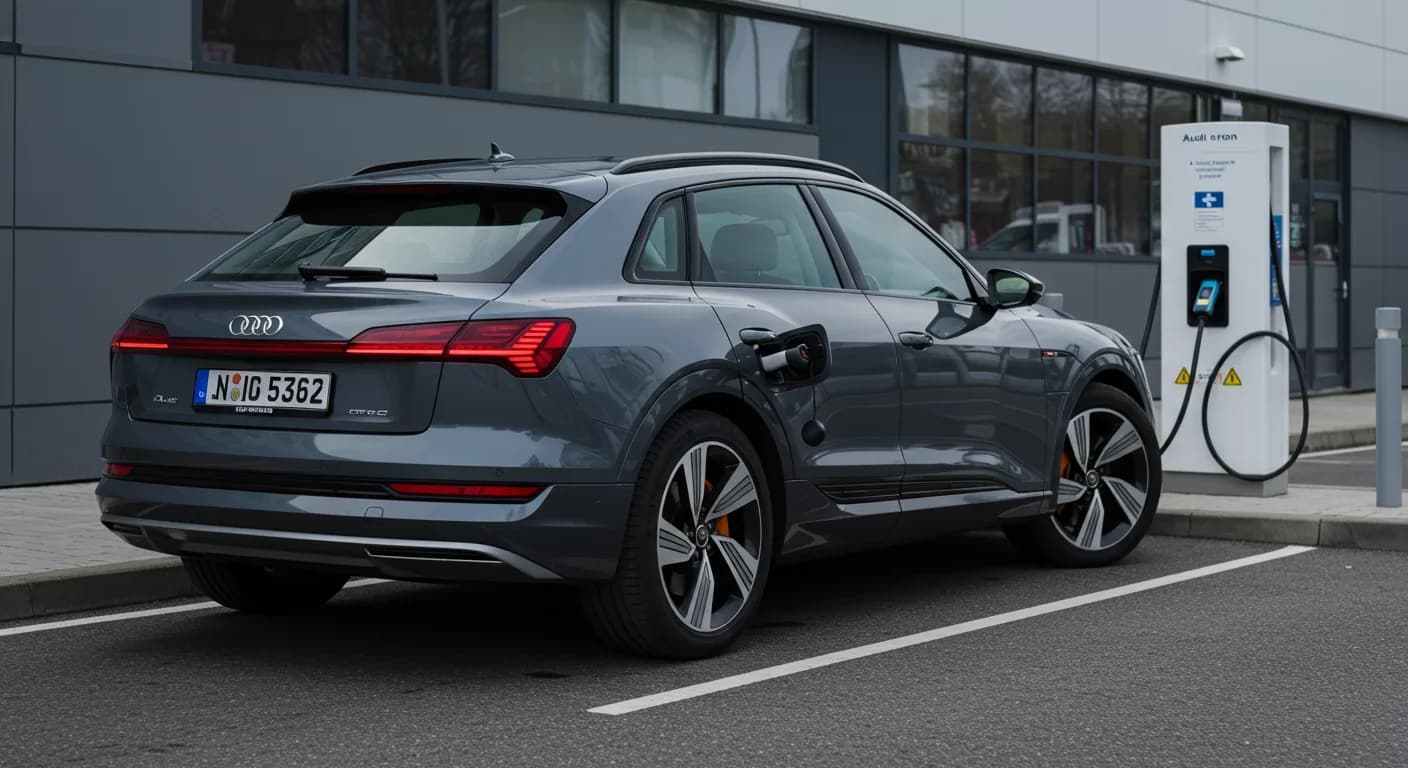
Also applies to
- Audi e-tron
- 2021, 2023
- Audi e-tron Sportback
- 2022
Symptoms
Owners of 2021-2023 Audi e-tron vehicles may find various Diagnostic Trouble Codes (DTCs) stored in the high-voltage battery charger control module, J1050 (address word 00C6). These codes are often discovered during Pre-Delivery Inspection (PDI) or other diagnostic work, even when there are no actual customer concerns regarding charging performance. These are known as Audi e-tron ghost DTCs.
Fault Codes / DTCs
This Technical Service Bulletin (TSB 2062631/4) identifies several DTCs that may be erroneously stored. These Audi e-tron ghost DTCs are categorized by the software version installed in the J1050 control module.
Vehicles with Software 0079 installed in J1050 (address word 00C6):
| Diagnostic address | DTC | Designation | Symptom Code |
|---|---|---|---|
| 00C6 | B1A8AF0 | Charge door 1 LIN actuator, path of movement fault | 3211268 |
Vehicles with Software 0081 installed in J1050 (address word 00C6):
| Diagnostic address | DTC | Designation | Symptom Code | Static / Sporadic |
|---|---|---|---|---|
| 00C6 | P0CA400 | Hybrid/High voltage battery load voltage too high | 14745862 | Both |
| 00C6 | U112100 | Data bus missing message | 13705524, 13705553, 13706243, 13705484 | Both |
Other DTCs that may be stored in vehicles with Software 0081 include:
- B194B13: Charge flap 2 search illumination – open circuit (3211295)
- B200000: Control module faulty (1049088)
- P1A1500: Charging unit 2 function restriction (14746766)
- P31D100: Charge socket A temperature sensor electrical error (14750742)
- P33E300: Charge socket A, communication error (2097664)
- P178E00: Function restriction due to excessive temperature (14750734)
- U15AC00: Signal damping log malfunction (3280913)
- U15B500: Quick battery charging (DC) – Charging station not active (2097301)
- U15BF00: Intelligent charging function – faulty communication (3276840, 3276846, 3276852)
- U15C900: Safety module (FuSi) function intervention (13709330)
Vehicles with Software 0088 installed in J1050 (address word 00C6) or J1239 (address word 8113):
| Diagnostic address | DTC | Designation | Symptom Code | Static / Sporadic |
|---|---|---|---|---|
| 00C6 or 8113 | P0D2800 | Battery charger Primary voltage too high | 14746125 | Both |
| 00C6 or 8113 | P33E500 | Quick battery charging (DC) Charge station initialization error | 2097287 | Sporadic |
| 00C6 or 8113 | U15AD00 | Quick battery charging (DC) Charging station incompatible | 2097292 | Both |
| 00C6 or 8113 | C116300 | Development functions active | 14753057 | Both |
| 00C6 or 8113 | P0CA400 | Hybrid/High voltage battery load voltage too high | 14745862 | Both |
Technical Background
The presence of these DTCs is due to a diagnosis issue within the software of the high-voltage battery charger control module, J1050 (address word 00C6). The system erroneously records these fault codes, even when no actual malfunction is present. This means these are Audi e-tron ghost DTCs that do not reflect a real problem with the vehicle's charging system.
Important Warnings
It is crucial for technicians and owners to understand that the DTCs listed in this bulletin are erroneous and should be ignored. This condition is considered normal.
- Do not perform any repairs. Any repairs or part replacements for this concern may be denied under warranty.
- This condition is normal and does not indicate a fault in the vehicle's charging system.
Owner Action
If you own a 2021-2023 Audi e-tron and these specific DTCs are found during a diagnostic scan, you should be aware that they are likely ghost codes and do not require any repair. However, if you experience actual customer concerns regarding your vehicle's charging performance, this TSB does not apply. In such cases, the vehicle must be repaired following standard Guided Fault Finding procedures to address the legitimate issue.
Source: NHTSA ID 10237408
Frequently Asked Questions
- What does TSB 2062631/4 mean for my Audi e-tron?
- TSB 2062631/4 indicates that certain Diagnostic Trouble Codes (DTCs), such as B200000 or P0CA400, may appear in your 2021-2023 Audi e-tron's high-voltage battery charger control module (J1050) without an actual fault. These are 'ghost DTCs' and do not require repair.
- Should I be concerned if my Audi e-tron shows DTC P0CA400?
- According to the TSB, if your 2021-2023 Audi e-tron shows DTC P0CA400 (Hybrid/High voltage battery load voltage too high) without any actual charging issues, it is likely an erroneous 'ghost DTC' and does not indicate a real problem. No repair is needed for this specific code if no other symptoms are present.
- Will my Audi e-tron's warranty cover repairs for these ghost DTCs?
- No, the TSB explicitly states that any repairs or part replacements performed solely for these erroneous 'ghost DTCs' may be denied under warranty. This is because the codes do not represent an actual malfunction, and the condition is considered normal.
- What should I do if my Audi e-tron has actual charging problems and also shows these DTCs?
- If you are experiencing genuine charging problems with your 2021-2023 Audi e-tron, this TSB does not apply to your situation. In such cases, your vehicle should be diagnosed and repaired following standard Guided Fault Finding procedures to address the actual customer concern, regardless of the presence of these ghost DTCs.
Other revisions of this TSB
- 2021-2025 Audi Emergency Call System Fault TSBB200000
- 2025-2026 Audi A5, S5, A6 Door Handle Release TSBU112100
- 2022-2025 Audi e-tron Emergency Call System Fault TSBB200000
- 2023-2026 Audi Emergency Call System Fault B200000 TSBB200000
- 2025 Audi Q5 Software Update for Electrical System WarningsU112100
- 2025 Audi Q5 / SQ5 Software Update for Various Error MessagesU112100
- 2022-2024 Audi A3, S3, RS 3 Exterior Lighting Warning TSBU112100
- 2025 Audi A5 / A6 e-tron Exterior Door Handle Ejection TSBU112100
Related Articles
2022 Audi e-tron Electrical System Problems: Complaints & TSBs
Owners of the 2022 Audi e-tron frequently report significant electrical system malfunctions, ranging from sudden power loss and charging hazards to software crashes. Braking issues and unexpected automatic emergency braking are also common concerns, alongside numerous technical service bulletins…
2022-2026 Audi Guided Fault Finding Reporting Obligation
Audi has issued Technical Service Bulletin TPI 2033392, also known as Transaction No. 2081531/1, regarding a reporting obligation for technicians when Guided Fault Finding produces an unexpected result. This TSB outlines the process for contacting Audi Product Support for diagnostic assistance.
2022-2026 Audi Infotainment System Complaints
Audi has released Technical Service Bulletin (TSB) 2081405/1 to address various customer complaints regarding infotainment systems in 2022-2026 Audi vehicles. This TSB helps technicians diagnose issues often caused by external media or mobile devices, rather than vehicle technology.
2018-2026 Audi Models Cracking Noise TSB 2061464/11
Audi Technical Service Bulletin 2061464/11 describes a cracking noise from the front or rear axle when changing direction in various 2018-2026 Audi models. The issue is due to stub axle movement and is resolved by bonding the stub axle to the wheel bearing with locking fluid.
2022-2026 Audi Parking Aid False Warnings TSB 2024323/13
Audi has released Technical Service Bulletin 2024323/13 to address customer complaints of false parking aid warnings. This bulletin details various environmental and vehicle-specific conditions that can cause the parking aid system to issue alerts even when no obstacles are present. It provides…
Leave a comment
Comments are moderated and may take a moment to appear. Only your first name and the initial of your last name are shown publicly.
Comments
Be the first to comment.