2018-2023 Audi AC Refrigerant Leak Diagnosis TSB
Audi Technical Service Bulletin 2064077/1 details a new method for diagnosing AC refrigerant circuit leaks using calibration gas for 2018-2023 Audi vehicles. This TSB addresses issues with insufficient cabin cooling.
 Marcus Weber2023 Audi e-tron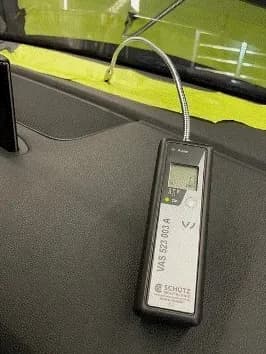
Also applies to
- Audi A3
- 2022–2023
- Audi A4
- 2021–2023
- Audi A4 allroad
- 2021
- Audi A5
- 2021–2023
- Audi A6
- 2021–2023
- Audi A6 allroad
- 2021
- Audi A7
- 2021–2023
- Audi A7 e
- 2021–2022
- Audi A8 L e
- 2021
- Audi e-tron
- 2021–2022
- Audi e-tron GT
- 2022–2023
- Audi Q3
- 2021–2023
- Audi Q7
- 2021–2023
- Audi Q8
- 2021–2023
- Audi R8
- 2021–2023
- Audi RS 3
- 2023
- Audi RS 5
- 2021–2023
- Audi RS 6 Avant
- 2021–2023
- Audi RS 7
- 2021–2023
- Audi RS e-tron GT
- 2022–2023
- Audi RS Q8
- 2021–2023
- Audi S3
- 2022–2023
- Audi S4
- 2021–2023
- Audi S5
- 2021–2023
- Audi S6
- 2021–2023
- Audi S7
- 2021–2023
- Audi S8
- 2021, 2023
- Audi SQ5
- 2021–2023
- Audi SQ7
- 2021–2023
- Audi SQ8
- 2021–2023
- Audi TT
- 2021–2023
- Audi TT RS
- 2021–2022
- Audi TTS
- 2021–2023
▸ Show 27 more▾ Show fewer
Audi Technical Service Bulletin 2064077/1, issued on April 15, 2022, introduces an advanced method for Audi AC leak diagnosis in 2018-2023 Audi vehicles. This bulletin addresses common issues with air conditioning systems that exhibit insufficient cooling capacity or are completely non-functional. The new procedure utilizes calibration gas to pinpoint leaks more effectively than traditional methods, particularly for R134a and R1234yf refrigerant systems.
Symptoms
Owners of affected 2018-2023 Audi models may experience the following symptoms related to their air conditioning system:
- "Insufficient cabin cooling"
- Air conditioning system operating "without function"
- Reduced cooling capacity from the AC system
These issues can indicate a refrigerant leak within the R134a or R1234yf refrigerant systems.
Diagnosis and Technical Background
Historically, diagnosing refrigerant circuit leaks, especially in the evaporator core, has been challenging. Traditional methods, such as adding contrast dye for UV light inspection, using electronic halogen leak detectors, or filling the circuit with pressurized nitrogen and applying a soap solution, often yield unreliable results. These methods are particularly problematic due to limited visual access to components like the evaporator core.
This TSB outlines a new Audi AC leak diagnosis method that uses calibration gas, a specific mixture of 95% nitrogen and 5% hydrogen, along with an electronic hydrogen detector (VAS523003A). This approach has been found to be significantly more effective for detecting leaks in hard-to-access areas, such as the evaporator core concealed inside the evaporator housing. This method is specifically for R134a and R1234yf refrigerant platforms. While the diagnostic method for the R744 system in the Q4 e-tron is similar, it has important procedural differences and should be carried out using the procedure in ElsaPro.
Important Warnings
Owners and technicians must be aware of critical safety information when performing this diagnostic procedure:
- Calibration Gas Safety: "Extreme caution must be exercised when handling and using calibration gas. The hydrogen component of the gas mixture is flammable. Failure to employ proper handling and use protocol invites the risk of serious personal injury or death."
- AC System Operation: "The air conditioning system must not be activated while the circuit is charged with calibration gas. Running the air conditioning system while it is charged with calibration gas will damage the compressor." If necessary, a warning sign stating “Do Not Run” or a similar advisory should be applied to the vehicle to prevent accidental operation while the circuit is filled with calibration gas for diagnosis.
- High Voltage Vehicles: For high voltage vehicles, "High voltage increases the risk of fatal injury. Severe bodily injury or death by electrocution or electric arcs is possible. Have an Audi high-voltage technician or an Audi high-voltage expert de-energize the high-voltage system." This critical step must be completed before servicing and observed again when re-energizing the vehicle.
- Evaporator Core Replacement: "If no leak is detected through the defroster outlet using this method the evaporator core is not the source of the refrigerant leak and the evaporator core is not to be replaced." Technicians should continue diagnosis on other components of the refrigerant circuit if the evaporator core is ruled out.
Repair Procedure Summary
The Audi AC leak diagnosis procedure involves a detailed, multi-step process to accurately identify refrigerant leaks using calibration gas:
- Refrigerant Recovery: If the vehicle presents with insufficient cabin cooling, technicians must first recover any refrigerant remaining in the AC circuit. The recovered amount is then compared to the specified total volume. A recovery of significantly less than 50% of the total volume indicates an active refrigerant circuit leak.
- Calibration Gas Acquisition: Obtain a tank of calibration gas, which is a mixture of 95% nitrogen and 5% hydrogen. This gas typically needs to be sourced locally from suppliers like Airgas. Figure 1 in the TSB visually depicts a tank of this calibration gas.
- Pressure Regulator Connection: The pressure regulator included in the standard NITROKITG is not suitable for flammable gasses. Instead, the VAS 584005 pressure regulator, which is part of the AT-448 Tool Set, must be used. This specific regulator is designed for gas tanks containing flammable components like hydrogen. Connect the VAS 584005 pressure regulator to the calibration gas tank, ensuring the tank valve remains closed initially. Figure 2 illustrates the VAS 584005 pressure regulator properly attached to the calibration gas tank.
- Vehicle HVAC Preparation: Prepare the vehicle's heating, ventilation, and air conditioning (HVAC) system by setting it to full defrost mode. All instrument panel vents must be closed, and the fresh air intake should be set to recirculation mode. The entire cabin, including windows, sunroof, doors, and rear lid, must be completely closed. Finally, turn off the vehicle entirely, ensuring the key is off and no blower activation occurs.
- High Voltage System De-energization: For high voltage vehicles, an Audi high-voltage technician or expert must safely de-energize the high-voltage system before proceeding with any service.
- Refrigerant Circuit Connection: The NITROKITG includes a service hose and a high-side service port snap coupler compatible with both R134a and R1234yf refrigerant systems. This allows for a single connection to the refrigerant circuit. Technicians should use the appropriate snap coupler from the NITROKITG for the specific refrigerant platform being serviced.
- Circuit Evacuation: Evacuate the vehicle's refrigerant circuit for a minimum of 15 minutes to ensure it is completely free of any refrigerant. Once evacuated, connect the service manifold from the NITROKITG Automotive A/C Nitrogen Leak Test Kit to the high-side service port of the vehicle. Figure 3 shows the NITROKITG manifold connected to the high-side service port, while Figure 4 specifically details the NITROKITG high-side snap coupler connected to the high-side service port. Only one port connection is required for this diagnostic procedure.
- Calibration Gas Charging: Connect the VAS 584005 Pressure Reducer to the NITROKITG manifold. Fill the refrigerant circuit with calibration gas to an absolute pressure not exceeding 14 bar. Figure 5 displays the calibration gas pressure within the circuit.
- Pressure Equalization: After charging the circuit with calibration gas, allow the pressure to equalize for 20 minutes before initiating the leak detection process.
- Leak Detection Setup: Close off the defroster outlets using masking tape, leaving a small opening. Insert the probe of the VAS 523003A gas leak detector into this opening. Figure 6 shows the VAS 523003A gas leak detector positioned in the defroster outlet.
- Performing Leak Diagnosis: The VAS 523003A gas leak detector is designed to react to the hydrogen component of the calibration gas. Since hydrogen is lighter than air, it will rise to the detector probe's position. However, the hydrogen content in the calibration gas evaporates over a short period. Therefore, the leak diagnosis must be performed immediately after charging the refrigerant circuit and completing the 20-minute equalization period. Figure 7 illustrates the VAS 523003A in place in the defroster outlet, detecting hydrogen presence. Depending on conditions, recharging the circuit with calibration gas may be necessary to clearly identify an evaporator core leak.
- Identifying Leak Source: If no leak is detected through the defroster outlet using this method, it confirms that the evaporator core is not the source of the refrigerant leak, and therefore, the "evaporator core is not to be replaced." Technicians should then continue the diagnosis using the VAS 523003A on all other components of the refrigerant circuit to pinpoint the actual leak source.
- Repair and Recharge: Once all leak sources have been identified and repaired, close the valve on the calibration gas tank. Any remaining calibration gas in the refrigerant circuit should be slowly ventilated until the circuit pressure equalizes with atmospheric pressure. Subsequently, perform the necessary repairs, evacuate the refrigerant circuit, and recharge the system with the appropriate refrigerant.
- High Voltage System Re-energization: For high voltage vehicles, an Audi high-voltage technician or expert must safely bring the high-voltage system back into service.
Required Tools and Parts
Technicians performing this diagnostic procedure will require specialized tools and equipment:
- VAS581009: R744 CO2 A/C Service Unit. This unit is used for servicing R744 CO2 air conditioning systems, though the TSB focuses on R134a/R1234yf leak detection.
- VAS584005: Pressure Reducer and Hose. This specific pressure regulator is crucial for safely connecting to calibration gas tanks containing flammable components.
- NITROKITG: Automotive A/C Nitrogen Leak Test Kit. This kit provides the service hose and snap couplers necessary for connecting to the vehicle's refrigerant circuit.
- VAS523003A: Gas Leak Detector. This electronic hydrogen detector is the primary tool for detecting the calibration gas and identifying leak points.
- AT-448 Tool Set Audi R744 CO2 A/C Service Introduction: This tool set is mentioned as containing the VAS 584005 pressure regulator and is adaptable for R134a and R1234yf leak diagnosis.
- Service Information circular – Special Tools and Equipment number ATE-21-21: This circular provides additional information regarding the tools.
- Calibration Gas: A local supply of 95% nitrogen / 5% hydrogen calibration gas.
Warranty Information
This Technical Service Bulletin (TSB 2064077) is provided for informational purposes only and is not applicable to any Audi Warranty. Owners should consult their authorized Audi dealership for specific warranty coverage related to any repairs required as a result of this diagnostic procedure.
Owner Action
If you are experiencing issues with your 2018-2023 Audi's air conditioning system, such as "insufficient cabin cooling" or the AC being "without function," it is strongly recommended to contact an authorized Audi dealership. They are equipped to perform the specialized Audi AC leak diagnosis using the methods outlined in TSB 2064077/1 to accurately identify and repair any refrigerant leaks in your R134a or R1234yf system.
Source: NHTSA ID: 10210511
Gallery
7 images
Frequently Asked Questions
- What is the main problem addressed by Audi TSB 2064077/1?
- Audi TSB 2064077/1 addresses insufficient or non-functional cabin air conditioning cooling capacity in 2018-2023 Audi vehicles equipped with R134a or R1234yf refrigerant systems.
- Why is a new diagnostic method needed for AC leaks?
- Traditional methods like dye inspection or electronic halogen detectors can be unreliable, especially for leaks within the evaporator core. The new method, using calibration gas (95% nitrogen / 5% hydrogen) and the VAS523003A gas leak detector, provides more accurate detection in difficult-to-access areas.
- What should I know about the calibration gas used for AC leak detection?
- Calibration gas, which contains hydrogen, is flammable. Technicians must exercise extreme caution during handling to prevent serious injury or death. Additionally, the AC system must not be activated while charged with calibration gas, as this can damage the compressor.
- Does this TSB cover all Audi models?
- This TSB applies to a wide range of 2018-2023 Audi models, including the e-tron, A4, A6, Q3, Q5, Q7, Q8, R8, S3, S4, S5, S6, S7, S8, SQ5, SQ7, SQ8, TT, TTS, RS3, RS5, RS6, RS7, and RS e-tron GT.
- Is the repair covered under warranty?
- Audi TSB 2064077/1 is informational only and does not apply to any Audi Warranty. Owners should consult their dealership regarding potential costs for diagnosis and repair.
Related Articles
Should 2023 Audi e-tron Owners Worry? Recall & TSB Roundup
The 2023 Audi e-tron faces significant safety concerns, including recalls for potential brake pedal detachment and charging cable overheating. Owners have also reported serious issues like unintended acceleration and electrical system malfunctions. This guide covers all known problems and solutions.
2023 Audi e-tron Brake Pedal Recall
Audi has issued a recall (NHTSA ID: 26V240000, Audi Recall 46P7) for certain 2019-2024 E-Tron and 2020-2024 E-Tron Sportback vehicles, including the 2023 Audi e-tron. The recall addresses a potential issue where the brake pedal may detach from the brake booster, leading to a loss of brake function.
2015-2027 Audi Noise Diagnosis with Frequency Analysis App TSB
Audi has released Technical Service Bulletin 2051095/11 detailing the Audi Frequency Analysis app. This app helps technicians diagnose noise complaints more precisely across 2015-2027 Audi models. Learn how the app works, where to download it, and its features for effective vehicle noise analysis.
2023 Audi e-tron AC/DC Charging Not Possible TSB
This manufacturer communication (NHTSA ID 11031035) provides critical information for 2023 Audi e-tron owners facing issues with AC/DC charging. It specifically highlights problems linked to software version 00C6: 0093/3119, which can prevent the vehicle from charging.
2023-2025 Audi Rear Seat Reminder Message TSB 2074943/2
Audi Technical Service Bulletin 2074943/2 explains the instrument cluster message 'Please check rear seats and be aware of door safelock' in various 2023-2025 Audi models. This informational TSB details the rear occupant detection system designed to prevent children and pets from being left in…
Leave a comment
Comments are moderated and may take a moment to appear. Only your first name and the initial of your last name are shown publicly.
Comments
Be the first to comment.