2025-2026 Audi Active Front Assist Intervention TSB
This Technical Service Bulletin (TSB) 2076135/5 from Audi addresses instances where the active front assist system intervenes in 2025-2026 Audi A5, A6, Q5, S5, and SQ5 models. The TSB outlines diagnostic procedures and a software update to improve system robustness.
 Marcus Weber2026 Audi A6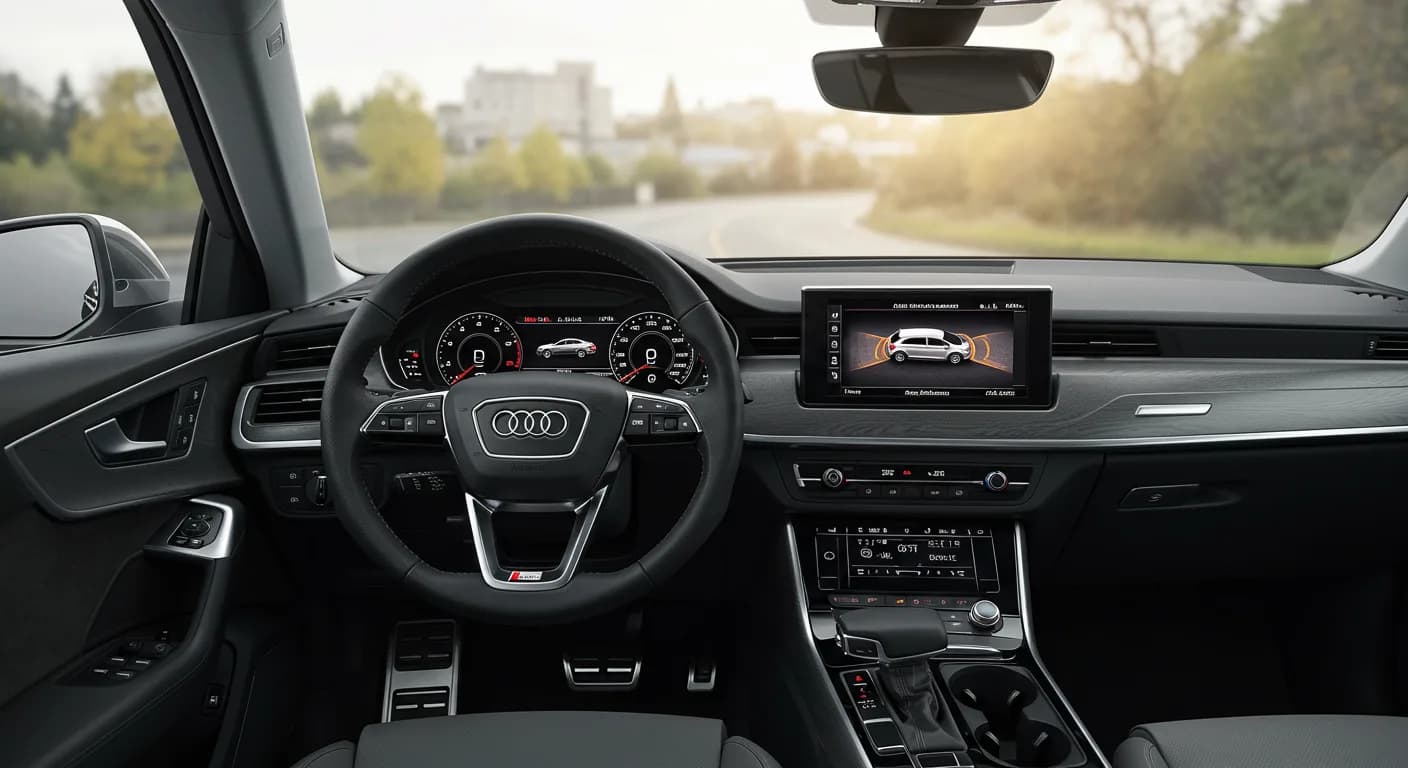
Also applies to
- Audi A5
- 2025
- Audi Q5
- 2025
- Audi S5
- 2025
- Audi SQ5
- 2025
Owners of 2025-2026 Audi A5, A6, Q5, S5, and SQ5 vehicles may notice their active front assist system intervening, sometimes accompanied by warning messages or icons. This behavior is addressed by Audi Technical Service Bulletin (TSB) 2076135/5, which outlines diagnostic steps and a software update to enhance the system's robustness. This bulletin was released on December 19, 2025, and has undergone several revisions.
Revision History
Technical Service Bulletin 2076135/5 has been revised multiple times to ensure accuracy and provide updated information:
- Revision 5: No specific purpose was listed for this revision.
- Revision 4: This revision included updated warranty information, specifically adding instructions for KD2 flash warranty claims.
- Revision 3 (October 17, 2025): The header was revised to include updated models, and the service section was revised to reference the KD2 update TSB.
Symptoms Owners May Notice
Drivers might observe the active front assist system intervening in various situations. This could manifest as:
- "The front assist is intervening."
- A "Collision warning."
- A sudden "Brake jolt."
- An "Automatic brake pressure increase."
- "Automatic brake intervention."
Additionally, an icon representing the front assist system (as shown in Figure 1 of the TSB) may be displayed on the instrument cluster or the MMI (Multi Media Interface) if any of the above actions are initiated. If the swerve assist function is active, a specific "Swerve assist activation icon" (as shown in Figure 2 of the TSB) might also appear.
Diagnosis and Intervention Types
To diagnose the active front assist system, technicians use the "Active front assist" test program within ODIS-S. This program allows them to review the intervention history for a specific period. The test program is located under: Test plan > Select self-test > Diagnostic capable system > 00A5 - Front sensors for driver assistant systems - R242 > 00A5 - Technical Service Bulletin (TSB) > Active front assist. Technicians enter a specific date, and the program checks for interventions within three days before and three days after that date, providing a list of all interventions.
The TSB details several types of interventions that the system can initiate:
- Preliminary warning: If a possible collision risk is detected, the driver receives visual and acoustic warnings to alert them to the danger.
- Main warning: In situations with an immediate collision risk, an acute warning, such as a short brake jolt, may be issued. The system indicates that evasive action or hard braking might be the only way to avoid the collision.
- Reaction time-increasing automatic braking (RAB): This function initiates partial braking early, increasing the time available before an impending collision. This gives the driver more time to react appropriately and reduces the speed of impact if a collision occurs.
- Deescalating automatic braking (DAB): When a collision can only be avoided by immediate braking, the system performs automatic braking. This helps prevent accidents or reduce their severity.
- Automatic braking to a stop (AFB): In critical situations at intersections, when driving away from a standstill and at low speeds, the vehicle is automatically braked to a stop to prevent collisions with oncoming vehicles in the adjacent lane or vehicles/cyclists crossing the vehicle's path.
- Driver-triggered controlled braking (FZB): If the driver is not braking sufficiently in a critical situation, the system increases the braking force to help avoid a collision.
- Swerve support (AWU): This corrective steering function assists the driver for a limited time within the system limits when there is a risk of a frontal collision. If the driver makes a clear steering movement, the system checks if swerving can avoid the collision and provides steering assistance, potentially including targeted braking of individual wheels. The driver can override this assistance.
- Automatic emergency swerve (ANA): Similar to swerve support, this function provides collision-avoiding steering intervention when a frontal collision risk exists. The system determines if an automatic evasive maneuver is possible and performs a steering intervention, which may include targeted braking of individual wheels. The driver can override this intervention.
Repair Procedure Summary
The primary solution for the 2026 Audi A6 active front assist issue, as outlined in TSB 2076135/5, involves a software update. Technicians are instructed to check the software version of the front camera for driver assist systems, identified as -R242- (diagnostic address 00A5).
A combined software update, specifically version "03.10.00/C (28.13.01) KD2", is available. This update is applicable to vehicles currently running software versions SW0250 or SW0295. The update includes measures designed to increase the robustness and reliability of the active front assist function. Further details on this specific KD2 update are provided in reference TSB 2079690, titled "00 Combined software update 03.10.00/C (28.13.01) KD2".
Required Tools or Parts
For the software update procedure, a connecting battery charger is required to maintain stable voltage during the flash process. No other specific special tools or part numbers are mentioned in this TSB.
Important Warnings for Technicians and Owners
Audi notes that this bulletin may apply to vehicles still within their new model launch repair authorization period. For such vehicles, workshops must create a case with the Technical Assistance Center (TAC) to obtain repair authorization, referencing TSB 2076135/5 in the first line of the TAC case.
Warranty Information
For vehicles still under warranty, claims for this repair should be submitted according to the Audi Warranty Policies and Procedures Manual. The damage code for this issue is 0039, and the service number is 9163. The claim comment should state "As per TSB 2076135/5".
Labor operations for this TSB include:
- Reading out history using "Active front assist" test program:
- GFF 0150 0060: Time stated on the diagnostic protocol.
- GFF 0150 0010: See SRT with associated operations.
- TSB 2079690, Combined software update "03.10.00/C (28.13.01) KD2":
- Software update, including connecting battery charger: 0151 0010, See SRT with associated operations.
- Fixed rate for software update, including all required preliminary and follow-up work (including bus sleep cycle, calibration drives, and additional work): 0151 0040, 130 TU.
- In the case of additional attempts after flash abort occurred, an additional lump sum of 50 time units can be claimed per flash cancellation: 0150 9999, 50 TU, Per each documented attempt.
Audi specifies that when performing the combined software update, time stamps are not required for billing under warranty. This means technicians are permitted to work on other vehicles simultaneously, and the combined software update can also be performed by non-productive personnel. If the vehicle is outside of its warranty period, this Technical Service Bulletin serves as informational guidance only.
Additional Information for Service Providers
All part and service references within TSB 2076135/5 are subject to change or removal. Technicians should always verify the latest information and parts bulletins with their Parts Department and/or ETKA. Additionally, the Repair Manual should be consulted for fasteners, bolts, nuts, and screws that require replacement during the repair.
What Owners Should Do
If you own a 2025-2026 Audi A5, A6, Q5, S5, or SQ5 and are experiencing frequent or unusual interventions from your active front assist system, or if you see related warning messages, it is recommended to contact your authorized Audi dealership. Inform them about the symptoms you are experiencing and mention Technical Service Bulletin 2076135/5. The dealership can perform the necessary diagnostic checks and apply the software update to resolve the issue with your 2026 Audi A6 active front assist system.
Source: NHTSA ID: 11027435
Frequently Asked Questions
- What does 'active front assist intervention' mean in my Audi?
- Active front assist intervention refers to situations where your Audi's driver assistance system takes action, such as issuing a "Collision warning," performing a "Brake jolt," or initiating "Automatic brake intervention," to help prevent or mitigate a collision. This TSB addresses software-related causes for these interventions.
- Which Audi models are affected by TSB 2076135/5?
- This Technical Service Bulletin (TSB) 2076135/5 applies to 2025-2026 Audi A5, A6, Q5, S5, and SQ5 models that may experience issues with the active front assist system.
- How is the active front assist intervention issue resolved?
- The issue is resolved by updating the software of the front camera for driver assist systems (-R242-) to version "03.10.00/C (28.13.01) KD2". This update improves the robustness of the active front assist function and is performed by an authorized Audi dealership.
- Will I see a warning light if my active front assist system is intervening?
- Yes, if your active front assist system is intervening, you may see a specific "Front assist icon displayed on the instrument cluster or the MMI". If the swerve assist is active, a "Swerve assist activation icon" may also appear.
- Is the software update for the 2026 Audi A6 active front assist covered under warranty?
- If your vehicle is still within its warranty period, the software update described in TSB 2076135/5 should be covered. It's best to confirm with your Audi dealership, as claims are processed according to Audi's warranty policies. The damage code for this repair is 0039.
Related Articles
2025-2026 Audi Drive System Fault DTC P119A00 P119B00
Audi has issued Technical Service Bulletin 2081542/1 for 2025-2026 A6, S5, and SQ5 models experiencing a 'Drive system fault' and storing DTCs P119A00 or P119B00. This is a known software issue, and a solution is anticipated by Q2 2026. Owners are advised against component replacement.
2025-2026 Audi Rear Lid Malfunction TSB 2081508/1
Audi has released Technical Service Bulletin (TSB) 2081508/1, a Pending Service Solution (PSS 55), concerning a rear lid malfunction in certain 2025-2026 Audi A5, S5, Q5, SQ5, and A6 models. Owners may experience the rear lid not opening or closing fully, or closing too quickly. This TSB outlines…
2025-2026 Audi Software Update 03.11.00/C Overview
Audi TSB 2081477/1 details the planned introduction dates for the combined software update 03.11.00/C PPE/PPC KD2 for various 2025-2026 Audi models. This informational bulletin outlines new software versions and affected platforms.
2025-2026 Audi Radiator Fan Fault P1A7B00 TSB
Audi has released Technical Service Bulletin 2081427/1 to address a check engine light (MIL) and unusual radiator fan behavior, often accompanied by DTC P1A7B00, in certain 2025-2026 A5, S5, Q5, SQ5, and 2026 A6 models. The fix involves configuring the HCP4 control unit.
2025-2026 Audi Time Changes Automatically While Driving
Audi has issued Technical Service Bulletin 2081404/1 addressing a software issue in 2025-2026 A5, Q5, and A6 models where the vehicle's clock automatically changes by an hour while driving. This TSB explains that a permanent fix is expected by late 2026, and no component replacement is needed.
Leave a comment
Comments are moderated and may take a moment to appear. Only your first name and the initial of your last name are shown publicly.
Comments
Be the first to comment.