2025-2026 Audi A5 / Q5 Engine MIL On DTC P029900 TSB
Audi has issued Technical Service Bulletin (TSB) 2079454/2 for 2025-2026 Audi A5 and Q5 models experiencing an illuminated Malfunction Indicator Lamp (MIL) and diagnostic trouble code P029900. This issue, linked to a software problem in the Engine Control Unit, typically occurs at high ambient…
 Ahmet Topcu2026 Audi A6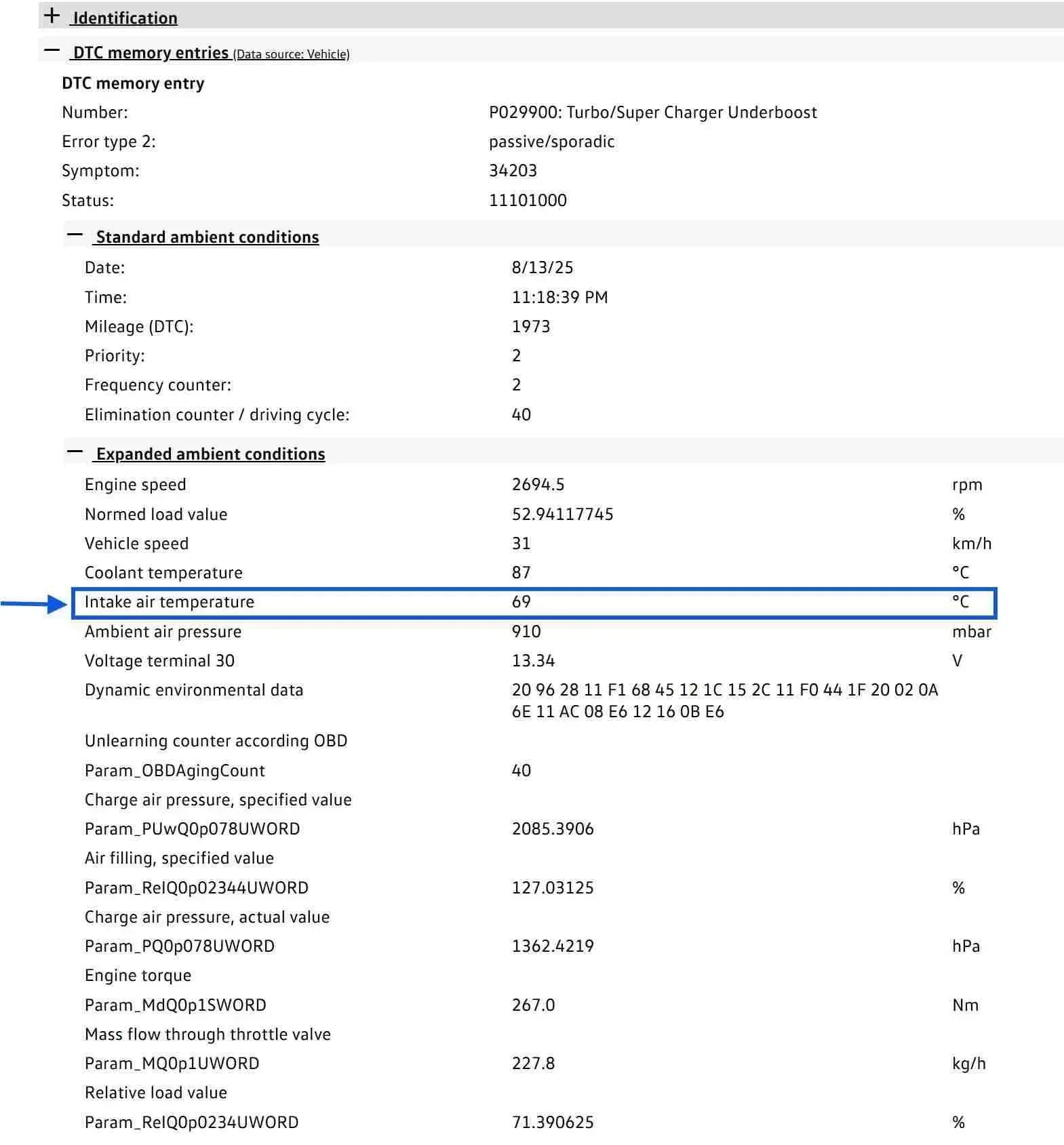
Also applies to
- Audi S5
- 2025
- Audi SQ5
- 2025
Revision History
This Technical Service Bulletin (TSB) 2079454/2 has undergone revisions since its initial publication. Revision 1 was initially published on September 30, 2025. Revision 2 updated the header to add specific models to the bulletin's scope.
Symptoms
Owners of affected 2025-2026 Audi A5 and Q5 vehicles equipped with the EA839evo V6 TFSI engine may observe several indicators pointing to this issue. The most prominent symptom is the illumination of the Malfunction Indicator Lamp (MIL), commonly known as the 'Check Engine' light, in the instrument cluster. This is often accompanied by a message indicating a "Drive System fault". Additionally, the "exhaust emissions warning lamp is illuminated in the instrument cluster." Owners may also notice "A slight loss of performance noticeable" while driving.
Fault Codes / DTCs
When diagnosing this issue, workshops will find a specific Diagnostic Trouble Code (DTC) stored in the Engine Control Unit (J62), which is addressed as word 0001. The presence of this code is a key indicator of the underlying problem.
| Code | Description | Symptom | Module |
|---|---|---|---|
| P029900 | Turbo/Super Charger Underboost | 34203 | Engine Control Unit, J62 (0001) |
This DTC is typically recorded as a static/intermittent fault.
Diagnosis and Trigger Conditions
This Audi P029900 MIL issue is specifically linked to certain environmental conditions. The Technical Service Bulletin 2079454/2 explicitly states that this TSB "only applies if the intake temperature is >65°C". This means that the fault is most likely to occur and be diagnosed when the vehicle is operating in high ambient temperature conditions, leading to elevated intake air temperatures. The complaint generally does not occur during normal vehicle operation but can manifest during extended stationary periods, such as during transportation or while the vehicle is at the workshop, due to a low charge level.
Technical Background
The root cause of the "Turbo/Super Charger Underboost" condition and the resulting Audi P029900 MIL warning is identified as a "Software issue (engine control unit, address 0001) with charge pressure diagnostics." This software anomaly primarily triggers the complaint when the vehicle experiences "high ambient temperatures." There is currently no production solution implemented for this issue.
Important Warnings and Owner Information
Audi has provided specific instructions for addressing this issue, and there are critical points for owners to understand:
- No Component Replacement: "Do not replace any components for this condition since this will not resolve the customer's concern." This TSB clarifies that the issue is software-related, and replacing hardware will not fix the problem.
- Resolution Under Review: Owners will be advised if any action is determined to be needed, with a result expected "by the end of the 4th quarter of 2025 (subject to change) and that no repairs are necessary at this point." This means a definitive fix is still being developed.
- New Model Launch Period: "This PSS may apply to vehicles still within the new model launch repair authorization period!" For vehicles in this phase, workshops must create a web ticket with the Technical Assistance Center (TAC) for repair authorization and enter the vehicle into the PSS database, referencing TSB 2079454/2 in the TAC case.
Warranty Information
For vehicles experiencing the Audi P029900 MIL issue, warranty claims are handled according to specific guidelines. The claim type is generally applicable if the vehicle is within its warranty period; otherwise, the bulletin serves as informational guidance. The Service Number associated with this TSB is 2470, and the Damage Code is 0055.
Labor operations for this service include:
- GFF/ Guided Functions (0150 0060): Time stated on the diagnostic protocol.
- GFF/ Guided Functions (0150 0010): See SRT with associated operations.
All warranty claims must adhere to the Audi Warranty Policies and Procedures Manual and are subject to review by Audi Warranty. The claim comment should reference "As per TSB 2079454/2".
Required Tools
To diagnose and address this condition, Audi workshops will utilize specific diagnostic equipment:
- VAS 6160/VAS 6150: These are specialized VAS testers.
- ODIS (Windows 10): The VAS testers must be running the current version of the Offboard Diagnostic Information System (ODIS) software on a Windows 10 operating system.
NHTSA ID: 10252577
Frequently Asked Questions
- What does the Audi P029900 MIL on warning mean?
- The 'MIL on' warning, accompanied by DTC P029900, indicates a 'Turbo/Super Charger Underboost' condition in your Audi A5 or Q5's V6 TFSI engine. This is often triggered by a software issue in the Engine Control Unit (J62) related to charge pressure diagnostics, especially when intake air temperatures exceed 65°C.
- Should I replace components if my Audi has DTC P029900?
- No, Audi Technical Service Bulletin 2079454/2 explicitly advises against replacing any components for this condition. The issue is identified as a software problem, and component replacement will not resolve the underlying concern. Audi is currently reviewing the matter and expects a resolution by the end of the fourth quarter of 2025.
- What should I do if my 2025-2026 Audi A5 or Q5 shows these symptoms?
- If your 2025-2026 Audi A5 or Q5 displays the 'MIL on' light, a 'Drive System fault' message, or experiences a slight loss of performance, especially in high ambient temperatures, you should contact your authorized Audi dealership. Inform them about the symptoms and reference TSB 2079454/2. The dealership will create a Pending Service Solutions (PSS) record and keep you informed about the forthcoming resolution.
- Is this issue covered under warranty?
- Yes, if your vehicle is still within its warranty period, this issue will be addressed under warranty. Audi TSB 2079454/2 specifies warranty claim types and labor operations for dealers to follow. If the vehicle is outside of warranty, the bulletin serves as informational guidance.
- What specific conditions trigger the Audi P029900 MIL fault?
- The Audi P029900 MIL fault is specifically triggered when the intake air temperature is above 65°C. This indicates that the software issue with charge pressure diagnostics in the Engine Control Unit (J62) is most likely to manifest in high ambient temperature conditions.
Other revisions of this TSB
Related Articles
2025-2026 Audi Drive System Fault DTC P119A00 P119B00
Audi has issued Technical Service Bulletin 2081542/1 for 2025-2026 A6, S5, and SQ5 models experiencing a 'Drive system fault' and storing DTCs P119A00 or P119B00. This is a known software issue, and a solution is anticipated by Q2 2026. Owners are advised against component replacement.
2025-2026 Audi Rear Lid Malfunction TSB 2081508/1
Audi has released Technical Service Bulletin (TSB) 2081508/1, a Pending Service Solution (PSS 55), concerning a rear lid malfunction in certain 2025-2026 Audi A5, S5, Q5, SQ5, and A6 models. Owners may experience the rear lid not opening or closing fully, or closing too quickly. This TSB outlines…
2025-2026 Audi Software Update 03.11.00/C Overview
Audi TSB 2081477/1 details the planned introduction dates for the combined software update 03.11.00/C PPE/PPC KD2 for various 2025-2026 Audi models. This informational bulletin outlines new software versions and affected platforms.
2025-2026 Audi Radiator Fan Fault P1A7B00 TSB
Audi has released Technical Service Bulletin 2081427/1 to address a check engine light (MIL) and unusual radiator fan behavior, often accompanied by DTC P1A7B00, in certain 2025-2026 A5, S5, Q5, SQ5, and 2026 A6 models. The fix involves configuring the HCP4 control unit.
2025-2026 Audi Time Changes Automatically While Driving
Audi has issued Technical Service Bulletin 2081404/1 addressing a software issue in 2025-2026 A5, Q5, and A6 models where the vehicle's clock automatically changes by an hour while driving. This TSB explains that a permanent fix is expected by late 2026, and no component replacement is needed.
Leave a comment
Comments are moderated and may take a moment to appear. Only your first name and the initial of your last name are shown publicly.
Comments
Be the first to comment.