2025-2026 Audi A5, Q5, S5, SQ5 Tire Pressure Warning TSB
Audi Technical Service Bulletin 2077226/4 addresses various warning and malfunction messages related to tire pressure and loose wheels in 2025-2026 Audi A5, Q5, S5, and SQ5 models. The primary fix involves a software update.
 Marcus Weber2026 Audi A5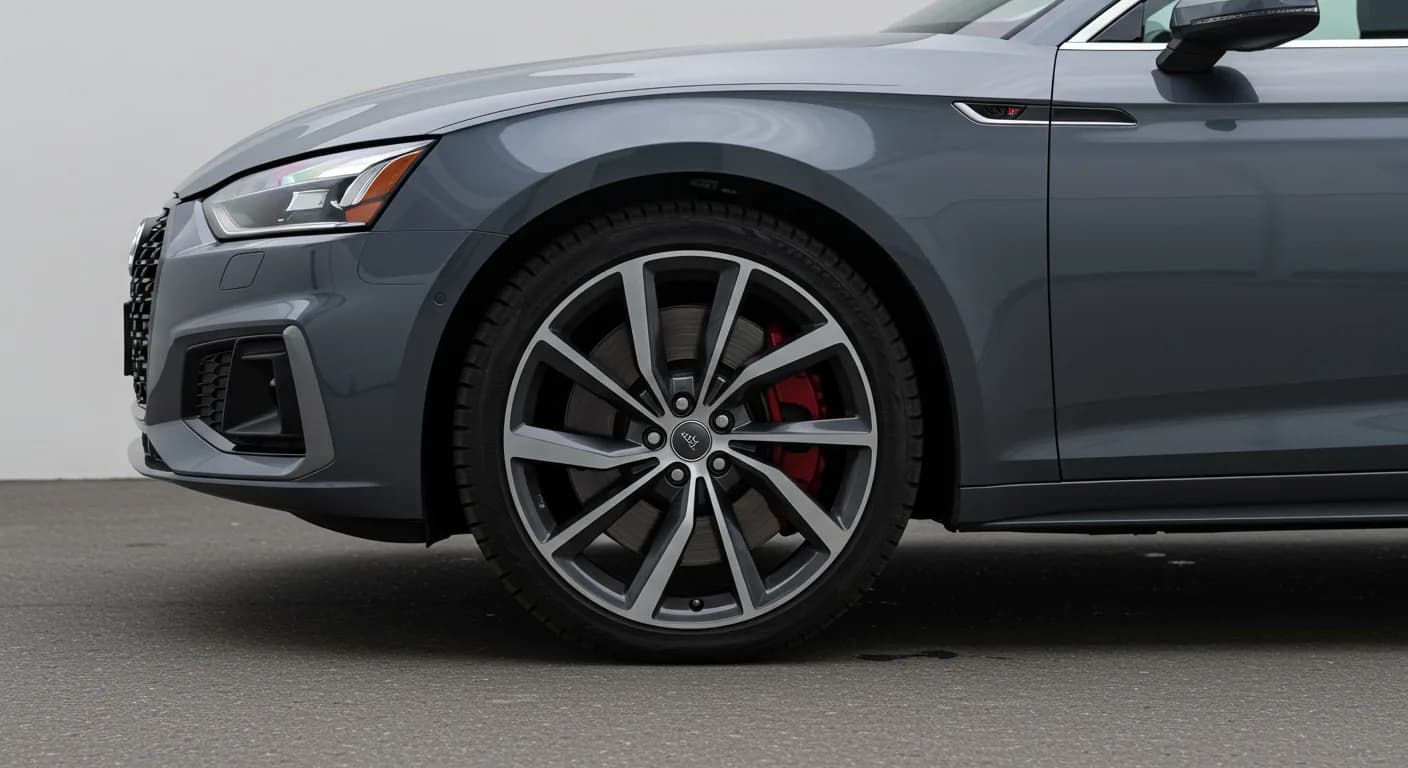
Also applies to
- Audi A5
- 2025
- Audi Q5
- 2025–2026
- Audi S5
- 2025–2026
- Audi SQ5
- 2025–2026
Symptoms
Owners of 2025-2026 Audi A5, Q5, S5, and SQ5 models may encounter an unexpected "loose wheel warning" or "tire pressure warning" displayed on their vehicle's instrument cluster. This primary Audi A5 tire pressure warning serves as a critical alert, indicating a potential issue with the wheels or tire pressure system. While the warning itself is straightforward, its appearance can sometimes be accompanied by or trigger a cascade of other related messages, making diagnosis more complex for the owner.
Related Warning Messages
Audi TSB 2077226/4 highlights that the initial "loose wheel warning" or "tire pressure warning" might not be an isolated incident. Instead, it can be part of a broader system malfunction, leading to a variety of additional warning and malfunction displays. These secondary messages indicate that the underlying issue could be affecting multiple vehicle systems. Owners might observe warnings such as:
- "parking brake indicator display" or "parking brake warning display," potentially escalating to a "parking brake malfunction display." These suggest an interaction between the wheel/tire system and the electronic parking brake.
- "shock absorber control system malfunction display," pointing to issues with the adaptive suspension.
- "power steering failure warning display," indicating a problem with the vehicle's steering assist.
- "tire pressure monitoring system malfunction display," which is a direct indication of a fault within the TPMS itself, beyond just low pressure. This can also manifest as "tire pressure loss warning display" or "tire pressure loss information display," and even "tire pressure monitoring system adaptation mode information display."
- "brake failure warning display" or "ABS malfunction display," signaling critical issues with the braking system.
- Finally, a "driving dynamics regulation (ESC) indicator display" suggests that the Electronic Stability Control system is affected, potentially due to incorrect wheel speed data or other related sensor inputs. The presence of any of these additional warnings alongside the primary Audi A5 tire pressure warning underscores the interconnectedness of vehicle systems and the need for a comprehensive diagnostic approach.
Diagnosis and Trigger Conditions
When a 2025-2026 Audi A5, Q5, S5, or SQ5 presents a "loose wheel warning" or "tire pressure warning," technicians will typically begin by attempting to reproduce the complaint. This step helps confirm the active nature of the warning and provides a baseline for further investigation. The TSB notes that during this diagnostic phase, various Diagnostic Trouble Codes (DTCs) are likely to be logged within the vehicle's control units. These codes provide valuable clues about the specific system or component experiencing a fault. It is crucial to understand that the "loose wheel warning" and "tire pressure messages" are often symptomatic of deeper, underlying issues rather than being direct component failures themselves. For instance, an issue with a wheel speed sensor could trigger a tire pressure warning, even if the tire pressure is correct. Therefore, the diagnostic process emphasizes identifying and rectifying the root cause first, as merely addressing the warning message without resolving the underlying problem will not provide a lasting solution. This approach ensures that the vehicle's safety and performance systems are fully restored.
Related Control Unit Addresses
For accurate diagnosis of the Audi A5 tire pressure warning and its associated messages, Audi TSB 2077226/4 directs technicians to meticulously check specific control unit addresses for any stored Diagnostic Trouble Codes (DTCs). These addresses act as digital locations where fault information from various vehicle systems is recorded. The TSB specifically mentions:
- Control unit address 812C: This address is critical for monitoring and diagnosing issues.
- Control unit address 0003: Another key control unit address to inspect for relevant fault codes.
- Control unit address 0065: Technicians should check this address if available, as it may contain additional diagnostic information pertinent to the complaint. Beyond merely checking for DTCs, the TSB also stresses the importance of ensuring that control unit addresses 812C and 0003 are functioning correctly. Malfunctions in these control units themselves could lead to erroneous warnings. Furthermore, for more complex scenarios or when the initial checks do not yield a clear cause, technicians are advised to consult TSB 2078345. This supplementary bulletin provides additional information on other potential causes of "loose wheel warning" issues, offering a broader diagnostic perspective and guiding technicians toward a comprehensive resolution.
Repair Procedure Summary
The primary and most effective solution for resolving the "loose wheel warning" and "tire pressure warning" in affected Audi models, including the Audi A5 tire pressure warning, is a software update. This update is detailed in a separate, comprehensive document, TSB 2079690.
- Initial Software Update: Technicians must first verify if TSB 2079690, specifically referencing "00 Combined software update 03.10.00/C (28.13.01) KD2", is applicable to the specific vehicle. If it is, the prescribed software update should be performed according to the detailed instructions within TSB 2079690. It's important for owners to note that this software update will be rolled out in stages, meaning its availability may vary depending on the specific vehicle model and market region.
- Addressing Persistent Issues or Unavailable Updates: In cases where TSB 2079690 is not yet available for a particular vehicle, or if the "loose wheel warning" or "tire pressure warning" persists even after the software update, additional diagnostic and corrective steps are outlined:
- Comprehensive Software Update: Always ensure the vehicle's entire software system is updated to the absolute latest version. This involves performing any other applicable service campaigns or Technical Service Bulletins that might address related software components.
- DTC Review: A thorough review of Diagnostic Trouble Codes (DTCs) stored in control unit addresses 812C, 0003, and 0065 is essential. These codes can pinpoint specific component or system failures contributing to the warning.
- Wheel System Inspection: If DTCs are logged for individual wheels or all four wheels, technicians should consider performing wheel balancing or even swapping wheels. Imbalances or physical issues with the wheels themselves can sometimes trigger these warnings.
- Sensor Integrity Check: Critical to the tire pressure monitoring and stability systems are the speed sensors and their associated sensor rings. Technicians must meticulously inspect these components for the affected wheels, ensuring they are clean, free from damage, and functioning correctly. Contamination or damage can lead to erroneous readings.
- Guided Fault Finding: For any problems related to the overall availability or functionality of the warning systems, technicians are instructed to utilize Audi's Guided Fault Finding procedures. This systematic approach helps in isolating and correcting complex electrical or electronic issues.
- Control Unit Functionality: A fundamental step is to confirm that control units 812C and 0003 are operating without fault. These units are integral to the proper functioning of the systems that generate these warnings.
- Cross-Referencing TSBs: Finally, technicians should consult TSB 2078345 for further diagnostic guidance, as it may provide insights into other potential causes for the "loose wheel warning" that might not be directly covered by the primary software update. This multi-faceted approach ensures that all possible causes for the persistent warnings are thoroughly investigated and resolved.
Important Warnings
Warranty Information
Audi Technical Service Bulletin 2077226/4 specifies Service Number 4545 and Damage Code KD02 for warranty claims related to this issue. The detailed labor operations and accounting instructions for performing the necessary repairs, particularly the software update, are outlined in TSB 2079690, which includes the specific software version "00 Combined software update 03.10.00/C (28.13.01) KD2". All warranty claims submitted for payment must strictly adhere to the guidelines provided in the Audi Warranty Policies and Procedures Manual. These claims are subject to review and potential audit by Audi Warranty to ensure compliance.
Source: NHTSA ID 11025348
Frequently Asked Questions
- What is Audi TSB 2077226/4 about?
- Audi TSB 2077226/4 addresses various warning messages, including "loose wheel warning" and "tire pressure warning," that may appear on the instrument cluster of 2025-2026 Audi A5, Q5, S5, and SQ5 models.
- How is the "Audi A5 tire pressure warning" typically resolved?
- The primary resolution for the "Audi A5 tire pressure warning" and related messages is a software update, specifically detailed in Audi TSB 2079690.
- What other warnings might appear with a tire pressure issue?
- Besides the "tire pressure warning," owners might see messages like "parking brake malfunction display," "shock absorber control system malfunction display," "power steering failure warning display," "ABS malfunction display," or "brake failure warning display."
- Are there specific control units involved in diagnosing this issue?
- Yes, technicians are advised to check Diagnostic Trouble Codes (DTCs) in control unit addresses 812C, 0003, and 0065, and ensure 812C and 0003 are functioning correctly.
- Is this repair covered under warranty?
- Audi TSB 2077226/4 notes that if your vehicle is outside of its warranty period, this bulletin is for informational purposes only, and any repairs may not be covered.
Related Articles
2025-2026 Audi A5/Q5 Front Anti-Roll Bar Rattling TSB
Audi has released a manufacturer communication, TSB 2081444/1, addressing a metallic rattling noise from the front of 2025-2026 Audi A5, Q5, S5, and SQ5 models, often linked to a broken front anti-roll bar. This TSB outlines a reporting obligation for technicians to gather data.
2025-2026 Audi Rear Occupant Detection Alarm TSB
This Technical Service Bulletin (TSB) 2080144/3 addresses an issue in 2025-2026 Audi A5, S5, Q5, and SQ5 models where the rear occupant detection system can cause unwanted triggering of the anti-theft alarm, leading to horn sounding and lights flashing. A software update is available to resolve…
2025-2026 Audi A5/S5/Q5/SQ5 P-Lock & Engine Warning TSB
Audi has released Technical Service Bulletin (TSB) 2080044/3 to address issues where the transmission parking lock (P) cannot be selected, or a yellow engine warning lamp illuminates in 2025-2026 Audi A5, S5, Q5, and SQ5 models. This TSB provides a software update to resolve diagnostic trouble…
2025-2026 Audi myAudi App Range Display Issue TSB 2080573/1
Audi Technical Service Bulletin (TSB) 2080573/1 addresses an issue where the range displayed in the myAudi app changes significantly after parking, then corrects itself after the next vehicle start for 2025-2026 A5, S5, Q5, SQ5 models.
2025-2026 Audi A5/S5/Q5/SQ5 Drivetrain Clacking Noise TSB
Audi has issued Technical Service Bulletin (TSB) 2080535/1 for 2025-2026 A5, S5, Q5, and SQ5 models experiencing 'load-change clacking noises from drive train'. This TSB outlines a software update to resolve the issue, particularly noticeable at low speeds.
Leave a comment
Comments are moderated and may take a moment to appear. Only your first name and the initial of your last name are shown publicly.
Comments
Be the first to comment.