2023 Audi Q5 High-Voltage Battery Bolt Service Action 93S3
Audi has launched Service Action 93S3 for specific 2023 Q5 vehicles. This action addresses an issue with incorrect bolt lengths used for securing the high-voltage battery wiring harness, which could cause the connector to loosen and potentially lead to a failure of the power unit's high-voltage…
 David Chen2023 Audi Q5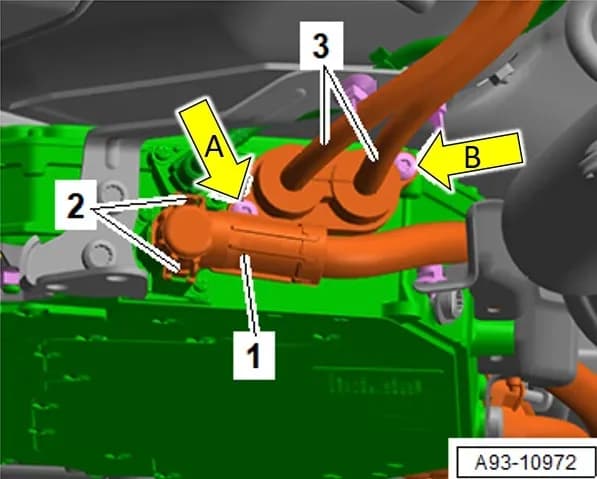
Why This Matters
Audi has identified a critical issue affecting a small number of 2023 Audi Q5 vehicles, specifically 103 units in the U.S. and 8 in Canada. An incorrect bolt length was used to secure the connector for the high-voltage battery wiring harness. This defect could cause the connector to loosen over time, potentially leading to a "failure of the high-voltage system for the power unit", posing a significant safety risk due to potential loss of power.
What's Being Addressed
This service action, identified as Service Action 93S3, focuses on replacing the high-voltage battery wiring harness bolts in affected 2023 Audi Q5 models. The original bolts were of an incorrect length, which could compromise the secure connection of the high-voltage battery wiring harness to the Electric Drive Power and Control Electronics -JX1-. This proactive measure ensures the integrity and safety of the high-voltage system by replacing the faulty components with bolts of the correct specification.
Symptoms
Owners may not notice any immediate symptoms, as the issue is a potential loosening of the connector over time. However, if the connector does come loose, it could result in a "failure of the high-voltage system for the power unit". This would likely manifest as a loss of power or other high-voltage system malfunctions.
Repair Procedure Summary
The repair procedure for the Audi Q5 high-voltage battery bolts involves several critical steps to ensure safety and proper function. First, technicians must safely de-energize the high-voltage system. This is done using a diagnostic tester like the -VAS6150X/6160X- and following a specific test plan in the ELSA Repair Manual, titled "High-voltage system, de-energize". This step is crucial due to the extreme danger posed by high voltage.
Once the system is safely de-energized, the Electrical A/C Compressor High-Voltage Cable <1> is carefully removed by releasing its catches <2>. The existing bolts securing the high-voltage wire 3 (indicated by arrows A and B in the repair diagram) to the Electric Drive Power and Control Electronics -JX1- are then replaced. Technicians first remove the left bolt (arrow A) and install a new bolt (part number N-101-961-03) hand-tight. This process is then repeated for the right bolt (arrow B), which is screwed in and tightened to 7 Nm. Finally, the newly installed left bolt (arrow A) is torqued to 7 Nm. The A/C Compressor High-Voltage Cable <1> is then reconnected.
The final stage of the repair involves re-energizing the high-voltage system. This also requires following specific ELSA procedures and test plans, specifically selecting the test plan "High-voltage system, restart". After re-energizing, the campaign is completed, and the repair order is stamped.
Required Tools or Parts
To perform Service Action 93S3, authorized Audi technicians will use specific tools and parts:
- Bolts: Two bolts with part number N-101-961-03 are required for the replacement. These are described as BOLT* in the parts information.
- Diagnostic Tester: A -VAS6150X/6160X- or equivalent diagnostic tester is necessary for safely de-energizing and re-energizing the high-voltage system.
- Padlock: A padlock, specifically -T40262/1- from the Service Disconnect Lock -T40262-, is used as a safety measure during the high-voltage system work to prevent accidental re-energization.
Important Warnings
Owners and dealers should be aware of several critical warnings related to this service action:
- Safety Risk: The high-voltage system is under heavy voltage, and severe bodily injury or death by electrocution or electric arcs is possible if not handled correctly. Persons with active implants "may not perform procedures on the high-voltage system" due to dangerous electric and magnetic fields.
- Unexpected Motor Start: There is a "Risk of injury - motor may start unexpectedly" as it can be difficult to determine if the drive system of an electric or hybrid vehicle is active. Moving parts can trap or draw in body parts.
- High-Voltage Wiring Damage: Incorrect handling can result in damage to the insulation of high-voltage wires or connectors. Technicians are warned to "Do not support yourself on high-voltage cables or connectors", "Never prop tools against high-voltage wiring or high-voltage connectors", "Never bend or kink high-voltage wiring", and "Observe the coding of the high-voltage connectors when joining them up".
- Prohibited Work: "Never use cutting/forming tools or other sharp-edged implements" near high-voltage components. "Never perform work using welding, brazing, thermal bonding or hot air in the area of high-voltage components and high-voltage cables."
- Inventory Vehicles: Dealers "must ensure that every affected inventory vehicle has this campaign completed before delivery to consumers."
- Campaign Expiration: This campaign expires on June 30, 2028. Work must be performed on or before this date to be eligible for payment. If an owner wishes to have this work performed after the expiration date, normal dealership costs will apply.
- Warranty Claims: "Damages resulting from improper repair or failure to follow these work instructions are the dealer's responsibility and are not eligible for reimbursement under this action." Also, "Diagnosis and repair of pre-existing conditions in the vehicle are not covered under this action." Dealers should "Do not claim wash/loaner under this action."
- Pre-existing Recalls: "All Safety Recalls must be completed prior to completing this campaign."
Owner Action
If you own a 2023 Audi Q5, you should contact your authorized Audi dealer as soon as possible to schedule an appointment for Service Action 93S3. The repair for the Audi Q5 high-voltage battery bolts will take approximately one hour and will be performed free of charge, provided it is completed by the campaign expiration date of June 30, 2028. You can also visit www.audiusa.com to locate a dealer and check your Vehicle Identification Number (VIN) for any open recalls or service campaigns.
Warranty Information
This service action is covered under warranty with the following details:
- Service Number: 93S3
- Damage Code: 0099
- Parts Vendor Code: 002
- Claim Type: Sold vehicle: 7 10; Unsold vehicle: 7 90
- Causal Indicator: BOLT*
- Labor Operations:
- 2706 89 50: Connect battery charger
- 9310 83 50: Disable HV system voltage deactivate and activate
- 9330 56 99: Replace bolts (estimated 10 time units)
- 0151 00 00: GFF Operations
NHTSA ID: 10238200
Galeri
5 görsel
Related Articles
2023 Audi Q5 Health Check: Recalls and Bulletins
The 2023 Audi Q5 has no reported recalls, owner complaints, or federal investigations. However, Audi has issued several technical service bulletins (TSBs) addressing various potential issues, including engine faults, electrical system warnings, and airbag system concerns. This article details…
2022-2024 Audi Q5 / A4 / A5 Engine Faults P060C00 U041600
Audi has released Technical Service Bulletin (TSB) 2076356/4 to address engine control unit drive system faults P060C00 and U041600 in certain 2022-2024 Audi Q5, A4, and A5 models. Owners may notice the 'EPC light is on' or a 'drive system fault' message. The fix involves a software update for the…
2022-2025 Audi A4, A5, Q5 AC Buttons Not Working TSB
Audi Technical Service Bulletin 2078655/2 details issues with non-functional air conditioning operating unit buttons in 2022-2025 Audi A4, A5, and Q5 models, logging DTC B131207. This bulletin outlines symptoms, diagnostic steps, and the recommended repair procedure for technicians.
2022-2025 Audi Q5 MIL On with DTC U060B00
Audi has issued Technical Service Bulletin 2074392/2 for 2022-2025 Q5 models. It addresses a Malfunction Indicator Lamp (MIL) illuminated due to Diagnostic Trouble Code U060B00, indicating lost communication with the turbocharger/supercharger boost sensor. The fix involves repairing wiring at…
2023-2024 Audi Q5 Turbocharger Boost Control DTC P256300
Audi has issued a manufacturer communication regarding a 'turbocharger boost control position sensor circuit range/performance' fault (DTC P256300) affecting 2023-2024 Audi Q5 models. This document outlines initial diagnostic steps and emphasizes contacting Audi Helpline before attempting any…
Yorum bırakın
Yorumlar moderasyondan geçer ve görünmesi biraz zaman alabilir. Sadece adınız ve soyadınızın baş harfi herkese açık olarak gösterilir.
Yorumlar
İlk yorum sizden olsun.