2023-2024 Audi Engine Coolant Mixing Guidelines
This Audi Technical Service Bulletin (TSB 2025303/14) provides crucial information on identifying and mixing factory-fill engine coolants for 2023-2024 Audi vehicles. Learn about the different coolant types, their compatibility, and important warnings to maintain your cooling system.
 Sarah Mitchell2023 Audi e-tron
Şu araçlar için de geçerli
- Audi A3
- 2022–2024
- Audi A4
- 2021–2024
- Audi A4 allroad
- 2021–2022
- Audi A5
- 2021–2024
- Audi A6
- 2021–2024
- Audi A6 allroad
- 2021–2022
- Audi A7
- 2021–2024
- Audi A7 e
- 2021–2022
- Audi A8 L e
- 2021
- Audi e-tron
- 2021–2022
- Audi e-tron GT
- 2022–2024
- Audi Q3
- 2021–2024
- Audi Q5
- 2021, 2023, 2024
- Audi Q5 e
- 2024
- Audi Q7
- 2021–2024
- Audi Q8
- 2021–2024
- Audi R8
- 2021–2023
- Audi RS 3
- 2022–2024
- Audi RS 5
- 2022–2024
- Audi RS 6 Avant
- 2021–2024
- Audi RS 7
- 2021–2024
- Audi RS e-tron GT
- 2022–2024
- Audi RS Q8
- 2021–2024
- Audi S3
- 2022–2024
- Audi S4
- 2021–2024
- Audi S5
- 2021–2024
- Audi S6
- 2021–2024
- Audi S7
- 2021–2024
- Audi S8
- 2021–2024
- Audi SQ5
- 2021–2024
- Audi SQ7
- 2021–2024
- Audi SQ8
- 2021–2024
- Audi TT
- 2021–2023
- Audi TT RS
- 2021–2022
- Audi TTS
- 2021–2023
▸ 29 tane daha göster▾ Daha az göster
Audi has issued Technical Service Bulletin (TSB) 2025303/14 to provide comprehensive guidelines on identifying and mixing factory-fill engine coolants. This bulletin, which supersedes TSB Group 19 number 22-28 dated January 28, 2022, is essential for maintaining the integrity of your Audi's cooling system, especially concerning proper Audi engine coolant mixing.
Technical Background
Modern combustion engines place higher demands on their cooling systems, requiring advanced coolants. Audi has continuously developed its coolant formulations to meet these evolving requirements. The TSB outlines the evolution of Audi's approved engine coolants over the years.
Evolution of Audi Engine Coolants
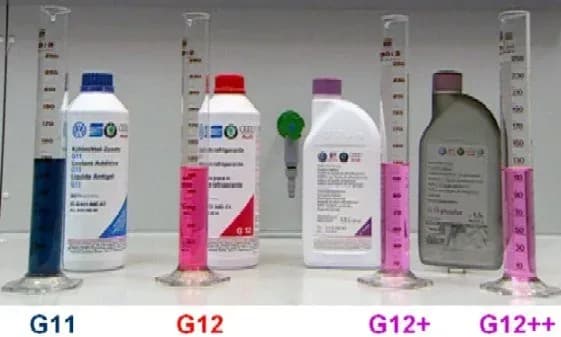
Audi has introduced several generations of engine coolants, each designed to offer improved performance and protection. Understanding these types is crucial for proper maintenance and Audi engine coolant mixing.
- G11, G12, and G12+ coolants: These older formulations have been replaced by improved versions.
- G12++ coolant: Introduced in Model Year (MY) 2005, this coolant became available for service in all engines.
- G13 coolant: Starting from MY 2008, G13 was used as the initial fill and service coolant.
- G12evo coolant: Introduced in MY19, G12evo also serves as the initial fill and service coolant.
It's important to note that Audi is one of the few manufacturers whose coolant does not typically require changing, emphasizing the need for correct coolant types and proper handling.
Understanding Coolant Mixing Compatibility
This TSB provides a detailed chart to determine which service coolants can be added to the factory-filled coolant. Improper Audi engine coolant mixing can lead to reduced corrosion protection.
To use the compatibility chart:
- Identify the coolant additive currently in your cooling system, often by its color (G11 green-blue, G12 red, G12+ red, G12++ violet, G12evo violet, G13 purple).
- Locate your current coolant in the upper horizontal row of the chart.
- Refer to the vertical column on the left to see which coolants can be mixed.
| Can be mixed with: | Green-blue G11 (≥ 1994) | Red G12 (≥ 1996) | Purple G12+ (≥ 2000) | Purple G12++ (≥ 2005) | Purple G13 (≥ 2012) | Purple G12evo (≥ 2018) |
|---|---|---|---|---|---|---|
| G11 | Green | Red | Red | Red | Red | Red |
| G12 | Red | Green | Yellow | Yellow | Yellow | Yellow |
| G12+ | Red | Yellow | Green | Yellow | Yellow | Yellow |
| G12++ | Red | Yellow | Yellow | Green | Green | Green |
| G13 | Red | Yellow | Yellow | Green | Green | Green |
| G12evo | Red | Yellow | Yellow | Green | Green | Green |
Color Key for Mixing:
- Green: Can be mixed in any ratio.
- Yellow: Mixing is possible, but it will cause a reduction in corrosion protection.
- Red: Cannot be mixed.
While coolants can be mixed as indicated, it is always best practice to change the coolant entirely if mixing incompatible types, due to the risk of reduced corrosion protection. G12++ and G13 are fully compatible with each other.
Important Warnings and Best Practices
Several critical warnings are highlighted in the TSB to ensure proper cooling system maintenance and prevent damage.
- Deionized water must not be used. Only mix distilled water with coolant additives as per ElsaPro procedures.
- Drained coolant must not be reused.
- If G11 is mixed with G12+, G12++, G13, or G12evo, the coolant will turn brown, which is considered normal.
- For MY2015 Audi A3 2.0TDI models with engine code CRUA, G13 must still be used. Only G12evo can be used in the Audi e-tron.
- If a cooling system issue necessitates a coolant change, the system should be drained using ElsaPro procedures, refilled with water, and the engine run for 15 minutes with the heater on to remove residual coolant. The final step is to drain and fill the system to the freeze protection ratio specified in ElsaPro.
Required Tools and Parts
When working with Audi coolants, specific tools and part numbers are referenced:
- G12evo part number: Ready-to-use G-12E-050-1G-DSP.
- Refractor T10007B or T10007A/B: Used to read the freeze protection of coolants, specifically the G12++ scale for G12evo coolant and the G13 scale for G12/G13 mixtures.
Warranty Information
Audi states that cooling system drain and fill procedures due to coolant mixing or the use of incorrect coolant are not covered by Warranty. This TSB is informational and does not apply to any Audi warranty claims related to these issues.
Source: NHTSA ID: 10233771
Galeri
1 görsel
Frequently Asked Questions
- What are the different types of Audi engine coolants?
- Audi has used several types of engine coolants, including G11, G12, G12+, G12++, G13, and the most recent G12evo. Each type has specific properties and was introduced in different model years.
- Can I mix different Audi engine coolants?
- Mixing is possible for some coolant combinations, but it's crucial to consult the compatibility chart provided in TSB 2025303/14. Mixing incompatible coolants or certain compatible ones can reduce corrosion protection. For example, G12++ and G13 are fully compatible, but mixing G11 with G12 will cause issues.
- What should I avoid when adding or changing Audi coolant?
- You must not use deionized water when mixing with coolant additives; only distilled water is recommended. Additionally, drained coolant should never be reused. Incorrect Audi engine coolant mixing can lead to reduced protection for your cooling system.
- Is coolant mixing covered under Audi's warranty?
- No, according to TSB 2025303/14, cooling system drain and fill procedures performed due to coolant mixing or the use of incorrect coolant are not covered by Audi's warranty.
- Are there specific coolants for certain Audi models?
- Yes, for example, MY2015 Audi A3 2.0TDI models with engine code CRUA must use G13, while only G12evo can be used in the Audi e-tron. Always check the specific requirements for your vehicle.
Related Articles
2023 Audi e-tron Problems: Recalls, Complaints & TSBs
The 2023 Audi e-tron has faced several significant safety concerns, including recalls for potential charging cable overheating and brake pedal detachment. Owners have also reported serious issues like sudden unintended acceleration and electrical system malfunctions. This profile details these…
2023 Audi e-tron Brake Pedal Recall
Audi has issued a recall (NHTSA ID: 26V240000, Audi Recall 46P7) for certain 2019-2024 E-Tron and 2020-2024 E-Tron Sportback vehicles, including the 2023 Audi e-tron. The recall addresses a potential issue where the brake pedal may detach from the brake booster, leading to a loss of brake function.
2015-2027 Audi Noise Diagnosis with Frequency Analysis App TSB
Audi has released Technical Service Bulletin 2051095/11 detailing the Audi Frequency Analysis app. This app helps technicians diagnose noise complaints more precisely across 2015-2027 Audi models. Learn how the app works, where to download it, and its features for effective vehicle noise analysis.
2023 Audi e-tron AC/DC Charging Not Possible TSB
This manufacturer communication (NHTSA ID 11031035) provides critical information for 2023 Audi e-tron owners facing issues with AC/DC charging. It specifically highlights problems linked to software version 00C6: 0093/3119, which can prevent the vehicle from charging.
2023-2025 Audi Rear Seat Reminder Message TSB 2074943/2
Audi Technical Service Bulletin 2074943/2 explains the instrument cluster message 'Please check rear seats and be aware of door safelock' in various 2023-2025 Audi models. This informational TSB details the rear occupant detection system designed to prevent children and pets from being left in…
Yorum bırakın
Yorumlar moderasyondan geçer ve görünmesi biraz zaman alabilir. Sadece adınız ve soyadınızın baş harfi herkese açık olarak gösterilir.
Yorumlar
İlk yorum sizden olsun.