2022-2024 BMW BEV/PHEV Charging Issues SIB 61 07 24
BMW has released Service Information Bulletin SIB 61 07 24 to provide a comprehensive guide for diagnosing and resolving charging issues in its Battery Electric Vehicles (BEV) and Plug-in Hybrid Electric Vehicles (PHEV) from model years 2022-2024.
 Ahmet Topcu2024 BMW i5
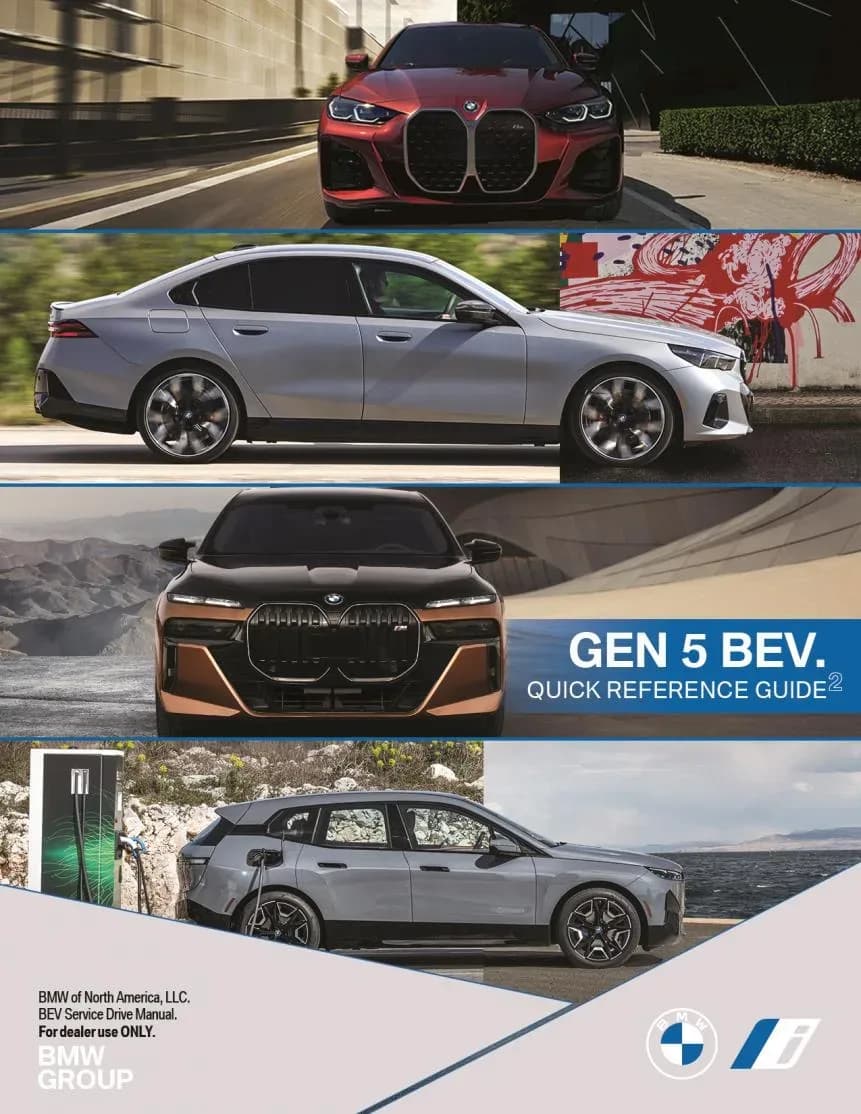
Também se aplica a
- BMW 750e
- 2024
- BMW i4
- 2022–2024
- BMW i7
- 2023–2024
- BMW iX
- 2022–2024
- BMW XM
- 2023–2024
BMW has released Service Information Bulletin SIB 61 07 24, titled "BEV/PHEV Charging Issue Work Through Procedure," to address the growing number of charging complaints in its Battery Electric Vehicles (BEV) and Plug-in Hybrid Electric Vehicles (PHEV). This bulletin provides a comprehensive guide for technicians to diagnose and resolve BMW BEV PHEV charging issues across various models from 2022 to 2024.
Why This Matters
As the market sees an increasing number of electrified vehicles, charging issues and errors are becoming a significant concern for owners. This informational bulletin aims to standardize the diagnostic and repair process, ensuring that customers receive effective support for their charging-related problems. The detailed procedures help technicians accurately identify whether the issue lies with the vehicle, the charger, or the charging infrastructure.
Affected BMW Models
This Service Information Bulletin applies to several BMW E-Series models, covering both Battery Electric Vehicles (BEV) and Plug-in Hybrid Electric Vehicles (PHEV) from 2022-2024. The affected models include:
- G05: X5 Sports Activity Vehicle (PHEV)
- G09: BMW XM Sports Activity Vehicle Plug-in Hybrid Electric Vehicle (PHEV)
- G26: i4 Gran Coupe (BEV)
- G60: i5 Sedan Battery Electric Vehicle (BEV)
- G70: i7 Sedan Battery Electric Vehicle (BEV)
- G70: 750e xDrive Sedan (PHEV)
- I20: iX Sports Activity Vehicle (SAV)
Important Warnings for Owners
BMW has provided several crucial notes for both technicians and owners regarding the diagnosis and handling of charging complaints:
- "Keep in mind that every vehicle and case is different, and the process will have to be adapted depending on the direction the diagnostic flow takes you."
- "Do not attempt to charge the vehicle at this time to duplicate the complaint as this will erase the customer charging history data!" This is critical because the vehicle's system can only store up to five charging events in its history. Any attempt to charge the vehicle could overwrite the data essential for diagnosing the customer's original complaint.
- "Not all service centers have a dedicated 240V outlet near the service bays for testing Level 2 chargers (i.e., NEMA 14/50)."
- "If there is NO level 3 - DC fast charger available at the dealership; a trusted public DC charger must be used."
- "Slower charging speeds may not indicate a vehicle malfunction." Various factors can influence charging speed, and a reduced rate does not automatically imply a vehicle fault.
- "A red pulsing light may not indicate a vehicle error." While a red pulsing light typically indicates a fault, it may not always signify a vehicle-specific problem.
- "Electrical work should only be performed by a qualified electrician! The vehicle AC current limit should not exceed the circuit breaker rating."
- "Extension cords or ground-fault circuit interrupter (GFCI) outlets should NOT be used in combination with charging devices."
Understanding EV/PHEV Charging Levels
BMW vehicles support three main charging levels, each with different power outputs and use cases:
Level 1 (AC Charging): This uses a standard 120VAC household outlet (15A max) and provides 1 to 2 kW of charging power. BMW recommends Level 1 for emergency or occasional charging, especially for BEVs, due to its slower speed. Recommended chargers include the BMW Flexible Fast Charger 1.0 (FFC1.0 with NEMA 5-15 120VAC adapter), BMW Flexible Fast Charger 2.0 (FFC2.0 with NEMA 5-15 120VAC adapter), and the BMW Occasional Use Charger (OUC).
Level 2 (AC Charging): This utilizes a 240VAC dedicated outlet or hardwired connection (50A max), offering 3 to 22 kW of charging power. Level 2 is the recommended type for daily charging of both BEVs and PHEVs. BMW Gen 5.0 vehicles are typically limited to 11kW AC. Recommended chargers include the Flexible Fast Charger (FFC) with a NEMA 14-50 outlet adapter and BMW "Wallbox" chargers.
Level 3 (DC Fast Charging): This is high-voltage DC charging (up to 480VAC) primarily found at commercial charging installations, delivering 30 to 350 kW. BMW Gen 5.0 vehicles are limited to 205kW DC. This level is ideal for rapid charging, especially during long trips. BMW vehicles in the US market use the Combined Charging System (CCS1) plug connector for DC charging.
Charging Socket Indicator Lights
The charge port on BMW Generation 5.0 Battery Electric Vehicles features an indicator light that communicates the current charging status. Owners should be familiar with these signals:
- "White: Ready to accept charger. Charging socket unlocked."
- "Yellow (pulsing): Communication between charger and vehicle is established."
- "Blue (permanent): Ready to charge in future (Charging in Timeslot)."
- "Blue (pulsing): Charging."
- "Green (permanent): Charging completed or target SoC reached."
- "Red (pulsing): Fault detected."
Additionally, the "Charger Lock" function ensures the charger is secured:
- "AC: Charger will be locked in port when vehicle is locked (Function 'Unlock after Charge' available in Head Unit)."
- "DC: Charger will be locked in port during communication state between charger and vehicle (prerequisite for DC charging)."
Diagnosing BMW BEV PHEV Charging Issues
The diagnostic process for BMW BEV PHEV charging issues begins with identifying the source of the complaint and involves several key steps for technicians:
Identify the Source of the Charging Complaint: This crucial first step involves gathering information from the customer, ideally when they drop off the vehicle. Technicians are advised to use the "SI B61 07 24 Attachment 2 Customer Charging Complaint Questionnaire.pdf" to determine if the issue occurred at home (Level 1 or 2 charger) or at a public Level 3 DC fast charger.
Proceed to Test with ISTA: Technicians must run the "charging history test plan" in ISTA (Integrated Service Technical Application) to collect valuable data. This includes analyzing any stored fault codes and performing a comprehensive charging check using the ABL DIT AT6144_CHRGCHCKS procedure. This test evaluates the vehicle's charging performance across all three levels, if applicable.
Troubleshooting Specific Charging Scenarios
The bulletin outlines specific diagnostic paths based on where the charging problem occurs:
Level 1 Charger Issues
If the complaint involves a Level 1 charger, technicians should verify its functionality at the dealership. For BMW Flexible Fast Chargers (FFC), reference SI B61 29 23 for more information. If the charger works at the dealer but not at the customer's home, a certified electrician should inspect the home's electrical installation (wiring, outlet, power grid). Mobile Service Technicians can be deployed to run vehicle tests and charging test plans on-site to rule out the vehicle as the source of the complaint. Further details are in SI B61 06 24 BEV/PHEV Charging Complaint Related to Charger/Infrastructure.
Level 2 Charger Issues
For Level 2 charging complaints, verification at the dealership is recommended if the service center has a dedicated 240V outlet. If the customer uses a hardwired wallbox, it cannot be verified at the dealer, necessitating a mobile service technician visit to inspect the customer's home charger and infrastructure. Mobile service technicians can perform on-site vehicle tests and charging test plans. Again, SI B61 06 24 provides additional information on charger/infrastructure related complaints.
Level 3 DC Fast Charger Issues
When dealing with Level 3 DC fast charging complaints, technicians should review SI B61 25 23 and its attachments, paying close attention to charging limitations. The vehicle's ability to charge at Level 3 should be verified at the dealership or a trusted public DC charger if no dealership facility is available. It's crucial to check for relevant charging fault codes and any intermittent high voltage system problems. If the issue occurs only at public stations, verifying the customer's account information may be necessary. For Plug & Charge functionality, SI B61 31 23 should be consulted.
Mobile Service Technician Deployment
BMW Mobile Service Technicians can be deployed in specific situations to assist customers with BMW BEV PHEV charging issues. These scenarios include:
- When the charger plug will not release from the vehicle. For this specific issue, refer to SI B61 08 24 BEV/PHEV Charger Plug Will Not Release from the Charging Socket.
- When the customer's charger works at the dealer but not at their location.
- When the customer's charger cannot be brought to the service center for verification.
- When there is a need to verify the customer's charger/infrastructure installation to confirm the vehicle is not the source of the charging complaint.
Flexible Fast Charger (FFC) Troubleshooting
The BMW Flexible Fast Charger (FFC) 2.0 includes error mode detections indicated by specific symbols:
- Vehicle Icon: Indicates an error due to overheat at the main plug/socket detected.
- No Error/Booting Icon: Signifies an error due to overheat at the Flexible Fast Charger function box.
- Infrastructure Icon: Points to a temporary error, requiring an FFC reboot.
- Flexible Fast Charger Icon: Also indicates a temporary error, requiring an FFC reboot.
To confirm a malfunction, a reboot of the FFC is advised, followed by an attempt to duplicate the error. A manual restart involves unplugging the vehicle connector, then the device from the socket, waiting at least 5 seconds, and then re-plugging both.
Factors Affecting Charging Performance
Several factors can influence the optimal charging times and power delivery for your BMW BEV or PHEV:
- Charging Station Output: The actual output of a charging station may be lower than its nominal value due to derating or infrastructure limitations.
- Vehicle State-of-Charge (SoC): Very low (less than 10%) or very high (greater than 80%) SoC at the start of charging can limit the maximum charge power.
- Battery Temperature: If battery pre-conditioning is not completed, the battery charging power may be limited to protect the battery.
- Interior Climate Pre-Conditioning: The power required to operate the climate control system, based on ambient conditions, can affect the charging speed of the high voltage battery.
Understanding Your Vehicle's Range
While BMW vehicles are subject to EPA testing for driving range, actual range can vary significantly due to various influences. BMW Gen 5.0 vehicles adapt to driving patterns and environmental conditions to display available range accordingly. Factors affecting range calculation include:
- Average Speed and Acceleration: Higher speeds and aggressive acceleration consume more energy.
- Use of Regenerative Modes: Utilizing regenerative braking can help extend range.
- Environmental Conditions: Ambient temperature and road conditions play a role.
- Tire Size: Larger tires can increase overall weight and friction, reducing range.
- Average Utilization of Climate Control: Extensive use of heating or air conditioning impacts energy consumption.
- High Payloads: Carrying heavy loads requires more energy, thus reducing range.
- Driving Behavior: Spirited driving styles, including fast acceleration and high speeds, can unfavorably affect range.
- Steep Roads and Unfavorable Road Conditions: These conditions, along with stop-and-go traffic, can lead to lower range.
Battery Pre-Conditioning: Using BMW Navigation eRoutes helps ensure automatic pre-conditioning of the battery, optimizing it for high-power DC charging in varying weather conditions. Manual pre-conditioning is also available via the vehicle's head unit or the myBMW App. Pre-conditioning can take up to 30 minutes, which should be accounted for before high-power DC charging.
Claim Information
Eligible repairs addressing vehicle components or assemblies with verified defects in materials and/or workmanship are covered under the terms of the BMW New Vehicle Limited Warranty for Passenger Cars and Light Trucks. Damage or issues caused by outside influences are not covered. To submit a claim, dealers must follow established warranty policies, referring to AIR for repair codes and flat rate unit (FRU) allowances. Technicians should refer to SI B01 01 20 or SI B01 07 20 for procedures on documenting diagnosis and repair work time.
Source: NHTSA ID: 10252039
Galeria
8 imagens
Frequently Asked Questions
- What is BMW Service Information Bulletin SIB 61 07 24 about?
- BMW Service Information Bulletin SIB 61 07 24 provides a detailed work-through procedure for diagnosing and resolving charging issues in 2022-2024 BMW Battery Electric Vehicles (BEV) and Plug-in Hybrid Electric Vehicles (PHEV).
- What should I do if my BMW BEV or PHEV shows a 'Red (pulsing): Fault detected.' light during charging?
- While a 'Red (pulsing): Fault detected.' light on your charging socket typically indicates a problem, BMW notes that it may not always signify a vehicle error. It's recommended to consult your dealership, as the issue could be related to the charger or infrastructure, as detailed in SIB 61 07 24.
- Can I charge my BMW BEV or PHEV with an extension cord?
- No, BMW explicitly states in SIB 61 07 24 that 'Extension cords or ground-fault circuit interrupter (GFCI) outlets should NOT be used in combination with charging devices' for your safety and to prevent potential charging issues.
- Why might my BMW BEV or PHEV be charging slower than expected?
- According to SIB 61 07 24, 'Slower charging speeds may not indicate a vehicle malfunction.' Factors like the charging station's actual output, your vehicle's State-of-Charge (SoC), battery temperature (lack of pre-conditioning), and even interior climate pre-conditioning can all affect charging speed.
- What is the role of a Mobile Service Technician in resolving BMW BEV PHEV charging issues?
- BMW Mobile Service Technicians can be deployed for on-site support in situations such as when the charger plug won't release (referencing SI B61 08 24), when your home charger works at the dealer but not at your location, or when there's a need to verify your charging infrastructure, as outlined in SIB 61 07 24.
Related Articles
2022-2024 BMW i Series Drivetrain Malfunction TSB
BMW has issued Service Information Bulletin SIB 12 05 23 to address a 'Drivetrain Malfunction' message and related isolation fault codes (0317F1, 0317F2) in 2022-2024 BMW i Series vehicles. The issue stems from metal debris in the eDrive motor's brush module, requiring a specialized cleaning…
2022-2025 BMW i4, i5, i7, iX Coolant Leak from Changeover Valve
BMW has issued Service Information Bulletin SIB 17 01 24 to address coolant leaks originating from the changeover valve(s) in certain 2022-2025 i4, i5, i7, and iX electric vehicles. This issue can lead to low heater output, a visible coolant leak, and specific fault codes.
2024 BMW iX, i5, i4, i7 High Voltage Parts Return
BMW has issued Parts Bulletin TEC837, requesting the return of specific high voltage connection part numbers for 2024 iX, i5, i4, and i7 electric vehicles. This bulletin instructs dealers to return affected inventory and previously shipped parts to the Regional Distribution Center.
2024-2025 BMW i5 Sunroof Water Drain Hose Delivery Stop
BMW has issued a delivery stop, SIB 54 06 25, for certain 2024-2025 BMW 5 Series Sedan and i5 Sedan models. The issue involves a disconnected front left sunroof water drain hose, which can lead to water ingress and damage to the vehicle's interior. Vehicles cannot be delivered until repaired.
2024-2025 BMW 5 Series / i5 Sunroof Drain Hose Delivery Stop
BMW has issued a delivery stop, SIB 54 06 25, for certain 2024-2025 BMW 5 Series and i5 vehicles due to a potential issue with the sunroof water drain hose. This means affected vehicles cannot be sold or delivered until the necessary repair is completed.
Leave a comment
Comments are moderated and may take a moment to appear. Only your first name and the initial of your last name are shown publicly.
Comments
Be the first to comment.