2024-2025 Audi Models Front Axle Guide Link Bush Noises
Audi has issued Technical Service Bulletin 40 25 93 2076605/1 to address sporadic rattling or clacking noises from the front axle guide link bush in various 2024-2025 models. This TSB explains the cause of the noise and provides guidance for diagnosis.
 Marcus Weber2025 Audi Q8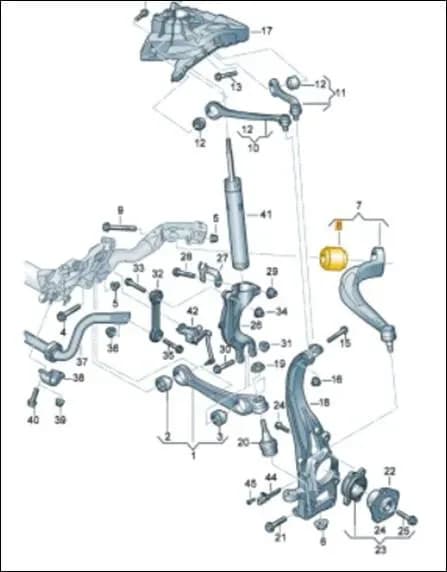
Si applica anche a
- Audi A4
- 2021–2025
- Audi A4 allroad
- 2021–2025
- Audi A5
- 2021–2024
- Audi A6
- 2021–2025
- Audi A6 allroad
- 2021–2025
- Audi A7
- 2021–2025
- Audi A7 e
- 2021–2022
- Audi A8 L e
- 2021
- Audi Q5
- 2021–2025
- Audi Q5 e
- 2021, 2023, 2024, 2025
- Audi Q7
- 2021–2025
- Audi Q8
- 2021–2024
- Audi RS 5
- 2021–2025
- Audi RS 6 Avant
- 2021–2025
- Audi RS 7
- 2021–2025
- Audi RS Q8
- 2021–2025
- Audi S4
- 2021–2025
- Audi S5
- 2021–2024
- Audi S6
- 2021–2025
- Audi S7
- 2021–2025
- Audi S8
- 2021–2025
- Audi SQ5
- 2021–2025
- Audi SQ7
- 2021–2025
- Audi SQ8
- 2021–2025
▸ Mostra altri 18▾ Mostra meno
Audi has released Technical Service Bulletin (TSB) 40 25 93 2076605/1, dated January 15, 2025, to address customer complaints regarding sporadic rattling and clacking noises emanating from the front axle. This TSB applies to a wide range of 2024-2025 Audi models and provides an explanation for the Audi guide link bush noise.
This informational bulletin helps technicians and owners understand the root cause of these sounds and clarifies that the guide link bush is functioning as intended despite the noise.
Symptoms of the Audi Guide Link Bush Noise
Owners may notice a distinct sporadic rattling or clacking noise originating from the front axle. These sounds are typically heard when the vehicle is rolling slowly, specifically at speeds under 12 mph. The noises are most prominent when driving over uneven road surfaces, such as cobblestones, or when traversing curbs.
Diagnosis and Trigger Conditions
When investigating the Audi guide link bush noise, technicians are advised that it is not productive to diagnose noises at temperatures below 32°F (0°C). At these low temperatures, the rubber bushes in the running gear harden, which can alter noise characteristics. Additionally, the presence of snow, ice, or grit can interfere with accurate noise analysis.
To precisely identify if the noise is coming from the guide link bush, technicians can utilize specialized equipment. The TSB recommends using the PICO tool VAS 611015 or other noise analysis tools. Further reference for this diagnostic process can be found in TSB 2070568 or by searching for "PICO" in the Audi Knowledge Tank.
Technical Explanation of the Noise
The rattling and clacking noises are caused by an air bubble that becomes enclosed within the guide link hydro-bush during its manufacturing process. This air bubble is designed to decouple the suspension from micro-amplitudes, which enhances the vehicle's interior acoustics, especially on rough asphalt, and positively influences steering behavior.
When the axle experiences vibrations from uneven road surfaces, particularly multiple brief, hard knocks, the high-frequency changes in the bush's internal pressure cause the volume of this air bubble to fluctuate. This phenomenon can lead to the characteristic rattling or clacking noises, especially under certain climatic conditions. Despite these noises, the TSB clarifies that the bush itself is functioning as designed under all conditions.
Important Notes for Owners
Owners should be aware that this Technical Service Bulletin 40 25 93 2076605/1 is purely informational. It is not associated with any Audi Warranty claims, meaning any diagnostic work or potential replacement of parts would typically not be covered under warranty. The TSB explicitly states that the guide link bush functions as it should, and the noises are a characteristic of its design and manufacturing process.
What Owners Should Do
If you experience the described Audi guide link bush noise in your 2024-2025 Audi model, you may consult with an authorized Audi dealer. The dealer can perform a diagnosis to confirm the source of the noise. However, it is important to understand that this TSB is for informational purposes, explaining the technical background of the noise rather than outlining a repair procedure for a defect.
Source: NHTSA ID: 11013719
Frequently Asked Questions
- What causes the rattling or clacking noises from the front axle in my 2024-2025 Audi?
- According to Audi TSB 40 25 93 2076605/1, these noises are caused by an air bubble trapped inside the guide link hydro-bush during manufacturing. This bubble's volume changes with vibrations, leading to the rattling or clacking sounds.
- When do these front axle noises typically occur?
- The sporadic rattling or clacking noises from the front axle are usually heard when driving slowly (under 12 mph) over uneven road surfaces like cobblestones or when going over curbs.
- Is there a repair available for the Audi guide link bush noise?
- Audi TSB 40 25 93 2076605/1 is an informational bulletin, not a repair procedure. It explains that the guide link bush is functioning as intended, and the noise is a characteristic of its design. Therefore, there isn't a specific repair outlined to eliminate this noise.
- Is the guide link bush noise covered under Audi's warranty?
- No, this TSB explicitly states that it is informational only and not applicable to any Audi Warranty. This means that any diagnosis or potential component replacement related to this noise would typically not be covered.
Related Articles
2024-2026 Audi MMI Weather Widget 'An error has occurred' TSB
Audi Technical Service Bulletin 2081500/1 addresses the 'An error has occurred' message on the MMI weather widget in 2024-2026 Audi models. This issue typically indicates a missing data plan for the Audi Application Store.
2018-2026 Audi V6 TFSI Drive System Malfunction TSB
Audi Technical Service Bulletin 2081342/1 addresses a "Drive system fault active in instrument cluster" message and associated knock sensor DTCs (P032700, P033200, P032800, P033300) in 2018-2026 V6 TFSI models. This issue is often caused by temporary moisture absorption in the knock sensor housing.
2024-2026 Audi Q8 48V Starter Generator DTCs P0A1A00 P19F800
Audi has released Technical Service Bulletin (TSB) 2076994/7 to address issues with the 48V starter generator (BSG) in 2024-2026 Audi Q8, A6, A7, Q7, and A6 allroad models equipped with MHEV. Owners may experience an illuminated engine warning lamp and various diagnostic trouble codes (DTCs)…
2025 Audi Q8 Bluetooth/Smartphone Interface Connection TSB
Audi Technical Service Bulletin 2079837/2 addresses customer complaints regarding slow or interrupted Bluetooth and Audi smartphone interface connections in 2025 Audi models, including the Q8. The issue stems from a software fault in the emergency call module control unit (DA 0075). The…
2023-2025 Audi On-Car Analysis List for Technicians
Audi's TSB 2066297 outlines an on-car analysis list for technicians, addressing common concerns such as the 48V battery cooling fan DTC P0A8200, B&O extendable tweeter operational issues, and PPE/PPC vehicle time synchronization problems for 2023-2025 Audi models.
Leave a comment
Comments are moderated and may take a moment to appear. Only your first name and the initial of your last name are shown publicly.
Comments
Be the first to comment.