2011-2026 Audi Instrument Cluster Noise TSB 2059335/6
This Technical Service Bulletin (TSB) 2059335/6 addresses customer complaints regarding noise originating from the instrument cluster area in 2011-2026 Audi vehicles. It outlines diagnostic steps to identify the source of vibrations and prevent unnecessary part replacement.
 Sarah Mitchell2022 Audi e-tron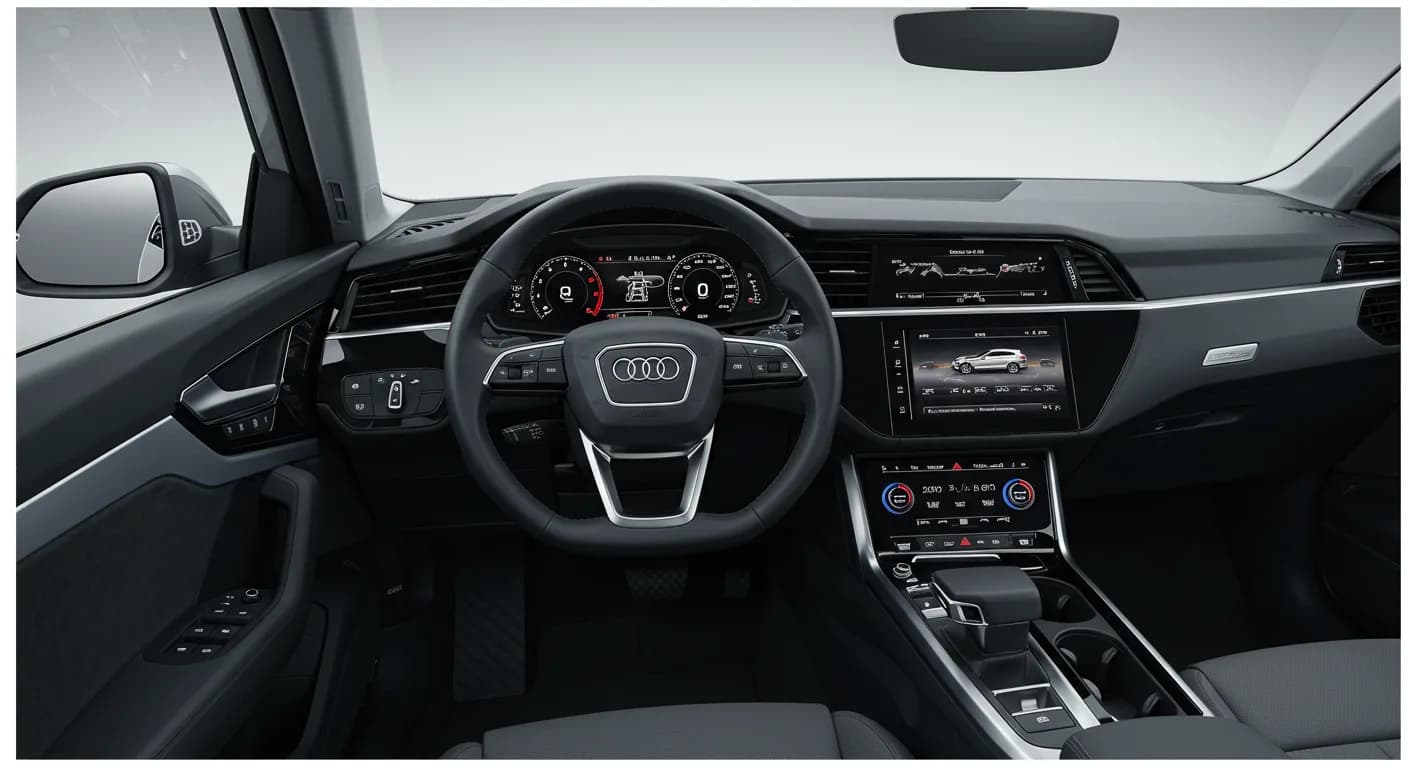
Si applica anche a
- Audi A3
- 2022–2026
- Audi A4
- 2021–2025
- Audi A4 allroad
- 2021–2025
- Audi A5
- 2021, 2022, 2023, 2024, 2026
- Audi A6
- 2021–2026
- Audi A6 allroad
- 2021–2026
- Audi A7
- 2021–2025
- Audi A7 e
- 2021–2022
- Audi A8 L e
- 2021
- Audi e-tron
- 2021, 2023
- Audi e-tron GT
- 2022–2025
- Audi e-tron Sportback
- 2021–2022
- Audi Q3
- 2021–2025
- Audi Q5
- 2021–2026
- Audi Q5 e
- 2021, 2023, 2024, 2025
- Audi Q7
- 2021–2026
- Audi Q8
- 2021–2026
- Audi R8
- 2021–2023
- Audi RS 3
- 2022–2026
- Audi RS 5
- 2021–2024
- Audi RS 6 Avant
- 2021–2026
- Audi RS 7
- 2021–2026
- Audi RS e-tron GT
- 2022–2026
- Audi RS Q8
- 2021–2026
- Audi S e-tron GT
- 2026
- Audi S3
- 2022–2026
- Audi S4
- 2021–2025
- Audi S5
- 2021, 2022, 2023, 2024, 2026
- Audi S6
- 2021–2025
- Audi S7
- 2021–2025
- Audi S8
- 2021–2026
- Audi SQ5
- 2021–2026
- Audi SQ7
- 2021–2026
- Audi SQ8
- 2021–2026
- Audi TT
- 2021–2023
- Audi TT RS
- 2021–2022
- Audi TTS
- 2021–2023
▸ Mostra altri 31▾ Mostra meno
Symptoms
Owners of 2011-2026 Audi vehicles may experience "Noises from the installation area of the instrument cluster." This symptom, described as "Noise from the area around the instrument cluster," is the primary complaint addressed by Technical Service Bulletin (TSB) 2059335/6. The noise is typically perceived as a rattle or vibration originating from the dashboard area near the instrument cluster.
Technical Background
The root cause of the "Audi instrument cluster noise" is often not the instrument cluster itself, but rather other components within the dash panel. Parts such as air ducts, vents, control module holders, the MMI screen, various trims, covers, wiring harnesses, and cable guides can resonate. These components vibrate due to engine operation or road surface conditions. When there is relative movement between parts directly applied to the instrument cluster, the noise becomes noticeable to the vehicle owner.
Diagnosis and Service Procedure
To accurately diagnose and address the "Audi instrument cluster noise," technicians should follow a specific two-step procedure outlined in TSB 2059335/6:
- Instrument Cluster Check: The technician must first remove the instrument cluster. Once removed, it should be shaken in all three directions to confirm that there are no loose internal parts. If no loose parts are found within the instrument cluster, it must not be replaced, as it is not the source of the noise.
- Dash Panel Area Inspection: If the instrument cluster itself is not the cause, the technician should then thoroughly check the surrounding dash panel area. This inspection focuses on identifying any loose bolts, brackets, cables, or other components that may be vibrating. Any loose parts found must be secured, or backing or felt material should be applied to dampen vibrations. Replacement of these parts may also be necessary.
Important Warnings for Owners
Audi has issued specific warnings within TSB 2059335/6 to prevent unnecessary repairs and charges:
- Claims for replaced parts will be subject to review. This means that if an instrument cluster is replaced without proper diagnosis, the warranty claim may be scrutinized.
- The cost of replacing the instrument cluster unnecessarily will be charged back. Owners should be aware that if the instrument cluster is replaced when the noise originates from other dash panel components, they may be held responsible for the cost of the unneeded replacement.
Warranty Information
This Technical Service Bulletin (TSB) 2059335/6 provides detailed guidance for warranty claims related to the "Audi instrument cluster noise."
- Claim Type: The TSB is informational only if the vehicle is outside its warranty period.
- Service Numbers:
- Cause 1: For internal noise originating from the instrument cluster, use service number 9025.
- Cause 2: In the event of noises caused by dash panel parts, technicians must use the service number of the part which caused the noises for invoicing and NOT the service number of the instrument cluster, even if felt was attached to the instrument cluster.
- Damage Codes:
- Cause 1: If the instrument cluster is the source of the noise, the damage code is 0020.
- Cause 2: For noises caused by dash panel parts, refer to the note in the service number section for the appropriate damage code.
- Labor Operations: The following labor operations and time units (TU) are specified:
- Remove and install instrument cluster: 9025 19XX (refer to SRT with associated operations)
- Check instrument cluster: 9025 0199 (10 TU)
- Check dash panel: 7018 0199 (10 TU)
- General Fault Finding (GFF): 0150 0060 (time stated on the diagnostic protocol)
- Claim Comment: All claims should include the comment "As per TSB 2059335/6".
Documentation Requirements
For warranty claims, especially when billing for repairs related to this TSB, technicians are required to submit a video clearly showing the complaint to DOC-IT. This video documentation must adhere to specific criteria:
- It must include the vehicle's VIN and the date.
- The video must not be edited.
- It should be in focus and filmed with sufficient light. A high resolution is not strictly necessary.
- If appropriate, the problem's location should be marked to aid parts analysis.
- Crucially, the video must not show any people, faces, license plates, or customer data.
Revision History
Technical Service Bulletin 2059335/6 has undergone several revisions to improve clarity and scope:
- Revision 6 (February 17, 2026): The header was revised to add the model year, and the Condition section was revised to include a model table and a documentation note.
- Revision 5 (April 11, 2024): The header was revised to add the model year.
- Revision 4 (July 19, 2023): The header was revised to add the model year.
Source: NHTSA ID: 2059335/6
Frequently Asked Questions
- What is Technical Service Bulletin 2059335/6 about?
- Technical Service Bulletin 2059335/6 addresses customer complaints of "noise from the area around the instrument cluster" in various 2011-2026 Audi models. It provides diagnostic steps for technicians to identify the true source of the noise, which is often vibrating dash panel components rather than the instrument cluster itself.
- Will my Audi dealer charge me to fix the "Audi instrument cluster noise"?
- Audi's TSB 2059335/6 explicitly states that "The cost of replacing the instrument cluster unnecessarily will be charged back." This emphasizes the importance of proper diagnosis. If the noise originates from other dash panel parts and the instrument cluster is replaced without cause, you may be charged. Warranty coverage depends on your vehicle's warranty status.
- How do technicians diagnose the "Audi instrument cluster noise"?
- According to TSB 2059335/6, technicians first remove and shake the instrument cluster to confirm there are no loose internal parts. If none are found, the instrument cluster is not replaced. The next step involves checking the surrounding dash panel area for loose bolts, brackets, cables, or other vibrating parts, securing them as needed.
- What should I do if I hear "Noises from the installation area of the instrument cluster" in my Audi?
- If you hear "Noises from the installation area of the instrument cluster" in your 2011-2026 Audi, it's recommended to schedule an appointment with an authorized Audi service center. Inform them about Technical Service Bulletin 2059335/6, as it provides specific diagnostic and repair guidance for this issue. This will help ensure a correct diagnosis and avoid unnecessary repairs.
- What are the warranty claim details for this issue?
- TSB 2059335/6 specifies different service numbers and damage codes depending on the noise source. If the noise is internal to the instrument cluster, Service Number 9025 and Damage Code 0020 apply. If the noise comes from other dash panel parts, a different service number corresponding to that part should be used, and the instrument cluster's service number should not be applied.
Related Articles
2022 Audi e-tron Problems: Electrical System & Braking Concerns
The 2022 Audi e-tron has faced significant owner complaints regarding its electrical system, including sudden power loss and charging hazards, as well as various braking malfunctions. This profile details these issues and relevant service bulletins.
2022-2026 Audi Guided Fault Finding Reporting Obligation
Audi has issued Technical Service Bulletin TPI 2033392, also known as Transaction No. 2081531/1, regarding a reporting obligation for technicians when Guided Fault Finding produces an unexpected result. This TSB outlines the process for contacting Audi Product Support for diagnostic assistance.
2022-2026 Audi Infotainment System Complaints
Audi has released Technical Service Bulletin (TSB) 2081405/1 to address various customer complaints regarding infotainment systems in 2022-2026 Audi vehicles. This TSB helps technicians diagnose issues often caused by external media or mobile devices, rather than vehicle technology.
2018-2026 Audi Models Cracking Noise TSB 2061464/11
Audi Technical Service Bulletin 2061464/11 describes a cracking noise from the front or rear axle when changing direction in various 2018-2026 Audi models. The issue is due to stub axle movement and is resolved by bonding the stub axle to the wheel bearing with locking fluid.
2022-2026 Audi Parking Aid False Warnings TSB 2024323/13
Audi has released Technical Service Bulletin 2024323/13 to address customer complaints of false parking aid warnings. This bulletin details various environmental and vehicle-specific conditions that can cause the parking aid system to issue alerts even when no obstacles are present. It provides…
Leave a comment
Comments are moderated and may take a moment to appear. Only your first name and the initial of your last name are shown publicly.
Comments
Be the first to comment.