2022-2026 Stellantis Aluminum Panel Corrosion TSB
Stellantis Technical Service Bulletin (TSB) 31-001-25 provides comprehensive guidance for diagnosing and repairing aluminum corrosion and bubbling on body panels, including hoods, hinges, doors, and liftgates, affecting various 2022-2026 Stellantis models.

Si applica anche a
- Alfa Romeo Stelvio
- 2023–2025
- Dodge Challenger
- 2021–2023
- Dodge Durango
- 2021–2026
- Jeep Cherokee
- 2021–2023
- Jeep Compass
- 2021–2024
- Jeep Gladiator
- 2021–2025
- Jeep Grand Cherokee
- 2021–2022
- Jeep Renegade
- 2021–2024
- Jeep Wrangler
- 2021–2025
- Ram 1500
- 2021–2025
- Ram 2500
- 2021–2026
- Ram 3500
- 2021–2026
- Ram 4500
- 2021–2026
- Ram 5500
- 2021–2026
▸ Mostra altri 8▾ Mostra meno
Symptoms of Aluminum Body Panel Corrosion
Owners of 2022-2026 Stellantis vehicles may observe "Aluminum corrosion or bubbling along the leading edge of hood, hinges or other exterior surface areas of the hinges, doors, fenders, swing gates or liftgates." This issue is attributed to general corrosion conditions. This Stellantis aluminum corrosion repair bulletin provides guidance for addressing these symptoms.
Diagnosis and Trigger Conditions
Diagnosing aluminum body panel corrosion involves identifying the type and location of the imperfection. Technicians will refer to a detailed "Imperfection Decision Tree" (Fig. 1 in the TSB) to determine the appropriate course of action for this Stellantis aluminum corrosion repair.
The diagnosis process includes:
- Class A Surface Inspection: Checking for corrosion visible when the door or hood is closed (Fig. 2, 3, 4). If present, current warranty policy regarding digital imaging pre-authorization or Regional Office Approval must be consulted.
- Class B Surface Inspection: Checking for imperfections visible only when the door or hood is open. If found, Warranty Bulletin D-25-15 is used to decide on the necessary service action.
- Pitting Assessment: After removing blistered paint, if severe pitting remains that cannot be removed by sanding, panel replacement is required (Fig. 5).
Important Warnings for Owners and Technicians
- This Technical Service Bulletin (TSB) 31-001-25 specifically applies to aluminum panels. It is crucial to verify if a panel is aluminum by consulting the collision manual's material specifications.
- "Verify current warranty policy to determine if digital imaging pre-authorization is required or pre-approval is required from the Regional Office; depending on market." This step is critical before proceeding with any repair.
- "To avoid the risk of cross-contamination that will lead to galvanic corrosion issues, grinding/sanding and prep work must be done in a separate room away from ferrous material using only clean, non-contaminated abrasives." This prevents further damage.
- "Exterior mounted hinges should not be removed unless repair procedures, such as filiform corrosion repair underneath and around the hinge area, are required. Unnecessary removal of the hinges will risk further corrosion damage by breaking the paint around the perimeter of the hinge."
- "Avoid using tools or abrasive materials interchangeably with steel and aluminum components to avoid galvanic corrosion that may lead to a sub-standard finish."
- "For SA market only, after applying this TSB, it is not necessary to send DID-I or DID-A."
Repair Procedure Summary
The repair for aluminum body panel corrosion, as outlined in Stellantis TSB 31-001-25, involves a multi-step process to ensure proper adhesion and prevent future corrosion. The general procedure for this Stellantis aluminum corrosion repair is as follows:
- Panel Removal: The affected aluminum panel is removed. Detailed service procedures are available in DealerCONNECT/Service Library.
- Trim Removal: Any necessary trim components are removed to facilitate repair and refinishing.
- Cleaning: The panel is thoroughly washed with soap and water, followed by wax and grease remover to eliminate contaminants.
- Corrosion Removal: Corrosion is removed using an angle grinder with 80-grit or finer grinding discs. Roloc® 3" grinding discs or Clean 'N Strip discs may be used for difficult areas.
- Sanding: Bare metal is sanded with 180-grit, and the old finish/repair area is feather-edged with 320-400 grit sandpaper.
- Masking and Re-cleaning: The prepared area is masked for primer application and re-cleaned with wax and grease remover.
- Primer Application: Clean, sanded bare aluminum areas are treated with a metal cleaner (e.g., Glasurit's 360-4) and prep wipes before applying two coats of an approved UV primer (e.g., BASF's Glasurit 151-170 UV Primer).
- Curing and Block Sanding: The primer is cured using a UV lamp, then block-sanded with 500-grit or finer sandpaper.
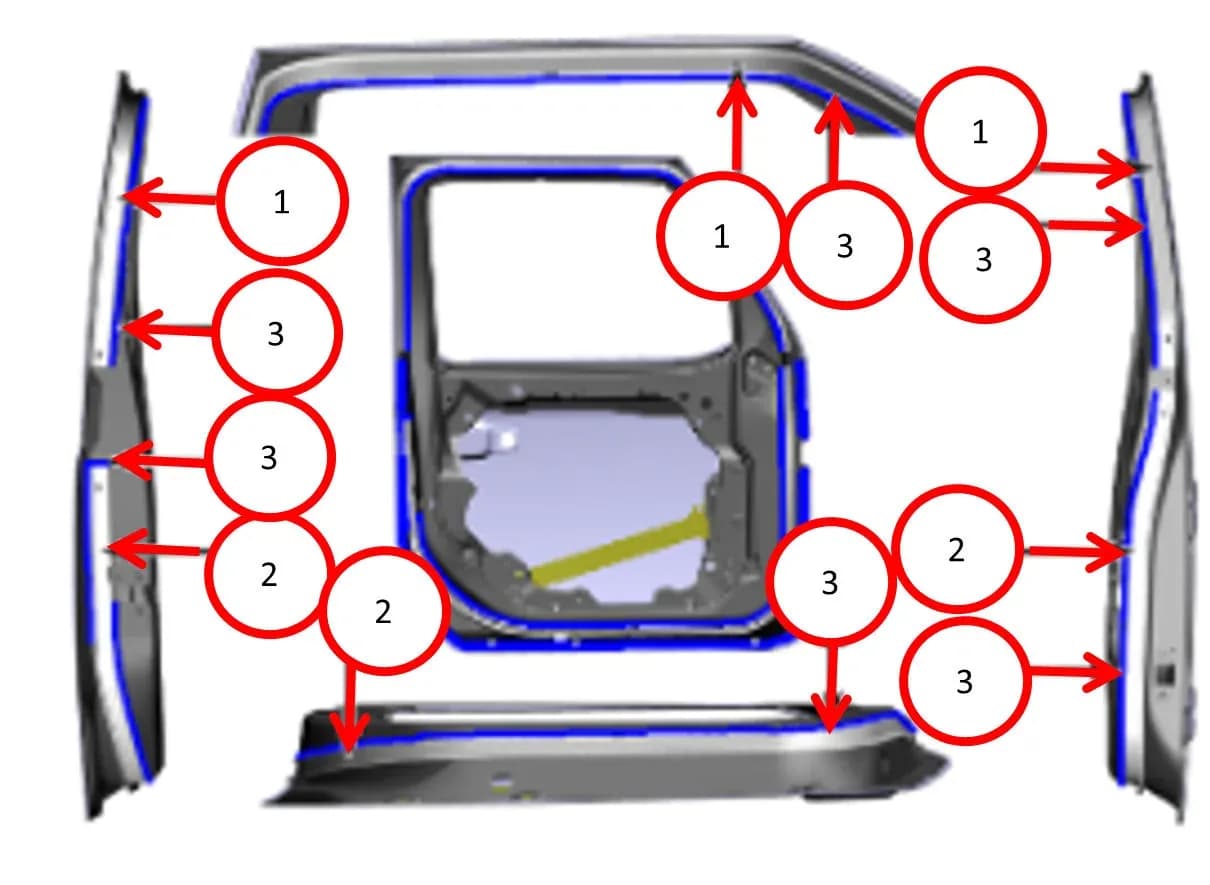
- Seam Sealer Application: If the backside of the panels required repair and seam sealer removal, it must be restored using approved sealers like Fusor 129 or 3M 08308. Seam sealer locations are identified in Service Library (Fig. 6).
- Refinishing: The panel is prepared for refinishing, cleaned, and then sealer, basecoat, and clearcoat are applied according to the chosen paint manufacturer's procedures.
- Reinstallation: The repaired panel and all removed trim components, including adhesive-backed items, are reinstalled.
Required Tools or Parts
Technicians will utilize specific materials for this Stellantis aluminum corrosion repair:
- Sandpaper: NPN 500-grit, 800-grit, and 180-grit sandpaper sheets.
- Discs: 3M® 3" Clean and Strip Disc (part number 07470 or equivalent).
- Scuffing Pad: 3M® Scotch-Brite Scuffing Pad Maroon (part number 07447*NPN or equivalent).
- Anti-Corrosion Pen: Part number 06103087AA.
- Approved UV Primers:
- Akzo Nobel®: "Sikkens Autosurfacer UV"
- Axalta®: "Cromax Premier LE3130S UV Primer Surfacer"
- BASF®: "Glasurit 151-170 UV Primer filler, Grey"
- PPG®: "SU1280 UV-Cured Primer Surfacer"
- Sherwin Williams®: "UVP2 UV Primer"
- Seam Sealers: Fusor 129 or 3M 08308.
- Cleaners: Metal cleaner (e.g., Glasurit's 360-4), BASF 2000 Advanced Prep Wipes, Pre-Kleano 700 wax and grease remover.
Source: NHTSA ID: 11022003, TSB: 31-001-25
Galleria
6 immagini
Frequently Asked Questions
- What causes aluminum corrosion on Stellantis vehicles?
- Aluminum corrosion or bubbling on Stellantis vehicles is generally caused by corrosion conditions, as indicated in TSB 31-001-25.
- How is aluminum corrosion diagnosed on Stellantis body panels?
- Diagnosis involves inspecting for "Aluminum corrosion or bubbling" on Class A (visible when closed) and Class B (visible when open) surfaces. Technicians use an 'Imperfection Decision Tree' and may require digital imaging pre-authorization, as per TSB 31-001-25 and Warranty Bulletin D-25-15.
- Can I repair aluminum corrosion myself, or do I need a dealer?
- Due to the specialized procedures, tools, and materials required to prevent galvanic corrosion and ensure a proper repair, it is strongly recommended that a qualified Stellantis dealership or body shop perform the aluminum corrosion repair as outlined in TSB 31-001-25.
- What is Stellantis TSB 31-001-25 about?
- TSB 31-001-25 is a Collision Service Bulletin from Stellantis providing information about the diagnosis and repair of aluminum corrosion or bubbling on exterior body panels such as hoods, hinges, doors, fenders, swing gates, and liftgates for various 2022-2026 models.
- Are there any special considerations for repairing aluminum panels?
- Yes, TSB 31-001-25 emphasizes several critical points, including performing grinding and sanding in a separate room from ferrous materials to prevent cross-contamination and galvanic corrosion. It also advises against removing exterior-mounted hinges unnecessarily and using specific approved materials and procedures.
What Alfa Romeo Stelvio owners report
Counted from the records in our database across 8 model years.
- 215
- Owner complaints
- 18
- Recalls
- 323
- Service bulletins
- 8
- Crashes reported
- 4
- Fires reported
- 7
- Injuries reported
The 2022 model year
8 complaints, the 4th most of 8 model years on file. Owners reported 1 crash, 0 fires and 2 injuries for this year, which also has 3 recalls on file.
Structure, the system this article covers, accounts for 5 of 215 complaints (2%).
Complaints by model year
| 2018 | 135 | |
|---|---|---|
| 2019 | 36 | |
| 2020 | 19 | |
| 2021 | 7 | |
| 2022 | 8 | |
| 2023 | 6 | |
| 2024 | 2 | |
| 2025 | 2 |
Most-reported systems
- Engine — 65
- Electrical System — 64
- Fuel System — 48
- Gasoline — 48
- Fuel/Propulsion System — 43
Latest recalls for the 2022 model year
- 25V667000 — Back Over Prevention (Oct 2025)
- 24V510000 — Air Bags (Jul 2024)
- 24V512000 — Equipment (Jul 2024)
Complaints are owner reports filed with NHTSA. They are unverified, and counts depend on how many vehicles were sold, so they are not a failure rate.
Related Articles
2013-2026 Stellantis Aluminum Body Panel Corrosion TSB
Stellantis has issued Technical Service Bulletin (TSB) 31-001-25 REV. B to address aluminum corrosion or bubbling on exterior body panels. This TSB covers a wide range of 2013-2026 models, providing detailed diagnosis and repair procedures for affected areas.
2022-2024 Alfa Romeo Stelvio Timing Cover Oil Leak TSB
Alfa Romeo has issued Technical Service Bulletin 09-013-25 REV. B for 2022-2024 Stelvio models. This TSB addresses oil leakage from the timing cover, often caused by loose fasteners, and outlines the repair procedure.
2021-2025 Stellantis EVAP System Hard to Fill TSB
This manufacturer communication, TSB 9100471, details diagnostic and repair procedures for 'Hard to Fill' fuel tank conditions and other evaporative system issues in various 2021-2025 Stellantis vehicles. It covers checks for the ESIM detector, vapor canister, and associated hoses.
2022 Alfa Romeo Stelvio PCM Update for MIL & DTCs
A Technical Service Bulletin (TSB 18-013-25) addresses Malfunction Indicator Lamp (MIL) illumination and various Diagnostic Trouble Codes (DTCs) in 2022 Alfa Romeo Stelvio vehicles. The fix involves updating the Powertrain Control Module (PCM) software.
2022-2024 Alfa Romeo Stelvio Check Engine Light & DTC P0606-00
If your 2022-2024 Alfa Romeo Stelvio has a Check Engine Light (MIL-On) and potentially a Limp-In condition with DTC P0606-00, a manufacturer communication (TSB S2418000016) indicates that this issue is under engineering investigation and component replacement is not recommended.
Leave a comment
Comments are moderated and may take a moment to appear. Only your first name and the initial of your last name are shown publicly.
Comments
Be the first to comment.