2024 Audi Key Adaptation Fault: Status 13 Security Denied
Audi has issued Technical Service Bulletin (TSB) 2071336/1 for 2024 models experiencing a 'Status: 13 / Security access denied' message during key adaptation. This bulletin provides a specific SVM code to resolve the immobilizer test plan error.
 Sarah Mitchell2024 Audi Q7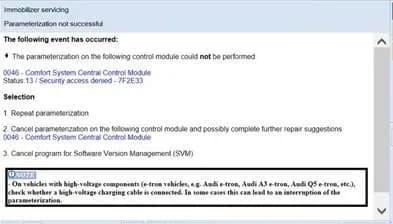
S'applique également à
- Audi A4
- 2024
- Audi A4 allroad
- 2024
- Audi A5
- 2024
- Audi A6
- 2024
- Audi A6 allroad
- 2024
- Audi A7
- 2024
- Audi e-tron GT
- 2024
- Audi Q5
- 2024
- Audi RS 5
- 2024
- Audi RS 6 Avant
- 2024
- Audi RS e-tron GT
- 2024
- Audi RS Q8
- 2024
- Audi S4
- 2024
- Audi S5
- 2024
- Audi S6
- 2024
- Audi S7
- 2024
- Audi SQ5
- 2024
- Audi SQ7
- 2024
- Audi SQ8
- 2024
▸ Afficher 13 de plus▾ Afficher moins
Owners of various 2024 Audi models, including the Audi Q7, may encounter a specific issue when attempting to adapt new or additional keys to their vehicle. This problem is detailed in Audi Technical Service Bulletin (TSB) 2071336/1, issued on September 8, 2023. The TSB addresses a key adaptation fault where the immobilizer test plan displays a 'Status: 13 / Security access denied' message.
This Audi key adaptation fault prevents proper key programming and is a known condition due to recent infrastructure upgrades to Audi's backend systems. The TSB outlines a temporary but effective solution involving a specific SVM code to bypass the security access denial.
Symptoms and Fault Codes
When attempting to adapt additional keys, technicians will observe a specific error message within the immobilizer test plan. The verbatim message displayed is:
"The parameterization on the following control module could not be performed: 0046- central module of comfort system Status: 13 / Security access denied ..."
This message may also appear with the specific diagnostic code "Status 13 / Security access denied - 7F2E33", indicating a failure in the parameterization process for the comfort system's central control module.
Important Warnings for Owners
Audi notes a critical detail for vehicles equipped with high-voltage components, such as Audi e-tron models. If a high-voltage charging cable is connected during the key adaptation process, it can lead to an interruption of the parameterization. Owners of e-tron vehicles should ensure the charging cable is disconnected before any key adaptation procedures are attempted.
Diagnosis and Trigger Conditions
The Audi key adaptation fault is specifically triggered when new or additional keys are being adapted to the vehicle. The error occurs during the immobilizer test plan, preventing the successful parameterization of the '0046- central module of comfort system'. This issue is a direct result of ongoing backend system upgrades at Audi.
Repair Procedure Summary
To resolve the 'Status: 13 / Security access denied' message and successfully adapt keys, technicians should follow a specific procedure outlined in TSB 2071336/1:
- Restart the Immobilizer Test Plan: Begin by restarting the immobilizer test plan within the diagnostic tool.
- Follow On-Screen Prompts: Proceed through all prompts displayed on the diagnostic screen.
- Select SVM Code Option: When prompted to check for an SVM code, select the option labeled "2 - SVM code available".
- Enter SVM Code: Input the specific SVM code UNECEKW2944 into the system.
- Continue Test Plan: Resume the immobilizer test plan as normal. This SVM code allows the system to bypass the security access denial and complete the key adaptation.
This procedure is a temporary measure. Audi anticipates that once the backend system updates are fully completed, this TSB will be retired, and the normal key adaptation process will resume without the need for a special SVM code.
Required Tools
Technicians will need specific diagnostic tools to perform this procedure:
- VAS 6160/VAS 6150: This refers to the VAS tester, which must be running the current version of ODIS (Offboard Diagnostic Information System) on Windows 10.
Warranty Information
Audi Technical Service Bulletin 2071336/1 is provided for informational purposes only. The procedures outlined in this TSB are not applicable to any Audi Warranty claims.
What Owners Should Do
If you own a 2024 Audi model and are experiencing issues with key adaptation, particularly if you see the 'Status: 13 / Security access denied' message, you should contact your authorized Audi service center. Inform them about the specific error message and refer to Audi TSB 2071336/1. The service center will have the necessary tools and the SVM code UNECEKW2944 to address this Audi key adaptation fault and successfully adapt your keys.
NHTSA ID: 10242951
Frequently Asked Questions
- What does 'Status: 13 / Security access denied' mean on my 2024 Audi?
- This message indicates a problem during the key adaptation process, specifically that the vehicle's immobilizer system is denying security access to the '0046- central module of comfort system'. It prevents new keys from being successfully programmed.
- Is there a fix for the Audi key adaptation fault described in TSB 2071336/1?
- Yes, Audi Technical Service Bulletin 2071336/1 provides a specific procedure involving the SVM code UNECEKW2944. This code allows technicians to bypass the security access denial and complete the key adaptation process.
- Can I adapt new keys myself if I see the 'Status 13 / Security access denied - 7F2E33' error?
- No, this procedure requires specialized diagnostic tools like the VAS tester with ODIS software and access to specific Audi SVM codes. It must be performed by an authorized Audi service technician.
- Does this key adaptation issue affect all 2024 Audi models?
- This TSB applies to a wide range of 2024 Audi models, including the A4, A5, A6, A7, A8, Q5, Q7, Q8, and e-tron GT series, as well as their S and RS variants. Your Audi service center can confirm if your specific model is covered.
- What should I do if I have an Audi e-tron and am adapting keys?
- If you own an Audi e-tron or any high-voltage Audi vehicle, ensure that the high-voltage charging cable is disconnected before any key adaptation procedures. Connecting the charging cable can interrupt the parameterization process and lead to further issues.
Related Articles
2022-2025 Audi On-Car Analysis List for Various Faults
Audi has released an On-Car Analysis List for 2022-2025 models, addressing various issues including engine oil leaks, ECM DTC P060600, engine oil pressure switch problems, airbag warning lights (DTC B12251B), noisy belt tensioners, dislocated steering column switches, and binding sunroof shades.
2023-2024 Audi Thermostat Oil Seal Leak TSB 19PP
Audi Technical Service Bulletin 19PP addresses potential oil seal leaks in the thermostat of certain 2023-2024 Audi models. This proactively released update aims to prevent leaks caused by wear or deformation of the thermostat's internal oil seal, requiring replacement of the engine temperature…
2023-2024 Audi Thermostat Leak Update 19PP
Audi has issued UPDATE 19PP for certain 2023-2024 models, including the 2024 Audi Q7, to address potential oil seal wear or deformation within the thermostat, which can lead to leaks. This update requires the replacement of the engine temperature regulation actuator.
2021-2025 Audi Q7/SQ7 Second Row Seat Noise TSB
Audi has released Technical Service Bulletin (TSB) 72 24 60 2060719/3 to address customer complaints of creaking and rattling noises from the second row seats in 2021-2025 Audi Q7 and SQ7 models. The TSB outlines a repair procedure to adjust the seat locking mechanism.
2023-2024 Audi Q7 Airbag Light B12251B Issue
This Audi On-car analysis list from August 22, 2024, details various issues affecting 2023-2024 Audi models, including the 'Airbag light B12251B' for the Q7, 'ECM DTC P016900' for the Q5, and MIB3 system problems for A3/Q3.
Leave a comment
Comments are moderated and may take a moment to appear. Only your first name and the initial of your last name are shown publicly.
Comments
Be the first to comment.